
Ch 02: Motion Along a Straight Line
Young & Freedman Calc - University Physics 14th Edition
Young & Freedman Calc14th EditionUniversity PhysicsISBN: 9780321973610당신이 사용하는 게 아니라요?교과서 변경
2장, 문제 39a

A tennis ball on Mars, where the acceleration due to gravity is 0.379g0.379g and air resistance is negligible, is hit directly upward and returns to the same level 8.58.5 s later. How high above its original point did the ball go?

검증된 단계별 안내
1
Identify the known values: The acceleration due to gravity on Mars is given as 0.379 times the acceleration due to gravity on Earth (g = 9.81 m/s²). Therefore, the acceleration due to gravity on Mars is 0.379 * 9.81 m/s².
Understand the motion: The ball is hit directly upward and returns to the same level after 8.5 seconds. This means the total time for the upward and downward journey is 8.5 seconds, so the time to reach the highest point is half of this, which is 4.25 seconds.
Use the kinematic equation for velocity: At the highest point, the velocity of the ball is 0 m/s. Use the equation v = u + at, where v is the final velocity (0 m/s), u is the initial velocity, a is the acceleration (-0.379 * 9.81 m/s², negative because it opposes the motion), and t is the time (4.25 s). Solve for the initial velocity u.
Use the kinematic equation for displacement: Once the initial velocity is found, use the equation s = ut + 0.5at² to find the maximum height s. Here, u is the initial velocity found in the previous step, a is the acceleration (-0.379 * 9.81 m/s²), and t is the time to reach the highest point (4.25 s).
Interpret the result: The value of s obtained from the previous step represents the maximum height above the original point that the ball reached.

비슷한 문제에 대한 검증된 영상 답변:

이 영상 해법은 위 문제에 도움이 된다고 튜터들이 추천한 것입니다.
영상 길이:
4m

주요 개념

질문에 올바르게 답하기 위해 반드시 이해해야 하는 핵심 개념들은 다음과 같습니다.

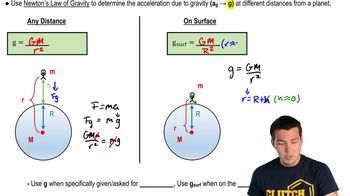
Acceleration due to Gravity

Acceleration due to gravity is the rate at which an object accelerates when falling freely under the influence of gravity. On Mars, this acceleration is 0.379 times that on Earth, which affects the motion of objects. Understanding this concept is crucial for calculating the height reached by the tennis ball.
추천 영상:
가이드 코스
05:20
Acceleration Due to Gravity

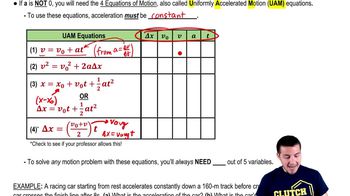
Kinematic Equations

Kinematic equations describe the motion of objects under constant acceleration. They are essential for solving problems involving projectile motion, like the tennis ball's trajectory. These equations allow us to relate time, initial velocity, final velocity, acceleration, and displacement to find the maximum height reached.
추천 영상:
가이드 코스
08:25
Kinematics Equations

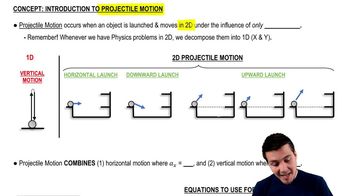
Projectile Motion

Projectile motion refers to the motion of an object thrown or projected into the air, subject only to acceleration due to gravity. In this scenario, the tennis ball's upward and downward journey is a classic example of projectile motion, where understanding the symmetry of the motion helps determine the peak height.
추천 영상:
가이드 코스
04:44
Introduction to Projectile Motion
관련 실천
교과서 질문

You throw a glob of putty straight up toward the ceiling, which is 3.603.60 m above the point where the putty leaves your hand. The initial speed of the putty as it leaves your hand is 9.509.50 m/s. What is the speed of the putty just before it strikes the ceiling?

1659
views
교과서 질문

You throw a glob of putty straight up toward the ceiling, which is 3.603.60 m above the point where the putty leaves your hand. The initial speed of the putty as it leaves your hand is 9.509.50 m/s. How much time from when it leaves your hand does it take the putty to reach the ceiling?

1937
views
교과서 질문

A brick is dropped (zero initial speed) from the roof of a building. The brick strikes the ground in 1.901.90 s. You may ignore air resistance, so the brick is in free fall. How tall, in meters, is the building?

1888
views
교과서 질문

A lunar lander is making its descent to Moon Base I (Fig. E2.402.40). The lander descends slowly under the retro-thrust of its descent engine. The engine is cut off when the lander is 5.05.0 m above the surface and has a downward speed of 0.80.8 m/s. With the engine off, the lander is in free fall. What is the speed of the lander just before it touches the surface? The acceleration due to gravity on the moon is 1.61.6 m/s.

2606
views
교과서 질문

A juggler throws a bowling pin straight up with an initial speed of 8.208.20 m/s. How much time elapses until the bowling pin returns to the juggler's hand?

2062
views
교과서 질문

A tennis ball on Mars, where the acceleration due to gravity is 0.379g0.379g and air resistance is negligible, is hit directly upward and returns to the same level 8.58.5 s later. How fast was it moving just after it was hit?

2211
views