Ch 02: Motion Along a Straight Line
Young & Freedman Calc - University Physics 14th Edition
Young & Freedman Calc14th EditionUniversity PhysicsISBN: 9780321973610당신이 사용하는 게 아니라요?교과서 변경
2장, 문제 34b

At the instant the traffic light turns green, a car that has been waiting at an intersection starts ahead with a constant acceleration of 2.802.80 m/s2. At the same instant a truck, traveling with a constant speed of 20.020.0 m/s, overtakes and passes the car. How fast is the car traveling when it overtakes the truck?

검증된 단계별 안내
1
Identify the equations of motion for both the car and the truck. The car starts from rest with a constant acceleration, so its velocity as a function of time is given by: v=at, where a is the acceleration and t is the time. The truck travels at a constant speed, so its velocity is v=20.0 m/s.
Determine the position of the car as a function of time using the equation: x=12at2. Since the car starts from rest, its initial position is zero.
Determine the position of the truck as a function of time using the equation: x=vt, where v is the constant speed of the truck.
Set the position equations of the car and the truck equal to each other to find the time at which the car overtakes the truck: 12at2=vt. Solve this equation for t.
Substitute the time found in the previous step into the car's velocity equation v=at to find the speed of the car when it overtakes the truck.

비슷한 문제에 대한 검증된 영상 답변:

이 영상 해법은 위 문제에 도움이 된다고 튜터들이 추천한 것입니다.
영상 길이:
5m

주요 개념

질문에 올바르게 답하기 위해 반드시 이해해야 하는 핵심 개념들은 다음과 같습니다.

Constant Acceleration

Constant acceleration refers to a situation where an object's velocity changes at a steady rate over time. In this problem, the car accelerates at 2.80 m/s², meaning its speed increases by 2.80 meters per second every second. Understanding this concept is crucial for calculating the car's velocity at any given time.
추천 영상:
가이드 코스
08:59
Phase Constant of a Wave Function

Relative Motion

Relative motion involves analyzing the movement of one object concerning another. Here, the car and truck are moving relative to each other, with the truck initially overtaking the car. To find when the car overtakes the truck, we must consider their relative speeds and positions over time.
추천 영상:
가이드 코스
04:27
Intro to Relative Motion (Relative Velocity)

Kinematic Equations

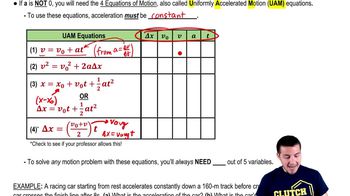
Kinematic equations describe the motion of objects under constant acceleration. They relate displacement, initial velocity, final velocity, acceleration, and time. In this scenario, these equations help determine the car's velocity when it catches up to the truck, using its initial velocity, acceleration, and the time taken to overtake.
추천 영상:
가이드 코스
08:25
Kinematics Equations
관련 실천
교과서 질문

If a flea can jump straight up to a height of 0.4400.440 m, what is its initial speed as it leaves the ground?

2014
views

교과서 질문

If a flea can jump straight up to a height of 0.4400.440 m, How long is it in the air?

1759
views
교과서 질문

A small rock is thrown vertically upward with a speed of 22.022.0 m/s from the edge of the roof of a 30.030.0-m-tall building. The rock doesn't hit the building on its way back down and lands on the street below. Ignore air resistance. What is the speed of the rock just before it hits the street?

1730
views
교과서 질문

A small block has constant acceleration as it slides down a frictionless incline. The block is released from rest at the top of the incline, and its speed after it has traveled 6.806.80 m to the bottom of the incline is 3.803.80 m/s. What is the speed of the block when it is 3.403.40 m from the top of the incline?

5186
views
1
rank
교과서 질문

A cat walks in a straight line, which we shall call the xx-axis, with the positive direction to the right. As an observant physicist, you make measurements of this cat's motion and construct a graph of the feline's velocity as a function of time (Fig. E2.302.30). Assuming that the cat started at the origin, sketch clear graphs of the cat's acceleration and position as functions of time.

2674
views
교과서 질문

At the instant the traffic light turns green, a car that has been waiting at an intersection starts ahead with a constant acceleration of 2.802.80 m/s2. At the same instant a truck, traveling with a constant speed of 20.020.0 m/s, overtakes and passes the car. How far beyond its starting point does the car overtake the truck?

2875
views