
Ch 03: Motion in Two or Three Dimensions
Young & Freedman Calc - University Physics 14th Edition
Young & Freedman Calc14th EditionUniversity PhysicsISBN: 9780321973610당신이 사용하는 게 아니라요?교과서 변경
3장, 문제 12c

A rookie quarterback throws a football with an initial upward velocity component of 12.0 m/s and a horizontal velocity component of 20.0 m/s. Ignore air resistance. How much time (after it is thrown) is required for the football to return to its original level? How does this compare with the time calculated in part (a)?

검증된 단계별 안내
1
First, identify the vertical motion of the football. The initial upward velocity component is given as 12.0 m/s. Use the kinematic equation for vertical motion: v=u+at, where v is the final velocity (0 m/s at the peak), u is the initial velocity (12.0 m/s), a is the acceleration due to gravity (-9.8 m/s²), and t is the time to reach the peak.
Solve the equation v=u+at for t to find the time to reach the peak. Rearrange to get t=-u/a. Substitute u=12.0 m/s and a=-9.8 m/s².
The time to reach the peak is half the total time for the football to return to its original level. Therefore, multiply the time to reach the peak by 2 to find the total time of flight.
Compare the total time calculated here with the time calculated in part (a). Ensure you understand the context of part (a) to make a meaningful comparison.
Reflect on the symmetry of projectile motion: the time to ascend to the peak is equal to the time to descend back to the original level, assuming no air resistance.

비슷한 문제에 대한 검증된 영상 답변:

이 영상 해법은 위 문제에 도움이 된다고 튜터들이 추천한 것입니다.
영상 길이:
2m
도움이 되었나요?

주요 개념

질문에 올바르게 답하기 위해 반드시 이해해야 하는 핵심 개념들은 다음과 같습니다.

Projectile Motion

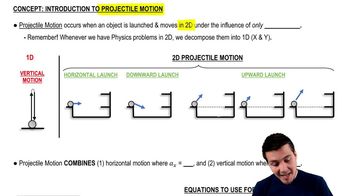
Projectile motion involves the motion of an object thrown into the air, subject to only the acceleration of gravity. It can be analyzed by separating the motion into horizontal and vertical components. The horizontal motion is uniform, while the vertical motion is uniformly accelerated due to gravity.
추천 영상:
가이드 코스
04:44
Introduction to Projectile Motion

Vertical Motion Under Gravity

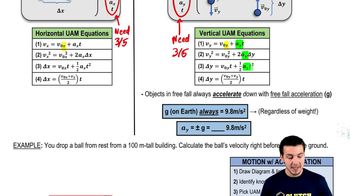
The vertical component of projectile motion is influenced by gravity, which causes a constant acceleration of approximately 9.81 m/s² downward. The time taken for an object to return to its original level can be calculated using kinematic equations, considering the initial vertical velocity and gravitational acceleration.
추천 영상:
가이드 코스
08:36
Vertical Motion & Free Fall

Time of Flight

Time of flight refers to the total time an object remains in the air during projectile motion. For symmetrical projectile motion, the time to reach the peak is equal to the time to descend back to the original level. This can be calculated by doubling the time taken to reach the peak, which is found using the initial vertical velocity and gravity.
추천 영상:
가이드 코스
05:59
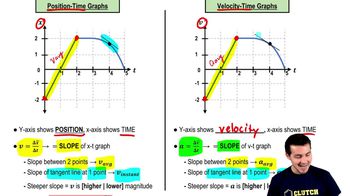
Velocity-Time Graphs & Acceleration
관련 실천
교과서 질문

The froghopper, Philaenus spumarius, holds the world record for insect jumps. When leaping at an angle of 58.0° above the horizontal, some of the tiny critters have reached a maximum height of 58.7 cm above the level ground. (See Nature, Vol. 424, July 31, 2003, p. 509.) What was the takeoff speed for such a leap?

5857
views
8
rank
교과서 질문

A rookie quarterback throws a football with an initial upward velocity component of 12.0 m/s and a horizontal velocity component of 20.0 m/s. Ignore air resistance. How high is this point?

3587
views
1
rank
교과서 질문

A rookie quarterback throws a football with an initial upward velocity component of 12.0 m/s and a horizontal velocity component of 20.0 m/s. Ignore air resistance. How far has the football traveled horizontally during this time?

2309
views
교과서 질문

Crickets Chirpy and Milada jump from the top of a vertical cliff. Chirpy drops downward and reaches the ground in 2.70 s, while Milada jumps horizontally with an initial speed of 95.0 cm/s. How far from the base of the cliff will Milada hit the ground? Ignore air resistance.

3876
views
교과서 질문

On level ground a shell is fired with an initial velocity of 40.0 m/s at 60.0° above the horizontal and feels no appreciable air resistance. Find the horizontal and vertical components of the shell's initial velocity.

2975
views
교과서 질문

A rookie quarterback throws a football with an initial upward velocity component of 12.0 m/s and a horizontal velocity component of 20.0 m/s. Ignore air resistance. How much time is required for the football to reach the highest point of the trajectory?

1453
views