Ch 03: Motion in Two or Three Dimensions
Young & Freedman Calc - University Physics 14th Edition
Young & Freedman Calc14th EditionUniversity PhysicsISBN: 9780321973610당신이 사용하는 게 아니라요?교과서 변경
3장, 문제 16c

On level ground a shell is fired with an initial velocity of 40.0 m/s at 60.0° above the horizontal and feels no appreciable air resistance. Find its maximum height above the ground.

검증된 단계별 안내
1
Identify the components of the initial velocity. The initial velocity is given as 40.0 m/s at an angle of 60.0° above the horizontal. Use trigonometric functions to find the vertical component (v_y) and the horizontal component (v_x) of the velocity. The vertical component can be found using v_y = v_0 * sin(θ), and the horizontal component using v_x = v_0 * cos(θ), where v_0 is the initial velocity and θ is the angle.
Calculate the vertical component of the initial velocity using the formula: v_y = 40.0 m/s * sin(60.0°). This will give you the initial velocity in the vertical direction, which is crucial for determining the maximum height.
Understand that at the maximum height, the vertical velocity becomes zero. Use the kinematic equation for vertical motion: v_y^2 = v_0y^2 - 2 * g * h_max, where v_y is the final vertical velocity (0 m/s at maximum height), v_0y is the initial vertical velocity, g is the acceleration due to gravity (approximately 9.81 m/s²), and h_max is the maximum height.
Rearrange the kinematic equation to solve for the maximum height: h_max = (v_0y^2) / (2 * g). Substitute the initial vertical velocity calculated in step 2 and the value of g into this equation to find the maximum height.
Ensure all units are consistent and double-check calculations for accuracy. The maximum height is the result of the vertical motion analysis, and it represents the peak of the projectile's trajectory.

비슷한 문제에 대한 검증된 영상 답변:

이 영상 해법은 위 문제에 도움이 된다고 튜터들이 추천한 것입니다.
영상 길이:
7m
도움이 되었나요?

주요 개념

질문에 올바르게 답하기 위해 반드시 이해해야 하는 핵심 개념들은 다음과 같습니다.

Projectile Motion

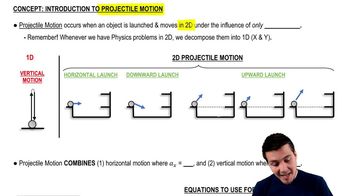
Projectile motion refers to the motion of an object thrown or projected into the air, subject to only the acceleration of gravity. It involves two components: horizontal and vertical motion. Understanding the initial velocity and angle of projection is crucial for analyzing the trajectory and determining key points like maximum height.
추천 영상:
가이드 코스
04:44
Introduction to Projectile Motion

Kinematic Equations

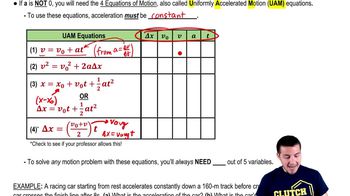
Kinematic equations describe the motion of objects without considering the forces that cause the motion. For vertical motion, the equation v^2 = u^2 + 2as can be used to find the maximum height, where v is the final velocity (0 at the peak), u is the initial vertical velocity, a is the acceleration due to gravity, and s is the displacement.
추천 영상:
가이드 코스
08:25
Kinematics Equations

Trigonometric Decomposition

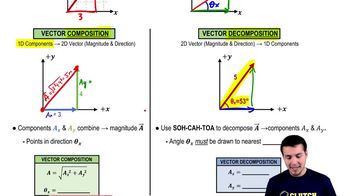
Trigonometric decomposition involves breaking down the initial velocity into horizontal and vertical components using sine and cosine functions. For a projectile launched at an angle θ, the vertical component is calculated as v_y = v * sin(θ), which is essential for determining the maximum height reached by the projectile.
추천 영상:
가이드 코스
07:47
Vector Composition & Decomposition
관련 실천
교과서 질문

On level ground a shell is fired with an initial velocity of 40.0 m/s at 60.0° above the horizontal and feels no appreciable air resistance. How long does it take the shell to reach its highest point?

2407
views

교과서 질문

The froghopper, Philaenus spumarius, holds the world record for insect jumps. When leaping at an angle of 58.0° above the horizontal, some of the tiny critters have reached a maximum height of 58.7 cm above the level ground. (See Nature, Vol. 424, July 31, 2003, p. 509.) What was the takeoff speed for such a leap?

5857
views
8
rank
교과서 질문

On level ground a shell is fired with an initial velocity of 40.0 m/s at 60.0° above the horizontal and feels no appreciable air resistance. How far from its firing point does the shell land?

2162
views
교과서 질문

On level ground a shell is fired with an initial velocity of 40.0 m/s at 60.0° above the horizontal and feels no appreciable air resistance. Find the horizontal and vertical components of the shell's initial velocity.

2975
views
교과서 질문

A shot putter releases the shot some distance above the level ground with a velocity of 12.0 m/s, 51.0° above the horizontal. The shot hits the ground 2.08 s later. Ignore air resistance. What are the components of the shot's velocity at the beginning and at the end of its trajectory?

3214
views
교과서 질문

On level ground a shell is fired with an initial velocity of 40.0 m/s at 60.0° above the horizontal and feels no appreciable air resistance. At its highest point, find the horizontal and vertical components of its acceleration and velocity.

4000
views
1
comments