Ch 03: Motion in Two or Three Dimensions
Young & Freedman Calc - University Physics 14th Edition
Young & Freedman Calc14th EditionUniversity PhysicsISBN: 9780321973610당신이 사용하는 게 아니라요?교과서 변경
3장, 문제 4a

The position of a squirrel running in a park is given by r=[(0.280 m/s)t+(0.0360 m/s2)t2]i^+(0.0190 m/s3)t3j^\(\vec{r}\) = \(\left\)[ (0.280~\(\mathrm{m/s}\))t + (0.0360~\(\mathrm{m/s^2}\))t^2 \(\right\)] \(\hat{i}\) + (0.0190~\(\mathrm{m/s^3}\))t^3 \(\hat{j}\) . (a) What are vx(t)v_{x}\(\left\)(t\(\right\)) and vy(t)v_{y}\(\left\)(t\(\right\)), the xx-and yy-components of the velocity of the squirrel, as functions of time?

검증된 단계별 안내
1
To find the velocity components, we need to differentiate the position vector with respect to time. The position vector is given as r(t) = [(0.280 m/s)t + (0.0360 m/s^2)t^2]î + (0.0190 m/s^3)t^3ĵ.
The x-component of the position is x(t) = (0.280 m/s)t + (0.0360 m/s^2)t^2. To find the x-component of the velocity, differentiate x(t) with respect to time t: υx(t) = d/dt[(0.280 m/s)t + (0.0360 m/s^2)t^2].
Apply the power rule of differentiation: d/dt[at^n] = n*at^(n-1). For the term (0.280 m/s)t, the derivative is 0.280 m/s. For the term (0.0360 m/s^2)t^2, the derivative is 2*(0.0360 m/s^2)t = 0.0720 m/s^2 * t.
Thus, the x-component of the velocity is υx(t) = 0.280 m/s + 0.0720 m/s^2 * t.
Now, for the y-component of the position, y(t) = (0.0190 m/s^3)t^3. Differentiate y(t) with respect to time t to find the y-component of the velocity: υy(t) = d/dt[(0.0190 m/s^3)t^3]. Using the power rule, the derivative is 3*(0.0190 m/s^3)t^2 = 0.0570 m/s^3 * t^2. Therefore, the y-component of the velocity is υy(t) = 0.0570 m/s^3 * t^2.

비슷한 문제에 대한 검증된 영상 답변:

이 영상 해법은 위 문제에 도움이 된다고 튜터들이 추천한 것입니다.
영상 길이:
2m
도움이 되었나요?

주요 개념

질문에 올바르게 답하기 위해 반드시 이해해야 하는 핵심 개념들은 다음과 같습니다.

Differentiation

Differentiation is a mathematical process used to find the rate at which a quantity changes. In physics, it is often used to determine velocity from a position function. By differentiating the position function with respect to time, we can find the velocity components, which are the derivatives of the position components.
추천 영상:
가이드 코스
13:04
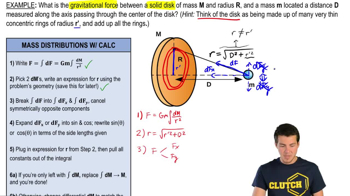
Gravitational Force from a Solid Disk

Vector Components

Vector components are the projections of a vector along the axes of a coordinate system. In this problem, the position vector r is expressed in terms of its x-component (î) and y-component (ĵ). Understanding how to separate these components is crucial for calculating the velocity in each direction independently.
추천 영상:
가이드 코스
07:30
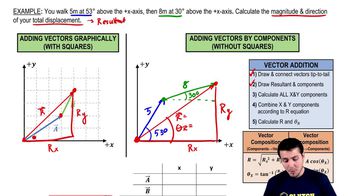
Vector Addition By Components

Polynomial Functions

Polynomial functions consist of terms with variables raised to integer powers. The position function given is a polynomial in terms of time, t, with coefficients indicating the rate of change. Recognizing the structure of polynomial functions helps in applying differentiation rules to find the velocity components as functions of time.
추천 영상:
가이드 코스
08:30
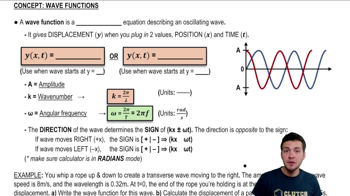
Intro to Wave Functions
관련 실천