
Ch 04: Newton's Laws of Motion
Young & Freedman Calc - University Physics 14th Edition
Young & Freedman Calc14th EditionUniversity PhysicsISBN: 9780321973610당신이 사용하는 게 아니라요?교과서 변경
4장, 문제 25a

Crates AA and BB sit at rest side by side on a frictionless horizontal surface. They have masses mAm_{A} and mBm_B, respectively. When a horizontal force FF is applied to crate AA, the two crates move off to the right. Draw clearly labeled free-body diagrams for crate AA and for crate BB. Indicate which pairs of forces, if any, are third-law action–reaction pairs.

검증된 단계별 안내
1
Step 1: Begin by understanding the problem. Crates A and B are on a frictionless surface, meaning there is no frictional force opposing their motion. A horizontal force F is applied to crate A, causing both crates to move together. This implies that crate A exerts a force on crate B, and crate B exerts an equal and opposite force on crate A (Newton's Third Law).
Step 2: Draw the free-body diagram for crate A. Identify all forces acting on it: (1) The applied force F acts to the right. (2) The normal force N_A acts upward, balancing the gravitational force. (3) The gravitational force m_A * g acts downward. (4) Crate B exerts a contact force F_BA to the left on crate A due to their interaction.
Step 3: Draw the free-body diagram for crate B. Identify all forces acting on it: (1) The contact force F_AB acts to the right, exerted by crate A on crate B. (2) The normal force N_B acts upward, balancing the gravitational force. (3) The gravitational force m_B * g acts downward.
Step 4: Indicate the action-reaction pairs. According to Newton's Third Law, the force F_BA (force exerted by crate B on crate A) and F_AB (force exerted by crate A on crate B) are equal in magnitude and opposite in direction. These are the action-reaction pairs.
Step 5: Ensure the diagrams are clearly labeled. For crate A, label F (applied force), F_BA (force from crate B), N_A (normal force), and m_A * g (gravitational force). For crate B, label F_AB (force from crate A), N_B (normal force), and m_B * g (gravitational force).

비슷한 문제에 대한 검증된 영상 답변:

이 영상 해법은 위 문제에 도움이 된다고 튜터들이 추천한 것입니다.
영상 길이:
6m
도움이 되었나요?

주요 개념

질문에 올바르게 답하기 위해 반드시 이해해야 하는 핵심 개념들은 다음과 같습니다.

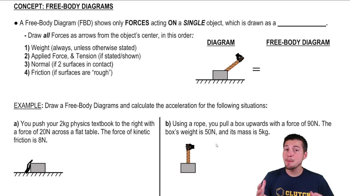
Free-Body Diagram

A free-body diagram is a graphical representation used to visualize the forces acting on an object. In this context, it helps identify all the forces acting on crates A and B, including applied forces, normal forces, and gravitational forces. By isolating the object and illustrating these forces, one can analyze the motion and interactions between the crates.
추천 영상:
가이드 코스
08:42
Free-Body Diagrams

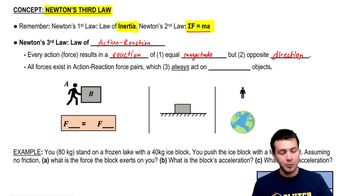
Newton's Third Law of Motion

Newton's Third Law states that for every action, there is an equal and opposite reaction. This principle is crucial for understanding the interactions between crate A and crate B when a force is applied. The forces that crate A exerts on crate B and vice versa are action-reaction pairs, which must be identified in the free-body diagrams.
추천 영상:
가이드 코스
08:01
Newton's Third Law & Action-Reaction Pairs

Frictionless Surface

A frictionless surface is an idealized scenario where no frictional forces oppose the motion of objects. In this problem, it allows crates A and B to move freely when a force is applied, simplifying the analysis of their motion. Understanding this concept is essential for accurately applying Newton's laws without the complicating effects of friction.
추천 영상:
가이드 코스
09:18
Equipotential Surfaces