Ch 04: Newton's Laws of Motion
Young & Freedman Calc - University Physics 14th Edition
Young & Freedman Calc14th EditionUniversity PhysicsISBN: 9780321973610당신이 사용하는 게 아니라요?교과서 변경
4장, 문제 1

Two dogs pull horizontally on ropes attached to a post; the angle between the ropes is 60.0 60.0°. If Rover exerts a force of 270270 N and Fido exerts a force of 300300 N, find the magnitude of the resultant force and the angle it makes with Rover's rope.

검증된 단계별 안내
1
Step 1: Represent the forces exerted by Rover and Fido as vectors. Rover's force vector has a magnitude of 270 N, and Fido's force vector has a magnitude of 300 N. The angle between the two vectors is given as 60.0°.
Step 2: Use the formula for the magnitude of the resultant force when two vectors are at an angle: \( F_{R} = \sqrt{F_{1}^2 + F_{2}^2 + 2F_{1}F_{2}\cos\theta} \), where \( F_{1} \) and \( F_{2} \) are the magnitudes of the forces, and \( \theta \) is the angle between them.
Step 3: Substitute the given values into the formula: \( F_{1} = 270 \, \text{N}, \, F_{2} = 300 \, \text{N}, \text{ and } \theta = 60.0° \). Calculate \( \cos\theta \) using \( \cos(60.0°) = 0.5 \).
Step 4: To find the angle \( \phi \) that the resultant force makes with Rover's rope, use the formula for the direction of the resultant vector: \( \tan\phi = \frac{F_{2}\sin\theta}{F_{1} + F_{2}\cos\theta} \). Substitute the values \( F_{1} = 270 \, \text{N}, \, F_{2} = 300 \, \text{N}, \text{ and } \theta = 60.0° \).
Step 5: Solve the equations step by step to find the magnitude of the resultant force \( F_{R} \) and the angle \( \phi \). Ensure proper handling of trigonometric functions and square roots during calculations.

비슷한 문제에 대한 검증된 영상 답변:

이 영상 해법은 위 문제에 도움이 된다고 튜터들이 추천한 것입니다.
영상 길이:
9m
도움이 되었나요?

주요 개념

질문에 올바르게 답하기 위해 반드시 이해해야 하는 핵심 개념들은 다음과 같습니다.

Vector Addition

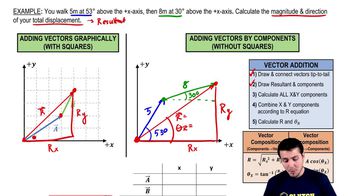
Vector addition is the process of combining two or more vectors to determine a resultant vector. In this scenario, the forces exerted by the dogs are vectors with both magnitude and direction. The resultant force can be found using the law of cosines or by breaking the vectors into their components and summing them.
추천 영상:
가이드 코스
07:30
Vector Addition By Components

Law of Cosines

The law of cosines relates the lengths of the sides of a triangle to the cosine of one of its angles. It is particularly useful in this problem to find the magnitude of the resultant force when two vectors are at an angle to each other. The formula is c² = a² + b² - 2ab*cos(θ), where θ is the angle between the two vectors.
추천 영상:

Resultant Force Direction

The direction of the resultant force can be determined using trigonometric functions, specifically the sine and cosine functions. By calculating the angle that the resultant makes with one of the original vectors, we can use the inverse tangent function to find this angle. This is essential for understanding how the combined forces act in relation to the individual forces.
추천 영상:
가이드 코스
08:17
The Normal Force