
Ch 05: Applying Newton's Laws
Young & Freedman Calc - University Physics 14th Edition
Young & Freedman Calc14th EditionUniversity PhysicsISBN: 9780321973610당신이 사용하는 게 아니라요?교과서 변경
5장, 문제 29c

A 45.045.0-kg crate of tools rests on a horizontal floor. You exert a gradually increasing horizontal push on it, and the crate just begins to move when your force exceeds 313313 N. Then you must reduce your push to 208208 N to keep it moving at a steady 25.025.0 cm/s. Suppose you were performing the same experiment on the moon, where the acceleration due to gravity is 1.621.62 m/s2.
(i) What magnitude push would cause it to move?
(ii) What would its acceleration be if you maintained the push in part (b)? Note: Part (b) asked what push you must exert to give it an acceleration of 1.101.10 m/s2.

검증된 단계별 안내
1
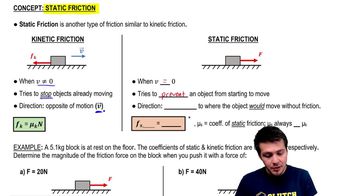
Step 1: Begin by understanding the forces acting on the crate. On Earth, the force required to overcome static friction is given as 313 N. The force required to maintain steady motion is 208 N, which corresponds to the kinetic friction force. The coefficient of static friction (μ_s) and kinetic friction (μ_k) can be calculated using the normal force, which is equal to the weight of the crate (mg). Use the formulas: F_s = μ_s * N and F_k = μ_k * N, where N = mg.
Step 2: Calculate the normal force on the moon. The normal force is equal to the weight of the crate, which depends on the moon's gravitational acceleration (1.62 m/s²). Use the formula: N = m * g_moon, where m = 45.0 kg and g_moon = 1.62 m/s².
Step 3: Determine the force required to overcome static friction on the moon. Use the coefficient of static friction (μ_s) calculated from the Earth scenario and apply it to the moon's normal force. The formula is: F_s_moon = μ_s * N_moon.
Step 4: Calculate the acceleration of the crate on the moon when a constant push of 208 N is applied. First, find the net force acting on the crate by subtracting the kinetic friction force (F_k_moon = μ_k * N_moon) from the applied force. Then, use Newton's second law: a = F_net / m, where F_net is the net force and m is the mass of the crate.
Step 5: Summarize the results. The magnitude of the push required to move the crate on the moon is determined by the static friction force (F_s_moon). The acceleration of the crate when maintaining the push of 208 N is calculated using the net force and Newton's second law.

비슷한 문제에 대한 검증된 영상 답변:

이 영상 해법은 위 문제에 도움이 된다고 튜터들이 추천한 것입니다.
도움이 되었나요?

주요 개념

질문에 올바르게 답하기 위해 반드시 이해해야 하는 핵심 개념들은 다음과 같습니다.

Friction

Friction is the force that opposes the relative motion of two surfaces in contact. It is dependent on the nature of the surfaces and the normal force acting between them. The static friction force must be overcome to initiate motion, while kinetic friction acts on moving objects. The coefficients of static and kinetic friction are crucial for calculating the forces required to move an object.
추천 영상:
08:11
Static Friction & Equilibrium

Newton's Second Law of Motion

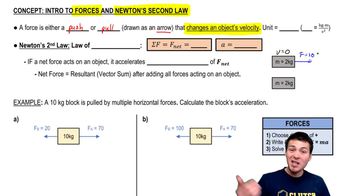
Newton's Second Law states that the acceleration of an object is directly proportional to the net force acting on it and inversely proportional to its mass. This relationship is expressed by the equation F = ma, where F is the net force, m is the mass, and a is the acceleration. Understanding this law is essential for analyzing how forces affect the motion of objects, especially when considering different gravitational environments.
추천 영상:
06:54
Intro to Forces & Newton's Second Law

Weight and Normal Force

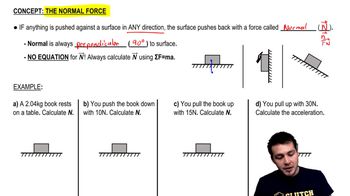
Weight is the force exerted by gravity on an object, calculated as the product of its mass and the acceleration due to gravity (W = mg). On the Moon, where gravity is weaker, the weight of the crate will be less than on Earth, affecting the normal force, which is the perpendicular force exerted by a surface to support the weight of an object resting on it. This change in weight influences the frictional forces and the amount of push required to initiate motion.
추천 영상:
08:17
The Normal Force
관련 실천
교과서 질문

A pickup truck is carrying a toolbox, but the rear gate of the truck is missing. The toolbox will slide out if it is set moving. The coefficients of kinetic friction and static friction between the box and the level bed of the truck are 0.3550.355 and 0.6500.650, respectively. Starting from rest, what is the shortest time this truck could accelerate uniformly to 30.030.0 m/s without causing the box to slide? Draw a free-body diagram of the toolbox.

2662
views
2
rank
교과서 질문

A box of bananas weighing 40.040.0 N rests on a horizontal surface. The coefficient of static friction between the box and the surface is 0.400.40, and the coefficient of kinetic friction is 0.200.20. If the monkey applies a horizontal force of 18.018.0 N, what is the magnitude of the friction force and what is the box's acceleration?

1715
views
교과서 질문

Two crates connected by a rope lie on a horizontal surface (Fig. E5.375.37). Crate A has mass mAm_A, and crate B has mass mBm_B. The coefficient of kinetic friction between each crate and the surface is μkμ_k. The crates are pulled to the right at constant velocity by a horizontal force FF. Draw one or more free-body diagrams to calculate the following in terms of mAm_A, mBm_B, and μkμ_k: the magnitude of FF.

1798
views
교과서 질문

A 25.025.0-kg box of textbooks rests on a loading ramp that makes an angle αα with the horizontal. The coefficient of kinetic friction is 0.250.25, and the coefficient of static friction is 0.350.35. At this angle, find the acceleration once the box has begun to move.

2513
views
교과서 질문

A 45.045.0-kg crate of tools rests on a horizontal floor. You exert a gradually increasing horizontal push on it, and the crate just begins to move when your force exceeds 313313 N. Then you must reduce your push to 208208 N to keep it moving at a steady 25.025.0 cm/s. What push must you exert to give it an acceleration of 1.101.10 m/s2?

2197
views
2
rank
교과서 질문

A 45.045.0-kg crate of tools rests on a horizontal floor. You exert a gradually increasing horizontal push on it, and the crate just begins to move when your force exceeds 313313 N. Then you must reduce your push to 208208 N to keep it moving at a steady 25.025.0 cm/s. What are the coefficients of static and kinetic friction between the crate and the floor?

3347
views