
Ch 05: Applying Newton's Laws
Young & Freedman Calc - University Physics 14th Edition
Young & Freedman Calc14th EditionUniversity PhysicsISBN: 9780321973610당신이 사용하는 게 아니라요?교과서 변경
5장, 문제 7

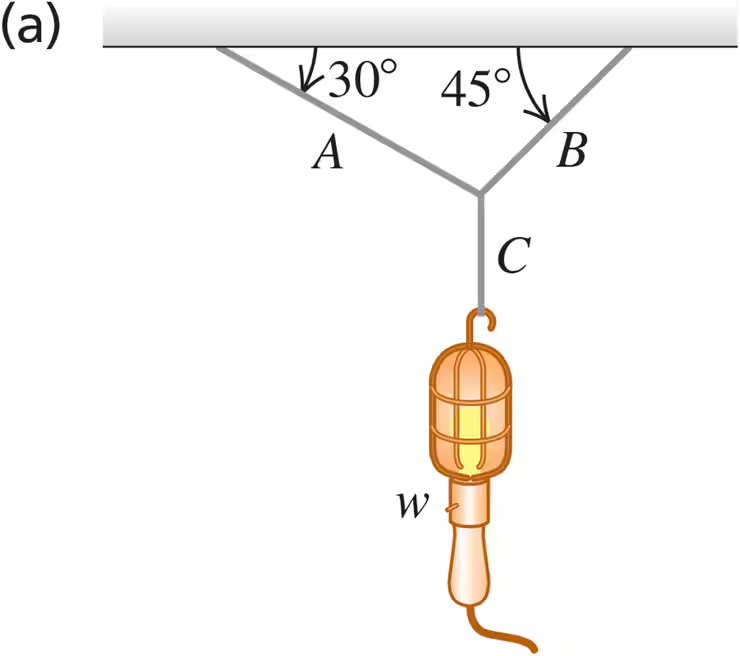
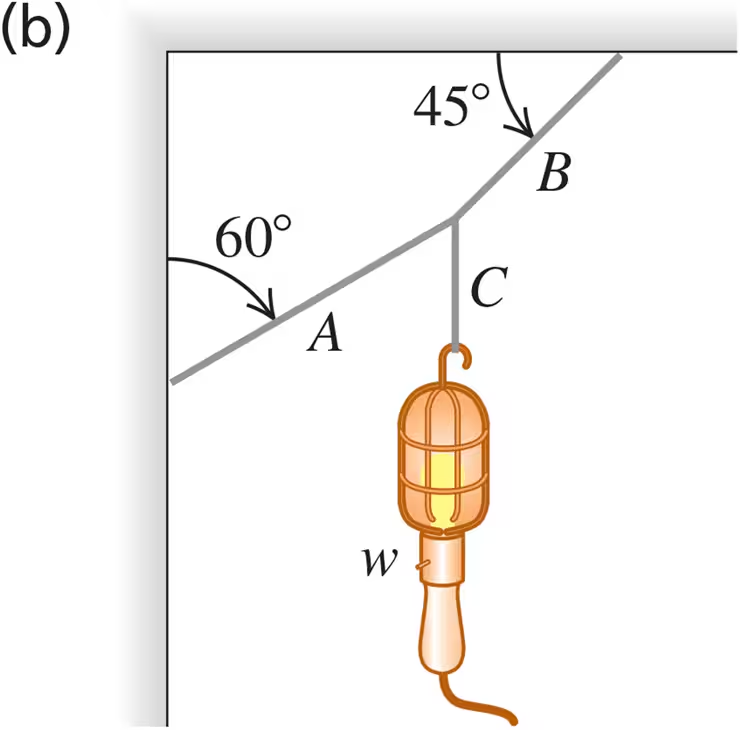
Find the tension in each cord in Fig. E5.75.7 if the weight of the suspended object is ww.
Diagram showing a suspended object with weight 'w' and two cords at angles of 30° and 45°, labeled A, B, and C.
Diagram showing a suspended object with weight w, supported by two cords at angles of 60° and 45°.

검증된 단계별 안내
1
Step 1: Identify the forces acting on the system. The object of weight w is suspended by three cords: cord A, cord B, and cord C. Cord C is vertical, while cords A and B are at angles of 20° and 35° respectively with the horizontal.
Step 2: Apply equilibrium conditions. Since the object is stationary, the forces in both the horizontal and vertical directions must sum to zero. This gives two equations: ΣFx = 0 (horizontal forces) and ΣFy = 0 (vertical forces).
Step 3: Write the horizontal force equation. The horizontal components of the tensions in cords A and B must cancel each other out: T_A * cos(20°) = T_B * cos(35°).
Step 4: Write the vertical force equation. The vertical components of the tensions in cords A and B must balance the weight w and the tension in cord C: T_A * sin(20°) + T_B * sin(35°) = w.
Step 5: Solve the system of equations. Use the two equations derived in steps 3 and 4 to solve for the tensions T_A and T_B in cords A and B. Cord C's tension is equal to the weight w since it directly supports the object vertically.

비슷한 문제에 대한 검증된 영상 답변:

이 영상 해법은 위 문제에 도움이 된다고 튜터들이 추천한 것입니다.
영상 길이:
11m

주요 개념

질문에 올바르게 답하기 위해 반드시 이해해야 하는 핵심 개념들은 다음과 같습니다.

Tension in Cords

Tension is the force exerted along a cord or rope when it is pulled tight by forces acting from opposite ends. In this scenario, the tensions in cords A and B must balance the weight of the suspended object (w) while also considering the angles at which the cords are positioned. The tension can be calculated using the components of the forces acting in both the vertical and horizontal directions.
추천 영상:
가이드 코스
06:34
Calculating Tension in a Pendulum with Energy Conservation

Equilibrium of Forces

For an object to be in equilibrium, the sum of all forces acting on it must equal zero. This means that the vertical components of the tensions in the cords must equal the weight of the object, while the horizontal components must cancel each other out. This principle allows us to set up equations based on the angles and the weight to solve for the tensions in the cords.
추천 영상:

Trigonometric Functions

Trigonometric functions, such as sine and cosine, relate the angles of a triangle to the ratios of its sides. In this problem, these functions are essential for resolving the tension forces into their vertical and horizontal components. For example, the vertical component of the tension in cord A can be found using T_A * sin(20°), and similarly for cord B using T_B * sin(35°).
추천 영상:
가이드 코스
08:30
Intro to Wave Functions
관련 실천
교과서 질문

A large wrecking ball is held in place by two light steel cables (Fig. E5.65.6). If the mass m of the wrecking ball is 36203620 kg, what are the (a) tension TBT_B in the cable that makes an angle of 40°40° with the vertical and (b) the tension TAT_{A} in the horizontal cable?

5047
views
교과서 질문

A picture frame hung against a wall is suspended by two wires attached to its upper corners. If the two wires make the same angle with the vertical, what must this angle be if the tension in each wire is equal to 0.750.75 of the weight of the frame? (Ignore any friction between the wall and the picture frame.)

2386
views
교과서 질문

A 75.075.0-kg wrecking ball hangs from a uniform, heavy-duty chain of mass 26.026.0 kg. What is the tension at a point three-fourths of the way up from the bottom of the chain?

1971
views
교과서 질문

A 11301130-kg car is held in place by a light cable on a very smooth (frictionless) ramp (Fig. E5.85.8). The cable makes an angle of 31.0°31.0° above the surface of the ramp, and the ramp itself rises at 25.0°25.0° above the horizontal. How hard does the surface of the ramp push on the car?

1295
views
교과서 질문

A 11301130-kg car is held in place by a light cable on a very smooth (frictionless) ramp (Fig. E5.85.8). The cable makes an angle of 31.0°31.0° above the surface of the ramp, and the ramp itself rises at 25.0°25.0° above the horizontal. Find the tension in the cable.

3546
views
교과서 질문

A 11301130-kg car is held in place by a light cable on a very smooth (frictionless) ramp (Fig. E5.85.8). The cable makes an angle of 31.0°31.0° above the surface of the ramp, and the ramp itself rises at 25.0°25.0° above the horizontal. Draw a free-body diagram for the car.

3671
views
1
comments