Ch 05: Applying Newton's Laws
Young & Freedman Calc - University Physics 14th Edition
Young & Freedman Calc14th EditionUniversity PhysicsISBN: 9780321973610당신이 사용하는 게 아니라요?교과서 변경
5장, 문제 13a

On September 8, 2004, the Genesis spacecraft crashed in the Utah desert because its parachute did not open. The 210210-kg capsule hit the ground at 311311 km/h and penetrated the soil to a depth of 81.081.0 cm. What was its acceleration (in m/s2 and in g's), assumed to be constant, during the crash?

검증된 단계별 안내
1
Step 1: Convert the initial velocity of the capsule from km/h to m/s. Use the conversion factor: 1 km/h = 0.27778 m/s. Multiply 311 km/h by 0.27778 to express the velocity in m/s.
Step 2: Note that the final velocity of the capsule is 0 m/s since it comes to rest after penetrating the soil. The depth of penetration (displacement) is given as 81.0 cm, which should be converted to meters by dividing by 100.
Step 3: Use the kinematic equation to find the acceleration: \( v^2 = u^2 + 2as \), where \( v \) is the final velocity, \( u \) is the initial velocity, \( a \) is the acceleration, and \( s \) is the displacement. Rearrange the equation to solve for \( a \): \( a = \frac{v^2 - u^2}{2s} \). Substitute the values for \( v \), \( u \), and \( s \).
Step 4: Once the acceleration in \( \text{m/s}^2 \) is calculated, convert it to g's by dividing the acceleration by the standard acceleration due to gravity (\( g = 9.8 \ \text{m/s}^2 \)). This gives the acceleration in terms of g's.
Step 5: Summarize the results by expressing the acceleration both in \( \text{m/s}^2 \) and in g's, ensuring the units are clearly stated.

비슷한 문제에 대한 검증된 영상 답변:

이 영상 해법은 위 문제에 도움이 된다고 튜터들이 추천한 것입니다.
영상 길이:
10m
도움이 되었나요?

주요 개념

질문에 올바르게 답하기 위해 반드시 이해해야 하는 핵심 개념들은 다음과 같습니다.

Acceleration

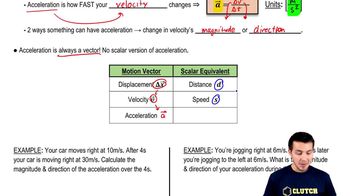
Acceleration is the rate of change of velocity of an object over time. It is a vector quantity, meaning it has both magnitude and direction. In this context, we can calculate the acceleration of the Genesis spacecraft during its crash by using the change in velocity and the time taken for the crash. The formula for acceleration is a = (final velocity - initial velocity) / time.
추천 영상:
가이드 코스
05:47
Intro to Acceleration

Kinematics

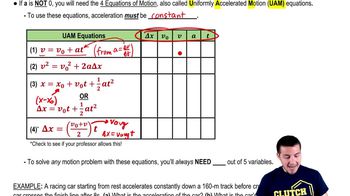
Kinematics is the branch of mechanics that deals with the motion of objects without considering the forces that cause the motion. It involves concepts such as displacement, velocity, and acceleration. In this problem, kinematic equations can be used to relate the initial and final velocities of the capsule, the distance it penetrated into the ground, and the time of the crash to find the acceleration.
추천 영상:
가이드 코스
08:25
Kinematics Equations

Gravitational Force

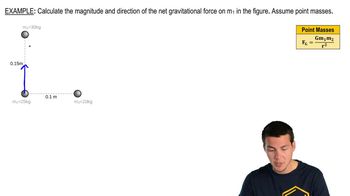
Gravitational force is the attractive force between two masses, which on Earth gives objects weight. It is commonly expressed in terms of 'g', where 1 g is approximately 9.81 m/s². When calculating acceleration in this problem, it is useful to express the result in terms of g's to understand how the capsule's deceleration compares to the force of gravity, providing context for the severity of the crash.
추천 영상:
가이드 코스
05:41
Gravitational Forces in 2D
관련 실천
교과서 질문

Three sleds are being pulled horizontally on frictionless horizontal ice using horizontal ropes (Fig. E5.145.14). The pull is of magnitude 190190 N. Find the acceleration of the system.

2429
views

교과서 질문

A man pushes on a piano with mass 180180 kg; it slides at constant velocity down a ramp that is inclined at 19.0°19.0° above the horizontal floor. Neglect any friction acting on the piano. Calculate the magnitude of the force applied by the man if he pushes parallel to the floor.

4636
views
교과서 질문

An astronaut is inside a 2.25×1062.25 × 10^6 kg rocket that is blasting off vertically from the launch pad. You want this rocket to reach the speed of sound (331331 m/s) as quickly as possible, but astronauts are in danger of blacking out at an acceleration greater than 4g4g. What is the maximum initial thrust this rocket's engines can have but just barely avoid blackout? Start with a free-body diagram of the rocket.

2499
views
1
rank
교과서 질문

On September 8, 2004, the Genesis spacecraft crashed in the Utah desert because its parachute did not open. The 210210-kg capsule hit the ground at 311311 km/h and penetrated the soil to a depth of 81.081.0 cm. What force did the ground exert on the capsule during the crash? Express the force in newtons and as a multiple of the capsule's weight.

2675
views
교과서 질문

Three sleds are being pulled horizontally on frictionless horizontal ice using horizontal ropes (Fig. E5.145.14). The pull is of magnitude 190190 N. Find the tension in ropes AA and BB.

6015
views
2
rank
교과서 질문

An astronaut is inside a 2.25×1062.25 × 10^6 kg rocket that is blasting off vertically from the launch pad. You want this rocket to reach the speed of sound (331331 m/s) as quickly as possible, but astronauts are in danger of blacking out at an acceleration greater than 4g4g. What force, in terms of the astronaut's weight ww, does the rocket exert on her? Start with a free-body diagram of the astronaut.

2944
views
1
rank