
Ch 08: Momentum, Impulse, and Collisions
Young & Freedman Calc - University Physics 14th Edition
Young & Freedman Calc14th EditionUniversity PhysicsISBN: 9780321973610당신이 사용하는 게 아니라요?교과서 변경
8장, 문제 62a

A small rocket burns 0.0500 kg of fuel per second, ejecting it as a gas with a velocity relative to the rocket of magnitude 1600 m/s. What is the thrust of the rocket?

검증된 단계별 안내
1
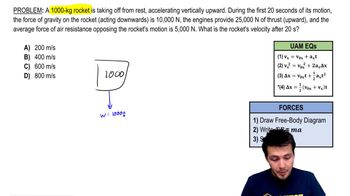
Understand the concept of thrust: Thrust is the force exerted by the rocket due to the ejection of fuel. It is calculated using the formula: F=dmv, where dm is the rate of change of mass (mass of fuel burned per second) and v is the velocity of the ejected gas relative to the rocket.
Identify the given values: The problem states that the mass of fuel burned per second is 0.0500 kg/s, and the velocity of the ejected gas relative to the rocket is 1600 m/s.
Substitute the given values into the thrust formula: F=dmv=0.05001600.
Simplify the expression to calculate the thrust: Perform the multiplication of the mass flow rate and the velocity of the ejected gas to find the thrust.
Interpret the result: The calculated thrust represents the force exerted by the rocket due to the ejection of fuel, measured in newtons (N).

비슷한 문제에 대한 검증된 영상 답변:

이 영상 해법은 위 문제에 도움이 된다고 튜터들이 추천한 것입니다.
영상 길이:
4m
도움이 되었나요?

주요 개념

질문에 올바르게 답하기 위해 반드시 이해해야 하는 핵심 개념들은 다음과 같습니다.

Thrust

Thrust is the force exerted by a rocket or engine to propel it forward. It is generated by the expulsion of mass (in this case, fuel) at high velocity. According to Newton's third law, for every action, there is an equal and opposite reaction, meaning that the force of the expelled gas creates an upward thrust that propels the rocket.
추천 영상:

Conservation of Momentum

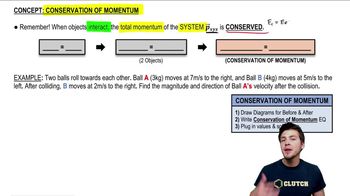
The conservation of momentum principle states that the total momentum of a closed system remains constant if no external forces act on it. In the context of rockets, as fuel is expelled, the momentum gained by the rocket in the opposite direction is equal to the momentum lost by the expelled fuel, allowing us to calculate thrust based on the mass flow rate and velocity of the exhaust.
추천 영상:
가이드 코스
05:58
Conservation Of Momentum

Mass Flow Rate

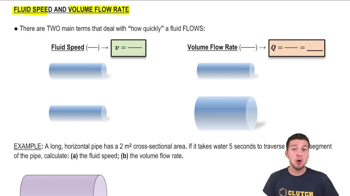
Mass flow rate is the amount of mass that passes through a given surface per unit time, typically expressed in kilograms per second (kg/s). In rocket propulsion, it is crucial for calculating thrust, as it directly relates to how much fuel is consumed and how quickly it is expelled, influencing the overall performance and efficiency of the rocket.
추천 영상:
가이드 코스
6:34
Fluid Speed & Volume Flow Rate