
Ch 08: Momentum, Impulse, and Collisions
Young & Freedman Calc - University Physics 14th Edition
Young & Freedman Calc14th EditionUniversity PhysicsISBN: 9780321973610당신이 사용하는 게 아니라요?교과서 변경
8장, 문제 34b

Two fun-loving otters are sliding toward each other on a muddy (and hence frictionless) horizontal surface. One of them, of mass 7.50 kg, is sliding to the left at 5.00 m/s, while the other, of mass 5.75 kg, is slipping to the right at 6.00 m/s. They hold fast to each other after they collide. How much mechanical energy dissipates during this play?

검증된 단계별 안내
1
Identify the type of collision: This is an inelastic collision because the two otters stick together after the collision. In such collisions, momentum is conserved, but mechanical energy is not.
Calculate the total initial momentum of the system: Use the formula for momentum, \( p = mv \), where \( m \) is mass and \( v \) is velocity. Assign positive and negative signs to velocities based on direction (e.g., left is negative, right is positive). Compute the momentum of each otter and sum them.
Determine the final velocity of the combined system: Since momentum is conserved, set the total initial momentum equal to the total final momentum. Use the formula \( p_{\text{initial}} = p_{\text{final}} \), where \( p_{\text{final}} = (m_1 + m_2)v_{\text{final}} \). Solve for \( v_{\text{final}} \).
Calculate the initial mechanical energy: Use the kinetic energy formula \( KE = \frac{1}{2}mv^2 \) for each otter before the collision. Add their kinetic energies to find the total initial mechanical energy.
Calculate the final mechanical energy and the energy dissipated: After the collision, the combined mass moves with the final velocity. Use \( KE = \frac{1}{2}(m_1 + m_2)v_{\text{final}}^2 \) to find the final mechanical energy. Subtract the final mechanical energy from the initial mechanical energy to find the energy dissipated.

비슷한 문제에 대한 검증된 영상 답변:

이 영상 해법은 위 문제에 도움이 된다고 튜터들이 추천한 것입니다.
영상 길이:
11m
도움이 되었나요?

주요 개념

질문에 올바르게 답하기 위해 반드시 이해해야 하는 핵심 개념들은 다음과 같습니다.

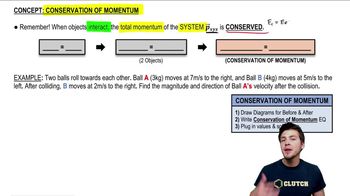
Conservation of Momentum

The principle of conservation of momentum states that in a closed system, the total momentum before an event (like a collision) is equal to the total momentum after the event. In this scenario, the momentum of the two otters before they collide can be calculated and must equal the momentum of the combined mass after they hold onto each other.
추천 영상:
가이드 코스
05:58
Conservation Of Momentum

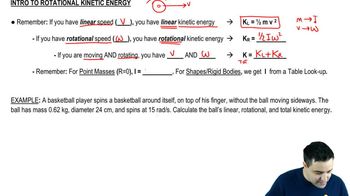
Kinetic Energy

Kinetic energy is the energy an object possesses due to its motion, calculated using the formula KE = 0.5 * m * v², where m is mass and v is velocity. In this problem, the kinetic energies of both otters before the collision must be determined to assess how much energy is lost during the collision.
추천 영상:
가이드 코스
06:07
Intro to Rotational Kinetic Energy

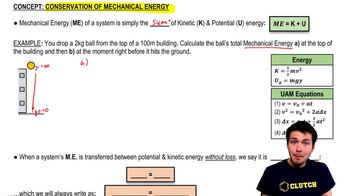
Mechanical Energy Dissipation

Mechanical energy dissipation refers to the loss of kinetic energy during a collision, often transformed into other forms of energy, such as heat or sound. Inelastic collisions, like the one described, result in some kinetic energy being converted to other forms, which can be calculated by comparing the total kinetic energy before and after the collision.
추천 영상:
가이드 코스
06:24
Conservation Of Mechanical Energy
관련 실천
교과서 질문

To protect their young in the nest, peregrine falcons will fly into birds of prey (such as ravens) at high speed. In one such episode, a 600-g falcon flying at 20.0 m/s hit a 1.50-kg raven flying at 9.0 m/s. The falcon hit the raven at right angles to its original path and bounced back at 5.0 m/s. (These figures were estimated by the author as he watched this attack occur in northern New Mexico.) By what angle did the falcon change the raven's direction of motion?

5187
views
교과서 질문

To protect their young in the nest, peregrine falcons will fly into birds of prey (such as ravens) at high speed. In one such episode, a 600-g falcon flying at 20.0 m/s hit a 1.50-kg raven flying at 9.0 m/s. The falcon hit the raven at right angles to its original path and bounced back at 5.0 m/s. (These figures were estimated by the author as he watched this attack occur in northern New Mexico.) What was the raven's speed right after the collision?

2127
views
교과서 질문

Two skaters collide and grab on to each other on frictionless ice. One of them, of mass 70.0 kg, is moving to the right at 4.00 m/s, while the other, of mass 65.0 kg, is moving to the left at 2.50 m/s. What are the magnitude and direction of the velocity of these skaters just after they collide?

3266
views
교과서 질문

Jack (mass 55.0 kg) is sliding due east with speed 8.00 m/s on the surface of a frozen pond. He collides with Jill (mass 48.0 kg), who is initially at rest. After the collision, Jack is traveling at 5.00 m/s in a direction 34.0° north of east. What is Jill's velocity (magnitude and direction) after the collision? Ignore friction.

3023
views
1
comments
교과서 질문

Two fun-loving otters are sliding toward each other on a muddy (and hence frictionless) horizontal surface. One of them, of mass 7.50 kg, is sliding to the left at 5.00 m/s, while the other, of mass 5.75 kg, is slipping to the right at 6.00 m/s. They hold fast to each other after they collide. Find the magnitude and direction of the velocity of these free-spirited otters right after they collide.

1802
views
교과서 질문

Two ice skaters, Daniel (mass 65.0 kg) and Rebecca (mass 45.0 kg), are practicing. Daniel stops to tie his shoelace and, while at rest, is struck by Rebecca, who is moving at 13.0 m/s before she collides with him. After the collision, Rebecca has a velocity of magnitude 8.00 m/s at an angle of 53.1° from her initial direction. Both skaters move on the frictionless, horizontal surface of the rink. What is the change in total kinetic energy of the two skaters as a result of the collision?

1551
views