
Ch 08: Momentum, Impulse, and Collisions
Young & Freedman Calc - University Physics 14th Edition
Young & Freedman Calc14th EditionUniversity PhysicsISBN: 9780321973610당신이 사용하는 게 아니라요?교과서 변경
8장, 문제 4b

Two vehicles are approaching an intersection. One is a 2500-kg pickup traveling at 14.0 m/s from east to west (the -x-direction), and the other is a 1500-kg sedan going from south to north (the +y-direction) at 23.0 m/s. What are the magnitude and direction of the net momentum?

검증된 단계별 안내
1
Step 1: Understand the concept of momentum. Momentum is a vector quantity defined as the product of an object's mass and velocity. The formula for momentum is \( \mathbf{p} = m \cdot \mathbf{v} \), where \( m \) is the mass and \( \mathbf{v} \) is the velocity vector.
Step 2: Calculate the momentum of the pickup truck. The pickup truck has a mass of 2500 kg and is traveling at a velocity of 14.0 m/s in the -x direction. Using \( \mathbf{p}_{\text{pickup}} = m \cdot \mathbf{v} \), the momentum vector of the pickup truck is \( \mathbf{p}_{\text{pickup}} = 2500 \cdot (-14.0) \) in the x-direction.
Step 3: Calculate the momentum of the sedan. The sedan has a mass of 1500 kg and is traveling at a velocity of 23.0 m/s in the +y direction. Using \( \mathbf{p}_{\text{sedan}} = m \cdot \mathbf{v} \), the momentum vector of the sedan is \( \mathbf{p}_{\text{sedan}} = 1500 \cdot 23.0 \) in the y-direction.
Step 4: Determine the net momentum vector. Since momentum is a vector quantity, the net momentum \( \mathbf{p}_{\text{net}} \) is the vector sum of the individual momenta: \( \mathbf{p}_{\text{net}} = \mathbf{p}_{\text{pickup}} + \mathbf{p}_{\text{sedan}} \). This involves adding the x-component of the pickup truck's momentum and the y-component of the sedan's momentum.
Step 5: Calculate the magnitude and direction of the net momentum. The magnitude of the net momentum is given by \( |\mathbf{p}_{\text{net}}| = \sqrt{(p_x)^2 + (p_y)^2} \), where \( p_x \) and \( p_y \) are the x and y components of the net momentum. The direction (angle \( \theta \)) can be found using \( \theta = \tan^{-1}(p_y / p_x) \).

비슷한 문제에 대한 검증된 영상 답변:

이 영상 해법은 위 문제에 도움이 된다고 튜터들이 추천한 것입니다.
영상 길이:
9m
도움이 되었나요?

주요 개념

질문에 올바르게 답하기 위해 반드시 이해해야 하는 핵심 개념들은 다음과 같습니다.

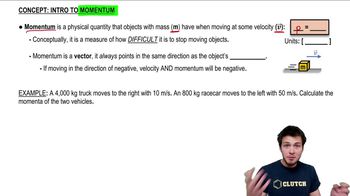
Momentum

Momentum is a vector quantity defined as the product of an object's mass and its velocity. It is expressed as p = mv, where p is momentum, m is mass, and v is velocity. Momentum has both magnitude and direction, making it crucial for analyzing collisions and interactions between objects.
추천 영상:
가이드 코스
05:17
Intro to Momentum

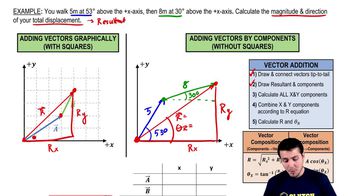
Vector Addition

Vector addition is the process of combining two or more vectors to determine a resultant vector. This involves adding the corresponding components of the vectors, taking into account their directions. In the context of momentum, the total momentum of a system is found by vectorially adding the momenta of individual objects.
추천 영상:
가이드 코스
07:30
Vector Addition By Components

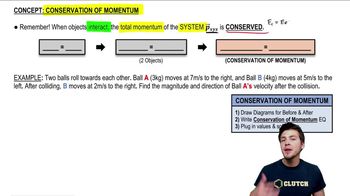
Conservation of Momentum

The conservation of momentum principle states that the total momentum of a closed system remains constant if no external forces act on it. This principle is fundamental in collision problems, allowing us to analyze the motion of objects before and after an interaction by equating their total momentum.
추천 영상:
가이드 코스
05:58
Conservation Of Momentum