
Ch 10: Dynamics of Rotational Motion
Young & Freedman Calc - University Physics 14th Edition
Young & Freedman Calc14th EditionUniversity PhysicsISBN: 9780321973610당신이 사용하는 게 아니라요?교과서 변경
10장, 문제 28b

A bicycle racer is going downhill at 11.0 m/s when, to his horror, one of his 2.25-kg wheels comes off as he is 75.0 m above the foot of the hill. We can model the wheel as a thin-walled cylinder 85.0 cm in diameter and ignore the small mass of the spokes. How much total kinetic energy does the wheel have when it reaches the bottom of the hill?

검증된 단계별 안내
1
First, identify the types of energy involved. The wheel has both translational kinetic energy due to its linear motion and rotational kinetic energy due to its spinning.
Calculate the initial potential energy of the wheel at the top of the hill using the formula: E=mgh, where m is the mass of the wheel, g is the acceleration due to gravity, and h is the height above the foot of the hill.
Determine the translational kinetic energy using the formula: E=12mv2, where v is the linear velocity of the wheel.
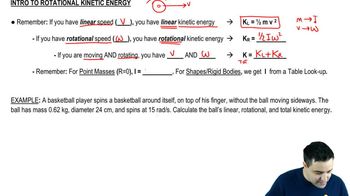
Calculate the rotational kinetic energy using the formula: E=12Iω2, where I is the moment of inertia of the wheel and ω is the angular velocity. For a thin-walled cylinder, I can be calculated as I=mr2, where r is the radius of the wheel.
Sum the translational and rotational kinetic energies to find the total kinetic energy of the wheel when it reaches the bottom of the hill.

비슷한 문제에 대한 검증된 영상 답변:

이 영상 해법은 위 문제에 도움이 된다고 튜터들이 추천한 것입니다.
영상 길이:
8m
도움이 되었나요?

주요 개념

질문에 올바르게 답하기 위해 반드시 이해해야 하는 핵심 개념들은 다음과 같습니다.

Kinetic Energy

Kinetic energy is the energy an object possesses due to its motion, calculated using the formula KE = 0.5 * m * v^2, where m is mass and v is velocity. In this scenario, the wheel's kinetic energy includes both translational and rotational components as it rolls downhill.
추천 영상:
가이드 코스
06:07
Intro to Rotational Kinetic Energy

Rotational Kinetic Energy

Rotational kinetic energy is the energy due to an object's rotation, given by KE_rot = 0.5 * I * ω^2, where I is the moment of inertia and ω is the angular velocity. For a thin-walled cylinder, I = m * r^2, where r is the radius, which is crucial for calculating the wheel's energy as it rolls.
추천 영상:
가이드 코스
06:07
Intro to Rotational Kinetic Energy

Conservation of Energy

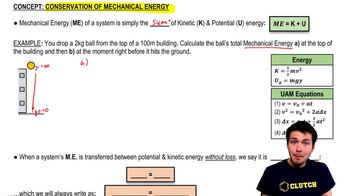
The conservation of energy principle states that energy cannot be created or destroyed, only transformed. As the wheel descends, its potential energy converts into kinetic energy, allowing us to calculate the total kinetic energy at the bottom by considering both translational and rotational forms.
추천 영상:
가이드 코스
06:24
Conservation Of Mechanical Energy
관련 실천
교과서 질문

A 2.20-kg hoop 1.20 m in diameter is rolling to the right without slipping on a horizontal floor at a steady 2.60 rad/s. Find the velocity vector of each of the following points, as viewed by a person at rest on the ground: (i) the highest point on the hoop; (ii) the lowest point on the hoop; (iii) a point on the right side of the hoop, midway between the top and the bottom.

2922
views
교과서 질문

A 2.80-kg grinding wheel is in the form of a solid cylinder of radius 0.100 m. What constant torque will bring it from rest to an angular speed of 1200 rev/min in 2.5 s?

2087
views
교과서 질문

A solid ball is released from rest and slides down a hillside that slopes downward at 65.0° from the horizontal. In part (a), why did we use the coefficient of static friction and not the coefficient of kinetic friction?

1302
views
교과서 질문

A playground merry-go-round has radius 2.40 m2.40\(\text{ m}\) and moment of inertia 2100 kg m22100\(\text{ kg m}\)^2 about a vertical axle through its center, and it turns with negligible friction. A child applies an 18.0 N18.0\(\text{ N}\) force tangentially to the edge of the merry-go-round for 15.0 s15.0\(\text{ s}\). If the merry-go-round is initially at rest, how much work did the child do on the merry-go-round?

2501
views
교과서 질문

A 2.20-kg hoop 1.20 m in diameter is rolling to the right without slipping on a horizontal floor at a steady 2.60 rad/s. Find the velocity vector for each of the points in part (c), but this time as viewed by someone moving along with the same velocity as the hoop.

1667
views
교과서 질문

A playground merry-go-round has radius 2.40 m2.40\(\text{ m}\) and moment of inertia 2100 kg m22100\(\text{ kg m}\)^2 about a vertical axle through its center, and it turns with negligible friction. A child applies an 18.0 N18.0\(\text{ N}\) force tangentially to the edge of the merry-go-round for 15.0 s15.0\(\text{ s}\). If the merry-go-round is initially at rest, what is its angular speed after this 15.0 s15.0\(\text{ s}\) interval?

1347
views