
Ch 10: Dynamics of Rotational Motion
Young & Freedman Calc - University Physics 14th Edition
Young & Freedman Calc14th EditionUniversity PhysicsISBN: 9780321973610당신이 사용하는 게 아니라요?교과서 변경
10장, 문제 52

A certain gyroscope precesses at a rate of 0.50 rad/s when used on earth. If it were taken to a lunar base, where the acceleration due to gravity is 0.165g, what would be its precession rate?

검증된 단계별 안내
1
Understand the concept of gyroscopic precession: Gyroscopic precession is the phenomenon where the axis of a spinning object moves in response to an external torque. The precession rate depends on the angular momentum of the gyroscope and the torque applied.
Identify the relationship between precession rate, angular momentum, and torque: The precession rate \( \Omega \) is given by \( \Omega = \frac{\tau}{L} \), where \( \tau \) is the torque and \( L \) is the angular momentum.
Recognize that the torque \( \tau \) is affected by gravity: On Earth, the torque is \( \tau = r \times m \times g \), where \( r \) is the radius, \( m \) is the mass, and \( g \) is the acceleration due to gravity. On the Moon, the torque becomes \( \tau_{moon} = r \times m \times 0.165g \).
Relate the precession rates on Earth and the Moon: Since the angular momentum \( L \) remains constant, the precession rate on the Moon \( \Omega_{moon} \) can be found using the ratio of torques: \( \Omega_{moon} = \Omega_{earth} \times \frac{\tau_{moon}}{\tau_{earth}} \).
Substitute the known values: Use \( \Omega_{earth} = 0.50 \) rad/s and the ratio \( \frac{\tau_{moon}}{\tau_{earth}} = 0.165 \) to find \( \Omega_{moon} \).

비슷한 문제에 대한 검증된 영상 답변:

이 영상 해법은 위 문제에 도움이 된다고 튜터들이 추천한 것입니다.
영상 길이:
3m
도움이 되었나요?

주요 개념

질문에 올바르게 답하기 위해 반드시 이해해야 하는 핵심 개념들은 다음과 같습니다.

Gyroscopic Precession

Gyroscopic precession is the phenomenon where a spinning object, like a gyroscope, experiences a change in its axis of rotation due to an external torque. This torque is often caused by gravity, and the precession rate depends on the angular momentum and the torque applied. Understanding this concept is crucial for determining how changes in gravitational force affect precession rates.

Torque and Angular Momentum

Torque is a measure of the force that can cause an object to rotate about an axis, while angular momentum is the quantity of rotation of a body, which is conserved in the absence of external torques. The relationship between torque and angular momentum is key to understanding gyroscopic precession, as the precession rate is proportional to the torque applied and inversely proportional to the angular momentum.
추천 영상:
가이드 코스
06:18
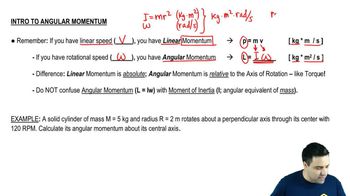
Intro to Angular Momentum

Gravitational Acceleration

Gravitational acceleration is the acceleration of an object due to the force of gravity. On Earth, this is approximately 9.81 m/s², but on the Moon, it is only 0.165 times that value. This difference in gravitational acceleration affects the torque exerted on the gyroscope, thereby influencing its precession rate. Understanding how gravity varies between Earth and the Moon is essential for calculating the new precession rate.
추천 영상:
가이드 코스
07:32
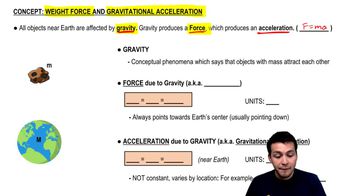
Weight Force & Gravitational Acceleration