

Ch 10: Dynamics of Rotational Motion
Young & Freedman Calc - University Physics 14th Edition
Young & Freedman Calc14th EditionUniversity PhysicsISBN: 9780321973610당신이 사용하는 게 아니라요?교과서 변경
10장, 문제 11a

A machine part has the shape of a solid uniform sphere of mass 225 g and diameter 3.00 cm. It is spinning about a frictionless axle through its center, but at one point on its equator, it is scraping against metal, resulting in a friction force of 0.0200 N at that point. Find its angular acceleration.

검증된 단계별 안내
1
First, convert the mass of the sphere from grams to kilograms. Since 1 g = 0.001 kg, the mass of the sphere is 225 g * 0.001 kg/g = 0.225 kg.
Next, calculate the radius of the sphere. The diameter is given as 3.00 cm, so the radius is half of that: 3.00 cm / 2 = 1.50 cm. Convert this to meters: 1.50 cm * 0.01 m/cm = 0.015 m.
Determine the moment of inertia (I) for a solid sphere rotating about an axis through its center. The formula for the moment of inertia of a solid sphere is: I=25mr2, where m is the mass and r is the radius.
Calculate the torque (τ) caused by the friction force. Torque is given by the formula: τ=Fr, where F is the friction force and r is the radius of the sphere.
Finally, use Newton's second law for rotation to find the angular acceleration (α). The formula is: α=τI, where τ is the torque and I is the moment of inertia.

비슷한 문제에 대한 검증된 영상 답변:

이 영상 해법은 위 문제에 도움이 된다고 튜터들이 추천한 것입니다.
영상 길이:
3m
도움이 되었나요?

주요 개념

질문에 올바르게 답하기 위해 반드시 이해해야 하는 핵심 개념들은 다음과 같습니다.

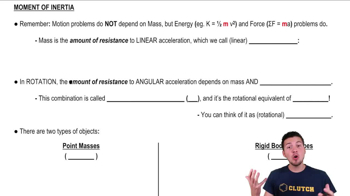
Moment of Inertia

The moment of inertia is a measure of an object's resistance to changes in its rotation. For a solid sphere, it is calculated using the formula I = 2/5 * m * r^2, where m is the mass and r is the radius. This concept is crucial for determining how the sphere's mass distribution affects its angular acceleration.
추천 영상:
가이드 코스
11:47
Intro to Moment of Inertia

Torque

Torque is the rotational equivalent of force, causing an object to rotate around an axis. It is calculated as the product of the force applied and the distance from the axis of rotation, T = F * r. In this scenario, the friction force at the equator generates torque, influencing the sphere's angular acceleration.
추천 영상:
가이드 코스
08:55
Net Torque & Sign of Torque

Angular Acceleration

Angular acceleration is the rate of change of angular velocity over time. It is determined by the net torque acting on an object divided by its moment of inertia, α = T/I. Understanding this concept is essential for calculating how the friction force affects the sphere's rotational speed.
추천 영상:
가이드 코스
12:12
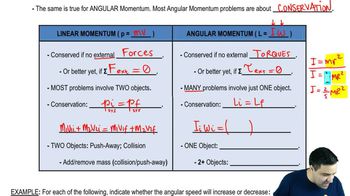
Conservation of Angular Momentum
관련 실천
교과서 질문

A cord is wrapped around the rim of a solid uniform wheel 0.250 m in radius and of mass 9.20 kg. A steady horizontal pull of 40.0 N to the right is exerted on the cord, pulling it off tangentially from the wheel. The wheel is mounted on frictionless bearings on a horizontal axle through its center. Find the magnitude and direction of the force that the axle exerts on the wheel.

4367
views
2
rank
교과서 질문

A machine part has the shape of a solid uniform sphere of mass 225 g and diameter 3.00 cm. It is spinning about a frictionless axle through its center, but at one point on its equator it is scraping against metal, resulting in a friction force of 0.0200 N at that point. How long will it take to decrease its rotational speed by 22.5 rad/s?

917
views
교과서 질문

Three forces are applied to a wheel of radius 0.350 m, as shown in Fig. E10.4. One force is perpendicular to the rim, one is tangent to it, and the other one makes a 40.0° angle with the radius. What is the net torque on the wheel due to these three forces for an axis perpendicular to the wheel and passing through its center?

3468
views
1
rank
1
comments
교과서 질문

A stone is suspended from the free end of a wire that is wrapped around the outer rim of a pulley, similar to what is shown in Fig. 10.10. The pulley is a uniform disk with mass 10.0 kg and radius 30.0 cm and turns on frictionless bearings. You measure that the stone travels 12.6 m in the first 3.00 s starting from rest. Find the tension in the wire.

4414
views
1
rank
1
comments
교과서 질문

(a) Calculate the magnitude of the angular momentum of the earth in a circular orbit around the sun. Is it reasonable to model it as a particle? Consult Appendix E and the astronomical data in Appendix F

2744
views
교과서 질문

A stone is suspended from the free end of a wire that is wrapped around the outer rim of a pulley, similar to what is shown in Fig. 10.10. The pulley is a uniform disk with mass 10.0 kg and radius 30.0 cm and turns on frictionless bearings. You measure that the stone travels 12.6 m in the first 3.00 s starting from rest. Find the mass of the stone.

877
views