
Ch 11: Equilibrium & Elasticity
Young & Freedman Calc - University Physics 14th Edition
Young & Freedman Calc14th EditionUniversity PhysicsISBN: 9780321973610당신이 사용하는 게 아니라요?교과서 변경
11장, 문제 13a

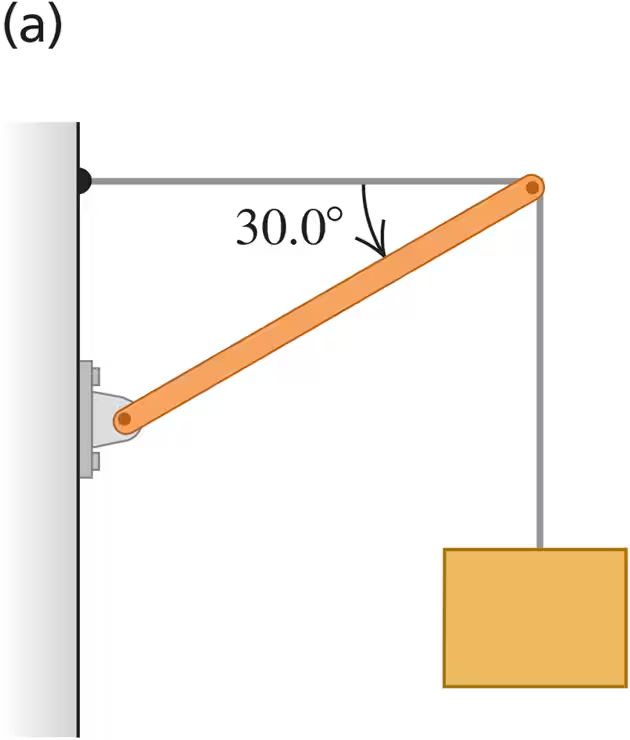
Find the tension T in each cable and the magnitude and direction of the force exerted on the strut by the pivot in each of the arrangements in Fig. E11.13. In each case let w be the weight of the suspended crate full of priceless art objects. The strut is uniform and also has weight w. Start each case with a free-body diagram of the strut.

검증된 단계별 안내
1
Begin by drawing a free-body diagram for the strut in arrangement (a). Identify all forces acting on the strut: the tension T in the cable, the weight of the strut w, the weight of the crate w, and the force exerted by the pivot.
Apply the equilibrium condition for forces in the vertical direction. The sum of the vertical components of the forces must be zero. This gives us: T * sin(30°) + F_pivot_vertical = 2w, where F_pivot_vertical is the vertical component of the force exerted by the pivot.
Apply the equilibrium condition for forces in the horizontal direction. The sum of the horizontal components of the forces must be zero. This gives us: T * cos(30°) = F_pivot_horizontal, where F_pivot_horizontal is the horizontal component of the force exerted by the pivot.
Apply the equilibrium condition for torques about the pivot point. The sum of the torques must be zero. Consider the torque due to the weight of the strut, the weight of the crate, and the tension in the cable. Set up the equation: w * (L/2) * cos(30°) + w * L * cos(30°) = T * L * sin(30°), where L is the length of the strut.
Solve the system of equations obtained from the equilibrium conditions to find the tension T in the cable and the components of the force exerted by the pivot. Use trigonometric identities and algebraic manipulation to isolate T and the pivot force components.

비슷한 문제에 대한 검증된 영상 답변:

이 영상 해법은 위 문제에 도움이 된다고 튜터들이 추천한 것입니다.
영상 길이:
16m
도움이 되었나요?

주요 개념

질문에 올바르게 답하기 위해 반드시 이해해야 하는 핵심 개념들은 다음과 같습니다.

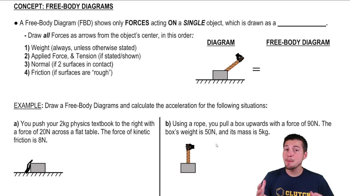
Free-Body Diagram

A free-body diagram is a graphical representation used to visualize the forces acting on an object. In this context, it helps identify all forces acting on the strut, including tension in the cables, gravitational forces due to the weights of the crate and the strut itself, and any reaction forces at the pivot. This diagram is essential for applying Newton's laws of motion to solve for unknown forces.
추천 영상:
가이드 코스
08:42
Free-Body Diagrams

Tension in Cables

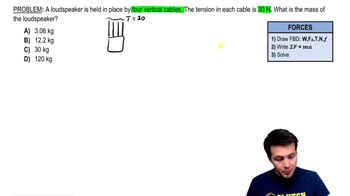
Tension is the force exerted along a cable or string when it is pulled tight by forces acting from opposite ends. In this problem, the tension in the cables supporting the strut must be calculated based on the weight of the suspended crate and the angle of the strut. Understanding how tension distributes in a system is crucial for determining the equilibrium of forces.
추천 영상:
가이드 코스
03:25
Multiple Cables on a Loudspeaker

Equilibrium of Forces

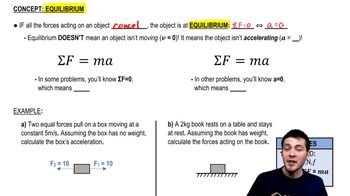
The equilibrium of forces occurs when the net force acting on an object is zero, meaning all forces balance out. In this scenario, the strut must be in static equilibrium, where the sum of vertical forces and the sum of horizontal forces are both zero. This principle allows us to set up equations based on the free-body diagram to solve for the unknown tension and pivot forces.
추천 영상:
관련 실천
교과서 질문

A diving board 3.00 m long is supported at a point 1.00 m from the end, and a diver weighing 500 N stands at the free end (Fig. E11.11). The diving board is of uniform cross section and weighs 280 N. Find the force at the support point.


2565
views
교과서 질문

The horizontal beam in Fig. E11.14 weighs 190 N, and its center of gravity is at its center. Find the tension in the cable.


2536
views
1
rank
교과서 질문

A uniform ladder 5.0 m long rests against a frictionless, vertical wall with its lower end 3.0 m from the wall. The ladder weighs 160 N. The coefficient of static friction between the foot of the ladder and the ground is 0.40. A man weighing 740 N climbs slowly up the ladder. Start by drawing a free-body diagram of the ladder. What is the maximum friction force that the ground can exert on the ladder at its lower end?

3284
views
교과서 질문

The horizontal beam in Fig. E11.14 weighs 190 N, and its center of gravity is at its center. Find the horizontal and vertical components of the force exerted on the beam at the wall.

1976
views
교과서 질문

A 350-N, uniform, 1.50-m bar is suspended horizontally by two vertical cables at each end. Cable A can support a maximum tension of 500.0 N without breaking, and cable B can support up to 400.0 N. You want to place a small weight on this bar. (a) What is the heaviest weight you can put on without breaking either cable, and (b) where should you put this weight?

2383
views
교과서 질문

Find the tension T in each cable and the magnitude and direction of the force exerted on the strut by the pivot in each of the arrangements in Fig. E11.13. In each case let w be the weight of the suspended crate full of priceless art objects. The strut is uniform and also has weight w. Start each case with a free-body diagram of the strut.

2200
views