

Ch 11: Equilibrium & Elasticity
Young & Freedman Calc - University Physics 14th Edition
Young & Freedman Calc14th EditionUniversity PhysicsISBN: 9780321973610당신이 사용하는 게 아니라요?교과서 변경
11장, 문제 16a

Suppose that you can lift no more than 650 N (around 150 lb) unaided.


How much can you lift using a 1.4 m-long wheelbarrow that weighs 80.0 N and whose center of gravity is 0.50 m from the center of the wheel (Fig. E11.16)? The center of gravity of the load carried in the wheelbarrow is also 0.50 m from the center of the wheel.
Illustration of a person lifting a wheelbarrow with labeled dimensions, demonstrating torque and equilibrium.

검증된 단계별 안내
1
Understand the problem: You are using a wheelbarrow as a lever to lift a load. The wheel acts as the fulcrum, and you apply force at the handles. The wheelbarrow itself and the load have their centers of gravity 0.50 m from the wheel.
Identify the lever arm distances: The total length of the wheelbarrow is 1.4 m, and the center of gravity of both the wheelbarrow and the load is 0.50 m from the wheel. Therefore, the distance from the handles to the wheel is 1.4 m.
Apply the principle of moments: The moment (torque) is the product of force and distance from the fulcrum. For equilibrium, the sum of moments about the fulcrum must be zero. Calculate the moment due to the wheelbarrow's weight and the load's weight, and set it equal to the moment due to the force you apply.
Set up the equation: Let F be the force you apply. The moment due to your force is F * 1.4 m. The moment due to the wheelbarrow's weight is 80.0 N * 0.50 m, and the moment due to the load's weight is W * 0.50 m, where W is the weight of the load. The equation is: F * 1.4 m = 80.0 N * 0.50 m + W * 0.50 m.
Solve for W: Rearrange the equation to solve for the weight of the load (W) you can lift. Remember that F is the maximum force you can apply, which is 650 N. Substitute F = 650 N into the equation and solve for W.

비슷한 문제에 대한 검증된 영상 답변:

이 영상 해법은 위 문제에 도움이 된다고 튜터들이 추천한 것입니다.
영상 길이:
10m
도움이 되었나요?

주요 개념

질문에 올바르게 답하기 위해 반드시 이해해야 하는 핵심 개념들은 다음과 같습니다.

Torque

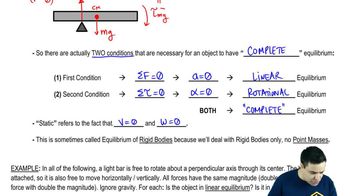
Torque is a measure of the rotational force applied to an object, calculated as the product of the force and the distance from the pivot point (lever arm). In this scenario, the wheelbarrow acts as a lever, where the wheel serves as the pivot. The torque generated by the load in the wheelbarrow must be balanced by the torque exerted by the person lifting it to maintain equilibrium.
추천 영상:
가이드 코스
08:55
Net Torque & Sign of Torque

Equilibrium

Equilibrium in physics refers to a state where all forces and torques acting on an object are balanced, resulting in no net force or rotation. In the context of the wheelbarrow, the weight of the load and the wheelbarrow itself must be countered by the lifting force applied by the person. Understanding equilibrium is crucial for determining how much weight can be lifted without exceeding the person's lifting capacity.
추천 영상:
가이드 코스
10:13
Torque & Equilibrium

Center of Gravity

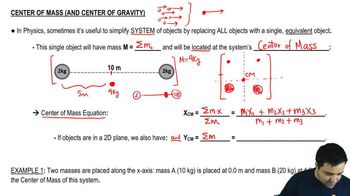
The center of gravity is the point at which the weight of an object is evenly distributed in all directions. For the wheelbarrow, the center of gravity is located at a specific distance from the wheel, affecting how the load is balanced and how torque is calculated. Knowing the center of gravity helps in analyzing the stability of the wheelbarrow when lifting and the effective load that can be managed.
추천 영상:
가이드 코스
14:02
Intro to Center of Mass
관련 실천
교과서 질문

Suppose that you can lift no more than 650 N (around 150 lb) unaided.

(a) How much can you lift using a 1.4-m-long wheelbarrow that weighs 80.0 N and whose center of gravity is 0.50 m from the center of the wheel (Fig. E11.16)? The cen-ter of gravity of the load car-ried in the wheelbarrow is also 0.50 m from the center of the wheel. (b) Where does the force come from to enable you to lift more than 650 N using the wheelbarrow?

1767
views
교과서 질문

The horizontal beam in Fig. E11.14 weighs 190 N, and its center of gravity is at its center. Find the tension in the cable.


2536
views
1
rank
교과서 질문

A 9.00-m-long uniform beam is hinged to a vertical wall and held horizontally by a 5.00-m-long cable attached to the wall 4.00 m above the hinge (Fig. E11.17). The metal of this cable has a test strength of 1.00 kN, which means that it will break if the tension in it exceeds that amount. What is the heaviest beam that the cable can support in this configuration?

3767
views
1
rank
1
comments
교과서 질문

The horizontal beam in Fig. E11.14 weighs 190 N, and its center of gravity is at its center. Find the horizontal and vertical components of the force exerted on the beam at the wall.

1976
views
교과서 질문

A 9.00 m-long uniform beam is hinged to a vertical wall and held horizontally by a 5.00 m-long cable attached to the wall 4.00 m above the hinge (Fig. E11.17). The metal of this cable has a test strength of 1.00 kN, which means that it will break if the tension in it exceeds that amount. Find the horizontal and vertical components of the force the hinge exerts on the beam. Is the vertical component upward or downward?

2575
views
1
rank
1
comments
교과서 질문

Find the tension T in each cable and the magnitude and direction of the force exerted on the strut by the pivot in each of the arrangements in Fig. E11.13. In each case let w be the weight of the suspended crate full of priceless art objects. The strut is uniform and also has weight w. Start each case with a free-body diagram of the strut.

2200
views