


Ch 11: Equilibrium & Elasticity
Young & Freedman Calc - University Physics 14th Edition
Young & Freedman Calc14th EditionUniversity PhysicsISBN: 9780321973610당신이 사용하는 게 아니라요?교과서 변경
11장, 문제 26

Two circular rods, one steel and the other copper, are joined end to end. Each rod is 0.750 m long and 1.50 cm in diameter. The combination is subjected to a tensile force with magnitude 4000 N. For each rod, what are (a) the strain and (b) the elongation?

검증된 단계별 안내
1
First, understand that strain is a dimensionless quantity defined as the change in length divided by the original length. It can be expressed as \( \text{strain} = \frac{\Delta L}{L_0} \), where \( \Delta L \) is the change in length and \( L_0 \) is the original length.
Next, recognize that the elongation \( \Delta L \) can be found using Hooke's Law, which relates the force \( F \), the original length \( L_0 \), the cross-sectional area \( A \), and Young's modulus \( E \) of the material: \( \Delta L = \frac{F L_0}{A E} \).
Calculate the cross-sectional area \( A \) of the rods using the formula for the area of a circle: \( A = \pi r^2 \), where \( r \) is the radius of the rod. Given the diameter is 1.50 cm, convert it to meters and find the radius.
For each rod, use the given tensile force \( F = 4000 \) N, the calculated cross-sectional area \( A \), and the respective Young's modulus \( E \) for steel and copper to find the elongation \( \Delta L \) using the formula \( \Delta L = \frac{F L_0}{A E} \).
Finally, calculate the strain for each rod using the formula \( \text{strain} = \frac{\Delta L}{L_0} \), where \( \Delta L \) is the elongation found in the previous step and \( L_0 = 0.750 \) m is the original length of each rod.

비슷한 문제에 대한 검증된 영상 답변:

이 영상 해법은 위 문제에 도움이 된다고 튜터들이 추천한 것입니다.
도움이 되었나요?

주요 개념

질문에 올바르게 답하기 위해 반드시 이해해야 하는 핵심 개념들은 다음과 같습니다.

Stress and Strain

Stress is the force applied per unit area on a material, while strain is the deformation or displacement it experiences due to this stress. Strain is a dimensionless quantity calculated as the change in length divided by the original length. Understanding these concepts is crucial for determining how materials respond to forces.
추천 영상:
07:49
Ray Diagrams for Convex Mirrors

Young's Modulus

Young's Modulus, or the modulus of elasticity, is a measure of a material's ability to withstand changes in length when under lengthwise tension or compression. It is defined as the ratio of stress to strain in the linear elasticity regime of a uniaxial deformation. This property is essential for calculating the strain and elongation of materials when subjected to forces.
추천 영상:
가이드 코스
12:00
Young's Double Slit Experiment

Material Properties of Steel and Copper

Steel and copper have distinct mechanical properties, including different Young's Moduli, which affect how they deform under stress. Steel typically has a higher Young's Modulus than copper, meaning it is stiffer and less prone to deformation. Understanding these properties is necessary to calculate and compare the strain and elongation in each rod when subjected to the same tensile force.
추천 영상:
가이드 코스
03:47
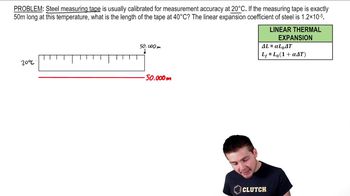
Expanding Steel Measuring Tape
관련 실천
교과서 질문

A solid gold bar is pulled up from the hold of the sunken RMS Titanic. The bulk modulus of lead is one-fourth that of gold. Find the ratio of the volume change of a solid lead bar to that of a gold bar of equal volume for the same pressure change.

1937
views
교과서 질문

A 15,000-N crane pivots around a friction-free axle at its base and is supported by a cable making a 25° angle with the crane (Fig. E11.18). The crane is 16 m long and is not uniform, its center of gravity being 7.0 m from the axle as measured along the crane. The cable is attached 3.0 m from the upper end of the crane. When the crane is raised to 55° above the horizontal holding an 11,000-N pallet of bricks by a 2.2-m, very light cord, find the tension in the cable. Start with a free-body diagram of the crane.

3953
views
1
rank
교과서 질문

A nonuniform beam 4.50 m long and weighing 1.40 kN makes an angle of 25.0° below the horizontal. It is held in position by a frictionless pivot at its upper right end and by a cable 3.00 m farther down the beam and perpendicular to it (Fig. E11.20). The center of gravity of the beam is 2.00 m down the beam from the pivot. Lighting equipment exerts a 5.00-kN downward force on the lower left end of the beam. Find the tension T in the cable and the horizontal and vertical components of the force exerted on the beam by the pivot. Start by sketching a free-body diagram of the beam.

2368
views
교과서 질문

A circular steel wire 2.00 m long must stretch no more than 0.25 cm when a tensile force of 700 N is applied to each end of the wire. What minimum diameter is required for the wire?

2838
views
교과서 질문

A specimen of oil having an initial volume of 600 cm3 is subjected to a pressure increase of 3.6×10⁶ Pa, and the volume is found to decrease by 0.45 cm3. What is the bulk modulus of the material and the compressibility?

2909
views
교과서 질문

A nylon rope used by mountaineers elongates 1.10 m under the weight of a 65.0 kg climber. If the rope is 45.0 m in length and 7.0 mm in diameter, what is Young's modulus for nylon?

1974
views