
Ch 12: Fluid Mechanics
Young & Freedman Calc - University Physics 14th Edition
Young & Freedman Calc14th EditionUniversity PhysicsISBN: 9780321973610당신이 사용하는 게 아니라요?교과서 변경
12장, 문제 2a

A cube 5.0 cm on each side is made of a metal alloy. After you drill a cylindrical hole 2.0 cm in diameter all the way through and perpendicular to one face, you find that the cube weighs 6.30 N. What is the density of this metal?

검증된 단계별 안내
1
Calculate the volume of the cube before the hole is drilled. The formula for the volume of a cube is \( V_{cube} = s^3 \), where \( s \) is the side length. Here, \( s = 5.0 \) cm, so \( V_{cube} = (5.0 \text{ cm})^3 \).
Calculate the volume of the cylindrical hole. The formula for the volume of a cylinder is \( V_{cylinder} = \pi r^2 h \), where \( r \) is the radius and \( h \) is the height. The diameter of the cylinder is 2.0 cm, so the radius \( r = 1.0 \) cm, and the height \( h \) is the same as the side of the cube, 5.0 cm.
Subtract the volume of the cylindrical hole from the volume of the cube to find the volume of the remaining metal. \( V_{metal} = V_{cube} - V_{cylinder} \).
Use the weight of the cube to find the mass. The weight \( W \) is given as 6.30 N. Use the relation \( W = mg \) to find the mass \( m \), where \( g \) is the acceleration due to gravity (approximately 9.81 m/s²). Rearrange to find \( m = \frac{W}{g} \).
Calculate the density of the metal using the formula \( \rho = \frac{m}{V_{metal}} \), where \( \rho \) is the density, \( m \) is the mass, and \( V_{metal} \) is the volume of the remaining metal.

비슷한 문제에 대한 검증된 영상 답변:

이 영상 해법은 위 문제에 도움이 된다고 튜터들이 추천한 것입니다.
영상 길이:
8m
도움이 되었나요?

주요 개념

질문에 올바르게 답하기 위해 반드시 이해해야 하는 핵심 개념들은 다음과 같습니다.

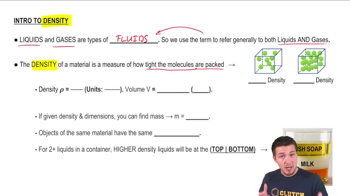
Density

Density is a measure of mass per unit volume, typically expressed in kilograms per cubic meter (kg/m³). It is calculated by dividing the mass of an object by its volume. Understanding density is crucial for determining how much mass is contained in a given volume of material, which is essential for solving problems involving mass and volume relationships.
추천 영상:
가이드 코스
8:13
Intro to Density

Volume of a Cube and Cylinder

The volume of a cube is calculated by cubing the length of one of its sides (V = a³), where 'a' is the side length. For a cylinder, the volume is found using the formula V = πr²h, where 'r' is the radius and 'h' is the height. In this problem, understanding these formulas helps determine the total volume of the cube and the volume of the cylindrical hole drilled through it.
추천 영상:
가이드 코스
05:21
Volume Thermal Expansion

Buoyancy and Weight

Weight is the force exerted by gravity on an object, calculated as the product of mass and gravitational acceleration (W = mg). In this context, the weight of the cube after drilling the hole is given, which allows for the calculation of the mass. Understanding the relationship between weight, mass, and volume is essential for determining the density of the metal alloy.
추천 영상:
가이드 코스
10:19
Torque Due to Weight