
Ch 12: Fluid Mechanics
Young & Freedman Calc - University Physics 14th Edition
Young & Freedman Calc14th EditionUniversity PhysicsISBN: 9780321973610당신이 사용하는 게 아니라요?교과서 변경
12장, 문제 33ab

A cubical block of wood, 10.0 cm on a side, floats at the interface between oil and water with its lower surface 1.50 cm below the interface (Fig. E12.33). The density of the oil is 790 kg/m3. (a) What is the gauge pressure at the upper face of the block? (b) What is the gauge pressure at the lower face of the block?

검증된 단계별 안내
1
To find the gauge pressure at the upper face of the block, we need to consider the pressure exerted by the oil above it. Gauge pressure is the pressure relative to atmospheric pressure. Since the upper face is at the oil-water interface, the gauge pressure is zero because it is exposed to the atmosphere.
For the gauge pressure at the lower face of the block, we need to calculate the pressure due to the oil column above it. The pressure at a depth in a fluid is given by the formula: \( P = \rho \cdot g \cdot h \), where \( \rho \) is the density of the fluid, \( g \) is the acceleration due to gravity, and \( h \) is the height of the fluid column. Here, \( \rho = 790 \text{ kg/m}^3 \), \( g = 9.81 \text{ m/s}^2 \), and \( h = 0.085 \text{ m} \) (since the block is 1.50 cm below the interface, and the block is 10 cm tall, the oil column is 8.5 cm).
To find the mass of the block, we use the principle of buoyancy. The block displaces a volume of oil and water equal to its own volume. The volume of the block is \( V = 0.1 \text{ m} \times 0.1 \text{ m} \times 0.1 \text{ m} = 0.001 \text{ m}^3 \). The mass of the block is equal to the mass of the displaced fluid, which is the sum of the mass of the displaced oil and water.
The density of the block can be found using the formula \( \text{Density} = \frac{\text{Mass}}{\text{Volume}} \). Once the mass is calculated from the buoyancy principle, divide it by the volume of the block to find the density.
To calculate the mass of the displaced oil, use \( \text{Mass} = \rho \cdot V \), where \( \rho \) is the density of the oil and \( V \) is the volume of the oil displaced. Similarly, calculate the mass of the displaced water using the density of water (1000 kg/m^3) and the volume of water displaced (1.5 cm of the block is submerged in water). Add these two masses to find the total mass of the block.

비슷한 문제에 대한 검증된 영상 답변:

이 영상 해법은 위 문제에 도움이 된다고 튜터들이 추천한 것입니다.
영상 길이:
6m
도움이 되었나요?

주요 개념

질문에 올바르게 답하기 위해 반드시 이해해야 하는 핵심 개념들은 다음과 같습니다.

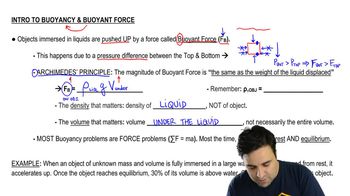
Buoyancy and Archimedes' Principle

Buoyancy is the upward force exerted by a fluid on an object submerged in it. Archimedes' Principle states that this buoyant force is equal to the weight of the fluid displaced by the object. In this problem, the wooden block displaces both oil and water, and the buoyant force must balance the block's weight for it to float at the interface.
추천 영상:
가이드 코스
11:06
Intro to Buoyancy & Buoyant Force

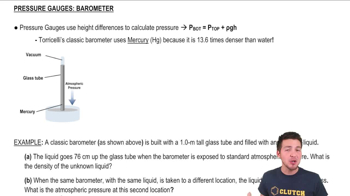
Gauge Pressure

Gauge pressure is the pressure relative to atmospheric pressure. It is calculated as the fluid pressure at a point minus atmospheric pressure. In this scenario, the gauge pressure at the upper and lower faces of the block can be determined by considering the depth of the block in the oil and water, respectively, and using the fluid density and gravitational acceleration.
추천 영상:
가이드 코스
09:27
Pressure Gauges: Barometer

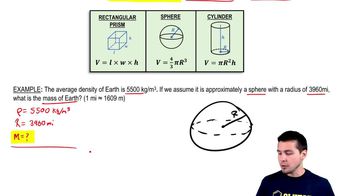
Density and Mass Calculation

Density is defined as mass per unit volume. To find the mass and density of the block, we use the volume of the block and the fact that the buoyant force equals the block's weight. By knowing the densities of oil and water and the submerged volume, we can calculate the block's mass and subsequently its density using the formula density = mass/volume.
추천 영상:
가이드 코스
04:33
Problems with Mass, Volume, & Density
관련 실천
교과서 질문

A hollow plastic sphere is held below the surface of a freshwater lake by a cord anchored to the bottom of the lake. The sphere has a volume of 0.650 m3 and the tension in the cord is 1120 N. The cord breaks and the sphere rises to the surface. When the sphere comes to rest, what fraction of its volume will be submerged?

1832
views
교과서 질문

A hollow plastic sphere is held below the surface of a freshwater lake by a cord anchored to the bottom of the lake. The sphere has a volume of 0.650 m3 and the tension in the cord is 1120 N. (a) Calculate the buoyant force exerted by the water on the sphere. (b) What is the mass of the sphere?

2198
views
교과서 질문

An ore sample weighs 17.50 N in air. When the sample is suspended by a light cord and totally immersed in water, the tension in the cord is 11.20 N. Find the total volume and the density of the sample.

3221
views
교과서 질문

A shower head has 20 circular openings, each with radius 1.0 mm. The shower head is connected to a pipe with radius 0.80 cm. If the speed of water in the pipe is 3.0 m/s, what is its speed as it exits the shower-head openings?

2984
views
1
rank
교과서 질문

Water is flowing in a pipe with a varying cross-sectional area, and at all points the water completely fills the pipe. At point 1 the cross-sectional area of the pipe is 0.070 m2, and the magnitude of the fluid velocity is 3.50 m/s. (c) Calculate the volume of water discharged from the open end of the pipe in 1.00 hour.

3467
views
교과서 질문

A cubical block of wood, 10.0 cm on a side, floats at the interface between oil and water with its lower surface 1.50 cm below the interface (Fig. E12.33). The density of the oil is 790 kg/m3. (a) What is the gauge pressure at the upper face of the block? (b) What is the gauge pressure at the lower face of the block?

2027
views