Ch 12: Fluid Mechanics
Young & Freedman Calc - University Physics 14th Edition
Young & Freedman Calc14th EditionUniversity PhysicsISBN: 9780321973610당신이 사용하는 게 아니라요?교과서 변경
12장, 문제 15a

Ear Damage from Diving. If the force on the tympanic membrane (eardrum) increases by about 1.5 N above the force from atmospheric pressure, the membrane can be damaged. When you go scuba diving in the ocean, below what depth could damage to your eardrum start to occur? The eardrum is typically 8.2 mm in diameter. (Consult Table 12.1.)

검증된 단계별 안내
1
First, calculate the area of the tympanic membrane (eardrum) using the formula for the area of a circle: \( A = \pi r^2 \). The diameter is given as 8.2 mm, so the radius \( r \) is half of that. Convert the radius from millimeters to meters for consistency in SI units.
Next, determine the pressure difference that would cause a force of 1.5 N on the eardrum. Use the formula \( F = P \times A \), where \( F \) is the force, \( P \) is the pressure difference, and \( A \) is the area. Rearrange this formula to solve for the pressure difference: \( P = \frac{F}{A} \).
The pressure difference \( P \) is due to the water pressure at a certain depth minus the atmospheric pressure. Water pressure at a depth \( h \) can be calculated using the formula \( P_{water} = \rho g h \), where \( \rho \) is the density of seawater (approximately 1025 kg/m³), \( g \) is the acceleration due to gravity (9.81 m/s²), and \( h \) is the depth in meters.
Set the pressure difference \( P \) equal to \( P_{water} - P_{atm} \), where \( P_{atm} \) is the atmospheric pressure (approximately 101,325 Pa). Solve for the depth \( h \) by rearranging the equation: \( h = \frac{P + P_{atm}}{\rho g} \).
Substitute the known values into the equation to find the depth \( h \) at which the pressure difference would be sufficient to cause a force of 1.5 N on the eardrum, potentially leading to damage.

비슷한 문제에 대한 검증된 영상 답변:

이 영상 해법은 위 문제에 도움이 된다고 튜터들이 추천한 것입니다.
영상 길이:
5m
도움이 되었나요?

주요 개념

질문에 올바르게 답하기 위해 반드시 이해해야 하는 핵심 개념들은 다음과 같습니다.

Pressure and Force Relationship

Pressure is defined as force per unit area. When diving, the pressure exerted by the water increases with depth, adding to the atmospheric pressure already present. The force on the eardrum is the product of this pressure and the area of the eardrum. Understanding this relationship is crucial to determine the depth at which the additional force could cause damage.
추천 영상:
가이드 코스
03:43
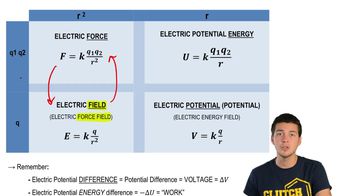
Relationships Between Force, Field, Energy, Potential

Hydrostatic Pressure

Hydrostatic pressure is the pressure exerted by a fluid at equilibrium due to the force of gravity. It increases linearly with depth, calculated as the product of the fluid's density, gravitational acceleration, and depth. This concept helps determine how much additional pressure is applied to the eardrum as a diver descends underwater.
추천 영상:
가이드 코스
17:04
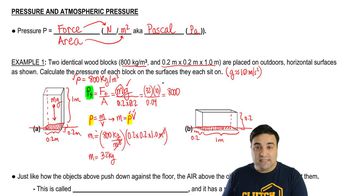
Pressure and Atmospheric Pressure

Area of a Circle

The area of a circle is calculated using the formula A = πr², where r is the radius. For the eardrum, knowing its diameter allows us to find the radius and subsequently the area. This area is essential for calculating the force exerted on the eardrum by the pressure at a given depth, which is necessary to assess the risk of damage.
추천 영상:
가이드 코스
04:05
Calculating Work As Area Under F-x Graphs
관련 실천
교과서 질문

You are designing a diving bell to withstand the pressure of seawater at a depth of 250 m. (a) What is the gauge pressure at this depth? (You can ignore changes in the density of the water with depth.)

1958
views

교과서 질문

The liquid in the open-tube manometer in Fig. 12.8a is mercury, y1=3.00 cm,and y2=7.00 cm. Atmospheric pressure is 980 millibars. What is (a) the absolute pressure at the bottom of the U-shaped tube; (b) the absolute pressure in the open tube at a depth of 4.00 cm below the free surface; (c) the absolute pressure of the gas in the container; (d) the gauge pressure of the gas in pascals?

2239
views
교과서 질문

BIO. The lower end of a long plastic straw is immersed below the surface of the water in a plastic cup. An average person sucking on the upper end of the straw can pull water into the straw to a vertical height of 1.1 m above the surface of the water in the cup. (a) What is the lowest gauge pressure that the average person can achieve inside his lungs? (b) Explain why your answer in part (a) is negative.

3037
views
교과서 질문

You are designing a diving bell to withstand the pressure of seawater at a depth of 250 m. What is the gauge pressure at this depth? (You can ignore changes in the density of the water with depth.) At this depth, what is the net force due to the water outside and the air inside the bell on a circular glass window 30.0 cm in diameter if the pressure inside the diving bell equals the pressure at the surface of the water? (Ignore the small variation of pressure over the surface of the window.)

1163
views
교과서 질문

BIO. There is a maximum depth at which a diver can breathe through a snorkel tube (Fig. E12.17) because as the depth increases, so does the pressure difference, which tends to collapse the diver's lungs. Since the snorkel connects the air in the lungs to the atmosphere at the surface, the pressure inside the lungs is atmospheric pressure. What is the external– internal pressure difference when the diver's lungs are at a depth of 6.1 m (about 20 ft)? Assume that the diver is in fresh-water. (A scuba diver breathing from compressed air tanks can operate at greater depths than can a snorkeler, since the pressure of the air inside the scuba diver's lungs increases to match the external pressure of the water.)


3511
views
교과서 질문

A barrel contains a 0.120-m layer of oil floating on water that is 0.250 m deep. The density of the oil is 600 kg/m3. (a) What is the gauge pressure at the oil–water interface? (b) What is the gauge pressure at the bottom of the barrel?

2842
views