

Ch 13: Gravitation
Young & Freedman Calc - University Physics 14th Edition
Young & Freedman Calc14th EditionUniversity PhysicsISBN: 9780321973610당신이 사용하는 게 아니라요?교과서 변경
13장, 문제 40b

In 2005 astronomers announced the discovery of a large black hole in the galaxy Markarian 766 having clumps of matter orbiting around once every 27 hours and moving at 30,000 km/s. What is the mass of this black hole, assuming circular orbits? Express your answer in kilograms and as a multiple of our sun's mass.

검증된 단계별 안내
1
To find the mass of the black hole, we can use Kepler's third law of planetary motion, which relates the orbital period and the radius of the orbit to the mass of the central object. The formula is: \( T^2 = \frac{4\pi^2}{G M} r^3 \), where \( T \) is the orbital period, \( G \) is the gravitational constant, \( M \) is the mass of the black hole, and \( r \) is the radius of the orbit.
First, convert the orbital period from hours to seconds. Since there are 3600 seconds in an hour, multiply 27 hours by 3600 to get the period in seconds.
Next, use the given orbital speed \( v = 30,000 \text{ km/s} \) to find the radius of the orbit. The relationship between speed, radius, and period for circular motion is \( v = \frac{2\pi r}{T} \). Rearrange this to solve for \( r \): \( r = \frac{vT}{2\pi} \).
Substitute the values of \( v \), \( T \), and \( G = 6.674 \times 10^{-11} \text{ m}^3\text{kg}^{-1}\text{s}^{-2} \) into the rearranged Kepler's third law formula to solve for the mass \( M \): \( M = \frac{4\pi^2 r^3}{G T^2} \).
Finally, to express the mass of the black hole as a multiple of the sun's mass, divide the calculated mass by the mass of the sun, \( M_{\odot} = 1.989 \times 10^{30} \text{ kg} \).

비슷한 문제에 대한 검증된 영상 답변:

이 영상 해법은 위 문제에 도움이 된다고 튜터들이 추천한 것입니다.
영상 길이:
4m
도움이 되었나요?

주요 개념

질문에 올바르게 답하기 위해 반드시 이해해야 하는 핵심 개념들은 다음과 같습니다.

Gravitational Force and Circular Orbits

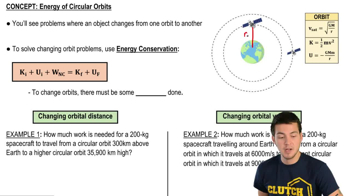
In a circular orbit, the gravitational force provides the necessary centripetal force to keep an object in orbit. The gravitational force between two masses is given by Newton's law of universal gravitation, F = G * (m1 * m2) / r^2, where G is the gravitational constant, m1 and m2 are the masses, and r is the distance between their centers. This concept is crucial for understanding how the mass of the black hole can be determined from the orbital motion of the clumps of matter.
추천 영상:
가이드 코스
9:11
Energy of Circular Orbits

Kepler's Third Law of Planetary Motion

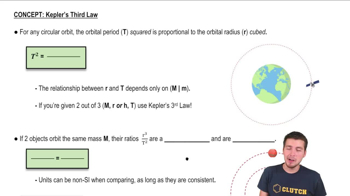
Kepler's Third Law states that the square of the orbital period (T) of a planet is directly proportional to the cube of the semi-major axis (r) of its orbit, T^2 ∝ r^3. For circular orbits, this can be used to relate the period of orbit to the mass of the central object. This law helps in calculating the mass of the black hole by using the period of the orbit and the velocity of the clumps of matter.
추천 영상:
가이드 코스
08:32
Kepler's Third Law

Mass of the Sun

The mass of the Sun is a standard unit of mass in astronomy, approximately 1.989 x 10^30 kilograms. When expressing the mass of astronomical objects, such as black holes, it is often useful to express them as multiples of the Sun's mass for easier comparison and understanding. This concept is essential for converting the calculated mass of the black hole into a more comprehensible form.
추천 영상:
가이드 코스
20:32
Mass Spectrometers