
Ch 13: Gravitation
Young & Freedman Calc - University Physics 14th Edition
Young & Freedman Calc14th EditionUniversity PhysicsISBN: 9780321973610당신이 사용하는 게 아니라요?교과서 변경
13장, 문제 5

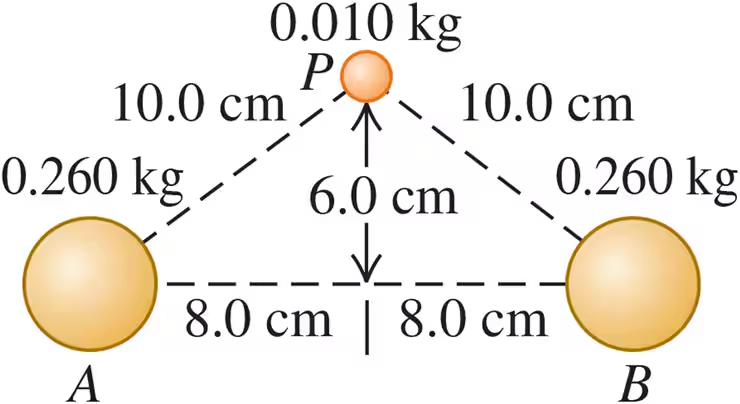
Two uniform spheres, each of mass 0.260 kg, are fixed at points A and B (Fig. E13.5). Find the magnitude and direction of the initial acceleration of a uniform sphere with mass 0.010 kg if released from rest at point P and acted on only by forces of gravitational attraction of the spheres at A and B.

검증된 단계별 안내
1
Identify the forces acting on the sphere at point P due to the gravitational attraction from the spheres at points A and B. Use Newton's law of universal gravitation: F=GmMr2, where G is the gravitational constant, m and M are the masses of the spheres, and r is the distance between the spheres.
Calculate the gravitational force exerted by the sphere at point A on the sphere at point P. Use the formula: F=GmMr2, substituting the appropriate values for the masses and distance.
Calculate the gravitational force exerted by the sphere at point B on the sphere at point P using the same formula as in step 2, substituting the appropriate values for the masses and distance.
Determine the net gravitational force acting on the sphere at point P by vectorially adding the forces calculated in steps 2 and 3. Consider the direction of each force based on the positions of points A and B relative to point P.
Use Newton's second law of motion, F=ma, to find the magnitude and direction of the initial acceleration of the sphere at point P. Solve for a by dividing the net force by the mass of the sphere at point P.

비슷한 문제에 대한 검증된 영상 답변:

이 영상 해법은 위 문제에 도움이 된다고 튜터들이 추천한 것입니다.
영상 길이:
13m
도움이 되었나요?

주요 개념

질문에 올바르게 답하기 위해 반드시 이해해야 하는 핵심 개념들은 다음과 같습니다.

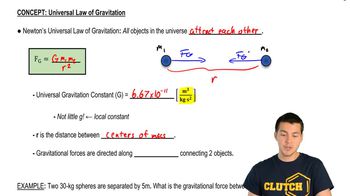
Newton's Law of Universal Gravitation

Newton's Law of Universal Gravitation states that every point mass attracts every other point mass by a force acting along the line intersecting both points. The magnitude of the force is proportional to the product of the masses and inversely proportional to the square of the distance between them. This law is essential for calculating the gravitational forces exerted by the spheres at points A and B on the sphere at point P.
추천 영상:
가이드 코스
04:05
Universal Law of Gravitation

Superposition Principle

The Superposition Principle in physics states that the net force acting on an object is the vector sum of all individual forces acting on it. In this problem, the sphere at point P experiences gravitational forces from both spheres at points A and B, and the superposition principle allows us to calculate the resultant force by summing these individual forces vectorially.
추천 영상:
가이드 코스
03:32
Superposition of Sinusoidal Wave Functions

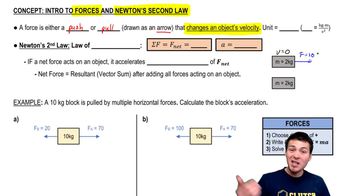
Newton's Second Law of Motion

Newton's Second Law of Motion states that the acceleration of an object is directly proportional to the net force acting on it and inversely proportional to its mass. This law is crucial for determining the initial acceleration of the sphere at point P once the net gravitational force is calculated, as it relates the force to the sphere's acceleration.
추천 영상:
가이드 코스
06:54
Intro to Forces & Newton's Second Law