Ch 14: Periodic Motion
Young & Freedman Calc - University Physics 14th Edition
Young & Freedman Calc14th EditionUniversity PhysicsISBN: 9780321973610당신이 사용하는 게 아니라요?교과서 변경
14장, 문제 20bc

A 0.500kg0.500\(\operatorname{kg}\) mass on a spring has velocity as a function of time given by vx(t)=(3.60cm/s)sin[(4.7 rad/s)t(π/2)]v_{x}(t)=-(3.60\(\operatorname{cm}\)/s)\(\sin\)[(4.7\(\text{ }\)rad/s)t-(\(\pi\)/2)]. What are the amplitude and the maximum acceleration of the mass?

검증된 단계별 안내
1
To find the period (T) of the motion, use the angular frequency (ω) from the velocity function vx(t) = -(3.60 cm/s) sin[(4.71 rad/s)t - (π/2)]. The period is given by T = 2π/ω. Substitute ω = 4.71 rad/s into the formula to find T.
The amplitude (A) of the motion can be determined from the maximum velocity given in the function vx(t). The maximum velocity occurs when the sine function equals ±1, so the amplitude of the velocity is 3.60 cm/s. Use the relationship between maximum velocity and amplitude: vmax = ωA, where ω = 4.71 rad/s. Solve for A.
To find the maximum acceleration (amax), use the relationship amax = ω²A. You have already found ω and A in previous steps. Substitute these values into the formula to find amax.
The force constant (k) of the spring can be found using Hooke's Law and the relationship between angular frequency and mass: ω = √(k/m). Rearrange this formula to solve for k: k = mω². Use m = 0.500 kg and ω = 4.71 rad/s to find k.
Review the units and ensure consistency across all calculations. Convert units where necessary, such as converting cm/s to m/s for velocity, to maintain SI units throughout the problem.

비슷한 문제에 대한 검증된 영상 답변:

이 영상 해법은 위 문제에 도움이 된다고 튜터들이 추천한 것입니다.
영상 길이:
5m
도움이 되었나요?

주요 개념

질문에 올바르게 답하기 위해 반드시 이해해야 하는 핵심 개념들은 다음과 같습니다.

Simple Harmonic Motion

Simple Harmonic Motion (SHM) describes the oscillatory motion of systems like masses on springs, where the restoring force is proportional to displacement. The velocity function given indicates SHM, characterized by sinusoidal functions for displacement, velocity, and acceleration. Understanding SHM is crucial for determining the period, amplitude, and other properties of the system.
추천 영상:
가이드 코스
07:52
Simple Harmonic Motion of Pendulums

Period of Oscillation

The period of oscillation is the time taken for one complete cycle of motion in SHM. It is inversely related to the angular frequency, ω, given in the velocity function. The period, T, can be calculated using T = 2π/ω, which helps in understanding the timing of the oscillatory motion and is essential for solving part (a) of the question.
추천 영상:
가이드 코스
06:28
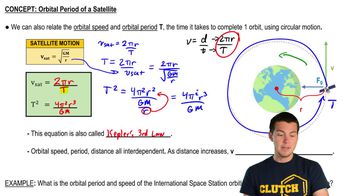
Satellite Period

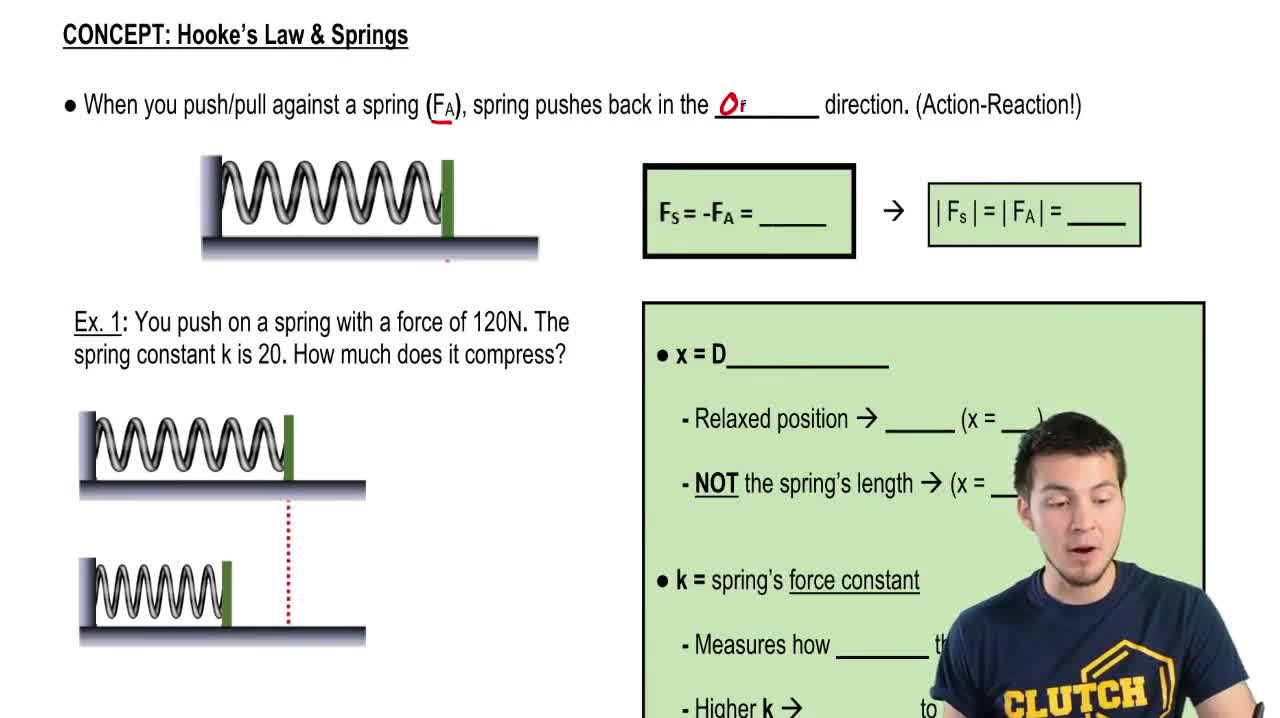
Hooke's Law and Spring Constant

Hooke's Law states that the force exerted by a spring is proportional to its displacement, F = -kx, where k is the spring constant. The spring constant is crucial for determining the force characteristics of the spring system. It can be derived from the mass and angular frequency using k = mω², which is necessary for solving part (d) of the question.
추천 영상:
가이드 코스
05:27
Spring Force (Hooke's Law)