Ch 14: Periodic Motion
Young & Freedman Calc - University Physics 14th Edition
Young & Freedman Calc14th EditionUniversity PhysicsISBN: 9780321973610당신이 사용하는 게 아니라요?교과서 변경
14장, 문제 47

A building in San Francisco has light fixtures consisting of small 2.35-kg bulbs with shades hanging from the ceiling at the end of light, thin cords 1.50 m long. If a minor earthquake occurs, how many swings per second will these fixtures make?

검증된 단계별 안내
1
Identify the problem as a simple pendulum problem, where the light fixture acts as a pendulum bob. The frequency of a simple pendulum depends on the length of the pendulum and the acceleration due to gravity.
Recall the formula for the period of a simple pendulum: T=2πlg, where l is the length of the pendulum and g is the acceleration due to gravity (approximately 9.81 m/s²).
Substitute the given length of the cord, l=1.50 m, into the period formula: T=2π1.509.81.
Calculate the period T using the formula. This will give you the time it takes for one complete swing back and forth.
Determine the frequency of the pendulum, which is the number of swings per second, by taking the reciprocal of the period: f=1T.

비슷한 문제에 대한 검증된 영상 답변:

이 영상 해법은 위 문제에 도움이 된다고 튜터들이 추천한 것입니다.
영상 길이:
2m
도움이 되었나요?

주요 개념

질문에 올바르게 답하기 위해 반드시 이해해야 하는 핵심 개념들은 다음과 같습니다.

Simple Harmonic Motion

Simple harmonic motion describes the oscillatory motion of objects like pendulums, where the restoring force is proportional to the displacement. In this context, the light fixtures act as pendulums, swinging back and forth due to gravitational forces, which can be modeled using the principles of simple harmonic motion.
추천 영상:
가이드 코스
07:52
Simple Harmonic Motion of Pendulums

Pendulum Formula

The period of a simple pendulum is determined by the formula T = 2π√(L/g), where T is the period, L is the length of the pendulum, and g is the acceleration due to gravity. This formula helps calculate the time it takes for one complete swing, which is essential for determining the frequency of oscillation during an earthquake.
추천 영상:
가이드 코스
06:53
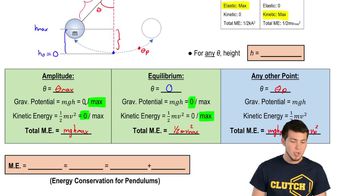
Energy in Pendulums

Frequency of Oscillation

Frequency refers to the number of complete cycles or swings per second, calculated as the inverse of the period (f = 1/T). Understanding frequency is crucial for determining how many swings per second the light fixtures will make during an earthquake, providing insight into their oscillatory behavior.
추천 영상:
가이드 코스
05:08
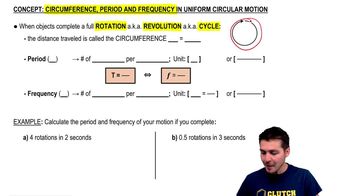
Circumference, Period, and Frequency in UCM
관련 실천
교과서 질문

A certain simple pendulum has a period on the earth of 1.60 s. What is its period on the surface of Mars, where g = 3.71 m/s2?

2144
views

교과서 질문

You pull a simple pendulum 0.240 m long to the side through an angle of 3.50° and release it. How much time does it take the pendulum bob to reach its highest speed?

1929
views
교과서 질문

You pull a simple pendulum 0.240 m long to the side through an angle of 3.50° and release it. How much time does it take if the pendulum is released at an angle of 1.75° instead of 3.50°?

1462
views
교과서 질문

A thrill-seeking cat with mass 4.00 kg is attached by a harness to an ideal spring of negligible mass and oscillates vertically in SHM. The amplitude is 0.050 m, and at the highest point of the motion the spring has its natural unstretched length. Calculate the elastic potential energy of the spring (take it to be zero for the unstretched spring), the kinetic energy of the cat, the gravitational potential energy of the system relative to the lowest point of the motion, and the sum of these three energies when the cat is at its highest point.

3635
views
교과서 질문

A simple pendulum 2.00 m long swings through a maximum angle of 30.0° with the vertical. Calculate its period (a) assuming a small amplitude, and (b) using the first three terms of Eq. (14.35). (c) Which of the answers in parts (a) and (b) is more accurate? What is the percentage error of the less accurate answer compared with the more accurate one?

1800
views
교과서 질문

A simple pendulum 2.00 m long swings through a maximum angle of 30.0° with the vertical. Calculate its period (a) assuming a small amplitude, and (b) using the first three terms of Eq. (14.35).

1657
views