

Ch 14: Periodic Motion
Young & Freedman Calc - University Physics 14th Edition
Young & Freedman Calc14th EditionUniversity PhysicsISBN: 9780321973610당신이 사용하는 게 아니라요?교과서 변경
14장, 문제 36

A mass is oscillating with amplitude A at the end of a spring. How far (in terms of A) is this mass from the equilibrium position of the spring when the elastic potential energy equals the kinetic energy?

검증된 단계별 안내
1
Start by understanding the energy conservation in a spring-mass system. The total mechanical energy in the system is the sum of kinetic energy (KE) and elastic potential energy (PE). At any point in the oscillation, this total energy remains constant.
Recall the formulas for kinetic energy and elastic potential energy in a spring system. The kinetic energy is given by \( KE = \frac{1}{2}mv^2 \), where \( m \) is the mass and \( v \) is the velocity. The elastic potential energy is given by \( PE = \frac{1}{2}kx^2 \), where \( k \) is the spring constant and \( x \) is the displacement from the equilibrium position.
Since the problem states that the elastic potential energy equals the kinetic energy, set \( \frac{1}{2}mv^2 = \frac{1}{2}kx^2 \). This equation implies that the energy is equally distributed between kinetic and potential forms at this point in the oscillation.
Simplify the equation \( mv^2 = kx^2 \) to find the relationship between \( x \) and \( A \). Recall that the maximum displacement \( A \) is the amplitude of the oscillation, and at maximum displacement, all energy is potential, \( PE = \frac{1}{2}kA^2 \).
Solve for \( x \) in terms of \( A \) by recognizing that when \( PE = KE \), the displacement \( x \) is such that \( x^2 = \frac{A^2}{2} \). Therefore, \( x = \frac{A}{\sqrt{2}} \). This is the distance from the equilibrium position where the energies are equal.

비슷한 문제에 대한 검증된 영상 답변:

이 영상 해법은 위 문제에 도움이 된다고 튜터들이 추천한 것입니다.
영상 길이:
4m
도움이 되었나요?

주요 개념

질문에 올바르게 답하기 위해 반드시 이해해야 하는 핵심 개념들은 다음과 같습니다.

Simple Harmonic Motion

Simple harmonic motion describes the oscillatory motion of a mass attached to a spring, where the restoring force is proportional to the displacement from the equilibrium position. The motion is sinusoidal, characterized by amplitude, frequency, and phase, and is governed by Hooke's Law.
추천 영상:
가이드 코스
07:52
Simple Harmonic Motion of Pendulums

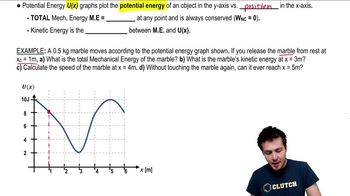
Elastic Potential Energy

Elastic potential energy in a spring system is the energy stored due to its deformation, calculated as (1/2)kx^2, where k is the spring constant and x is the displacement from equilibrium. This energy is maximum at the amplitude and zero at the equilibrium position.
추천 영상:
가이드 코스
07:24
Potential Energy Graphs

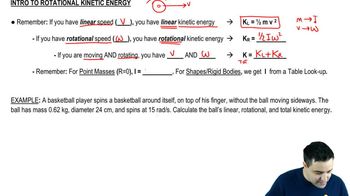
Kinetic Energy in Oscillations

Kinetic energy in oscillatory motion is the energy due to the mass's velocity, given by (1/2)mv^2. In a spring-mass system, kinetic energy is maximum at the equilibrium position and zero at the amplitude, varying inversely with elastic potential energy during oscillation.
추천 영상:
가이드 코스
06:07
Intro to Rotational Kinetic Energy
관련 실천
교과서 질문

A cheerleader waves her pom-pom in SHM with an amplitude of 18.0 cm and a frequency of 0.850 Hz. Find (a) the maximum magnitude of the acceleration and of the velocity; (b) the acceleration and speed when the pom-pom's coordinate is x = +9.0 cm; (c) the time required to move from the equilibrium position directly to a point 12.0 cm away. (d) Which of the quantities asked for in parts (a), (b), and (c) can be found by using the energy approach used in Section 14.3, and which cannot? Explain.

1907
views
교과서 질문

You pull a simple pendulum 0.240 m long to the side through an angle of 3.50° and release it. How much time does it take the pendulum bob to reach its highest speed?

1929
views
교과서 질문

You pull a simple pendulum 0.240 m long to the side through an angle of 3.50° and release it. How much time does it take if the pendulum is released at an angle of 1.75° instead of 3.50°?

1462
views
교과서 질문

A 0.500-kg glider, attached to the end of an ideal spring with force constant k = 450 N/m, undergoes SHM with an amplitude of 0.040 m. Compute the speed of the glider when it is at x = -0.015 m.

2429
views
교과서 질문

A 0.500-kg glider, attached to the end of an ideal spring with force constant k = 450 N/m, undergoes SHM with an amplitude of 0.040 m. Compute the total mechanical energy of the glider at any point in its motion

2474
views
교과서 질문

A thrill-seeking cat with mass 4.00 kg is attached by a harness to an ideal spring of negligible mass and oscillates vertically in SHM. The amplitude is 0.050 m, and at the highest point of the motion the spring has its natural unstretched length. Calculate the elastic potential energy of the spring (take it to be zero for the unstretched spring), the kinetic energy of the cat, the gravitational potential energy of the system relative to the lowest point of the motion, and the sum of these three energies when the cat is at its highest point.

3635
views