
Ch 15: Mechanical Waves
Young & Freedman Calc - University Physics 14th Edition
Young & Freedman Calc14th EditionUniversity PhysicsISBN: 9780321973610당신이 사용하는 게 아니라요?교과서 변경
15장, 문제 28de

A fellow student with a mathematical bent tells you that the wave function of a traveling wave on a thin rope is y(x,t)=(2.30mm)cos[(16.98 rad/m)x+(742 rad/s)t]y(x,t)=\(\left\)(2.30\(\operatorname{mm)}\]\cos\)[\(\left\)(16.98\(\text{ }\)rad/m\(\right\))x+(742\(\text{ }\)rad/s\(\right\))t]. Being more practical, you measure the rope to have a length of 1.35 m1.35\(\text{ m}\) and a mass of 0.00338kg0.00338\(\operatorname{kg}\). You are then asked to determine the following: (d) wave speed; (e) direction the wave is traveling;

검증된 단계별 안내
1
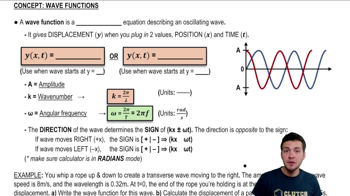
To find the wave speed, we need to use the formula for wave speed \( v \), which is given by \( v = \frac{\omega}{k} \), where \( \omega \) is the angular frequency and \( k \) is the wave number. From the wave function \( y(x, t) = 2.30 \text{ mm} \cos[(16.98 \text{ rad/m})x + (742 \text{ rad/s})t] \), we identify \( \omega = 742 \text{ rad/s} \) and \( k = 16.98 \text{ rad/m} \).
Substitute the values of \( \omega \) and \( k \) into the wave speed formula: \( v = \frac{742 \text{ rad/s}}{16.98 \text{ rad/m}} \). This will give you the wave speed in meters per second.
To determine the direction the wave is traveling, examine the sign of the terms in the wave function. The wave function is \( y(x, t) = 2.30 \text{ mm} \cos[(16.98 \text{ rad/m})x + (742 \text{ rad/s})t] \). The positive sign in front of \( t \) indicates that the wave is traveling in the negative x-direction.
The wave speed can also be verified using the physical properties of the rope. The speed of a wave on a string is given by \( v = \sqrt{\frac{T}{\mu}} \), where \( T \) is the tension in the rope and \( \mu \) is the linear mass density. Calculate \( \mu \) using \( \mu = \frac{\text{mass}}{\text{length}} = \frac{0.00338 \text{ kg}}{1.35 \text{ m}} \).
If the tension \( T \) is known or can be measured, substitute \( \mu \) and \( T \) into the formula \( v = \sqrt{\frac{T}{\mu}} \) to verify the wave speed calculated from the wave function.

비슷한 문제에 대한 검증된 영상 답변:

이 영상 해법은 위 문제에 도움이 된다고 튜터들이 추천한 것입니다.
영상 길이:
6m
도움이 되었나요?

주요 개념

질문에 올바르게 답하기 위해 반드시 이해해야 하는 핵심 개념들은 다음과 같습니다.

Wave Function

The wave function y(x, t) = 2.30mm cos[(16.98 rad/m)x + (742 rad/s)t] describes the displacement of the wave at any position x and time t. It is a mathematical representation of the wave's oscillation, where the cosine function indicates a harmonic wave, and the coefficients provide information about amplitude, wave number, and angular frequency.
추천 영상:
가이드 코스
08:30
Intro to Wave Functions

Wave Speed

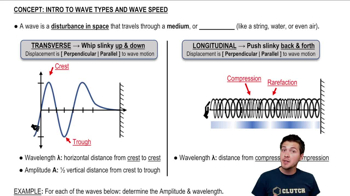
Wave speed is the rate at which a wave propagates through a medium. It can be calculated using the formula v = ω/k, where ω is the angular frequency (742 rad/s) and k is the wave number (16.98 rad/m). This relationship shows how the frequency and wavelength of the wave determine its speed, which is crucial for understanding wave dynamics.
추천 영상:
가이드 코스
07:19
Intro to Waves and Wave Speed

Direction of Wave Travel

The direction of wave travel is determined by the sign of the terms in the wave function. In y(x, t) = 2.30mm cos[(16.98 rad/m)x + (742 rad/s)t], the positive sign between the wave number and angular frequency indicates the wave is traveling in the negative x-direction. This concept helps in visualizing the movement of the wave along the rope.
추천 영상:
가이드 코스
07:19
Intro to Waves and Wave Speed
관련 실천
교과서 질문

A fellow student with a mathematical bent tells you that the wave function of a traveling wave on a thin rope is y(x,t)=(2.30mm)cos[(16.98 rad/m)x+(742 rad/s)t]y(x,t)=\(\left\)(2.30\(\operatorname{mm)}\]\cos\)[\(\left\)(16.98\(\text{ }\)rad/m\(\right\))x+(742\(\text{ }\)rad/s\(\right\))t]. Being more practical, you measure the rope to have a length of 1.35 m1.35\(\text{ m}\) and a mass of 0.00338kg0.00338\(\operatorname{kg}\). You are then asked to determine the following: (f) tension in the rope; (g) average power transmitted by the wave.

1591
views
교과서 질문

Two pulses are moving in opposite directions at 1.0 cm/s on a taut string, as shown in Fig. E15.34. Each square is 1.0 cm.

<Image>

Sketch the shape of the string at the end of 6.0 s.

2169
views
교과서 질문

At a distance of 7.00 x 10¹² m from a star, the intensity of the radiation from the star is 15.4 W/m2. Assuming that the star radiates uniformly in all directions, what is the total power output of the star?

2085
views
교과서 질문

A fellow student with a mathematical bent tells you that the wave function of a traveling wave on a thin rope is y(x,t)=(2.30mm)cos[(16.98 rad/m)x+(742 rad/s)t]y(x,t)=\(\left\)(2.30\(\operatorname{mm)}\]\cos\)[\(\left\)(16.98\(\text{ }\)rad/m\(\right\))x+(742\(\text{ }\)rad/s\(\right\))t]. Being more practical, you measure the rope to have a length of 1.35 m1.35\(\text{ m}\) and a mass of 0.00338kg0.00338\(\operatorname{kg}\). You are then asked to determine the following: (a) amplitude; (b) frequency; (c) wavelength.

1975
views
교과서 질문

Energy Output. By measurement you determine that sound waves are spreading out equally in all directions from a point source and that the intensity is 0.026 W/m2 at a distance of 4.3 m from the source. What is the intensity at a distance of 3.1 m from the source?

1533
views
교과서 질문

Energy Output. By measurement you determine that sound waves are spreading out equally in all directions from a point source and that the intensity is 0.026 W/m2 at a distance of 4.3 m from the source. How much sound energy does the source emit in one hour if its power output remains constant?

1615
views
1
rank