
A horizontal string tied at both ends is vibrating in its fundamental mode. The traveling waves have speed , frequency , amplitude , and wavelength . Calculate the maximum transverse velocity and maximum transverse acceleration of points located at (i) , (ii) , and (iii) , from the left-hand end of the string.
Ch 15: Mechanical Waves
15장, 문제 46c
A horizontal string tied at both ends is vibrating in its fundamental mode. The traveling waves have speed , frequency , amplitude , and wavelength . How much time does it take the string to go from its largest upward displacement to its largest downward displacement at the points located at (i) , (ii) , and (iii) , from the left-hand end of the string.
검증된 단계별 안내1
Understand that the string is vibrating in its fundamental mode, which means it forms a standing wave with nodes and antinodes. The fundamental frequency corresponds to the simplest pattern of vibration.
Recognize that the time taken for the string to move from its largest upward displacement to its largest downward displacement is half the period of the wave. The period T is the reciprocal of the frequency, given by T = 1/f.
Calculate the period of the wave using the formula T = 1/f. This period represents the time for one complete cycle of the wave.
For each point (x = λ/2, x = λ/4, x = λ/8), determine the position relative to the nodes and antinodes. At x = λ/2, the point is at an antinode, while at x = λ/4 and x = λ/8, the points are between nodes and antinodes.
Since the time to go from the largest upward displacement to the largest downward displacement is half the period, calculate this time as T/2 for each point. This time is the same for all points because the wave's frequency and period are uniform across the string.

비슷한 문제에 대한 검증된 영상 답변:
이 영상 해법은 위 문제에 도움이 된다고 튜터들이 추천한 것입니다.
영상 길이:
7m도움이 되었나요?
주요 개념
질문에 올바르게 답하기 위해 반드시 이해해야 하는 핵심 개념들은 다음과 같습니다.
Wave Motion
Wave motion refers to the transfer of energy through a medium via oscillations or vibrations. In the context of a vibrating string, waves travel along the string, characterized by parameters such as speed, frequency, amplitude, and wavelength. Understanding wave motion is crucial for analyzing how the string moves between its maximum displacements.
추천 영상:
가이드 코스
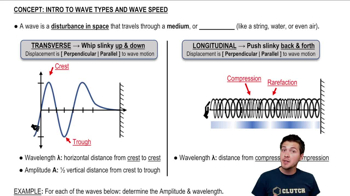
Intro to Waves and Wave Speed
Fundamental Mode of Vibration
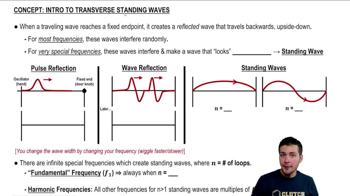
The fundamental mode of vibration is the simplest form of oscillation for a system, where the entire string vibrates in a single segment between its fixed ends. This mode has the lowest frequency and longest wavelength, and it is essential for determining the behavior of the string at specific points, such as x = λ/2, λ/4, and λ/8.
추천 영상:
가이드 코스
Intro to Transverse Standing Waves
Wave Period and Frequency
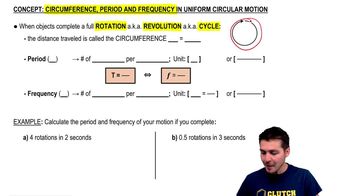
The period of a wave is the time it takes for one complete cycle of vibration, while frequency is the number of cycles per second. These concepts are inversely related and are crucial for calculating the time taken for the string to move from its largest upward to downward displacement, as the period determines the timing of oscillations at different points along the string.
추천 영상:
가이드 코스
Circumference, Period, and Frequency in UCM
관련 실천
교과서 질문
1333
views
교과서 질문
One string of a certain musical instrument is 75.0 cm long and has a mass of 8.75 g. It is being played in a room where the speed of sound is 344 m/s. (a) To what tension must you adjust the string so that, when vibrating in its second overtone, it produces sound of wavelength 0.765 m? (Assume that the break-ing stress of the wire is very large and isn't exceeded.) (b) What frequency sound does this string produce in its fundamental mode of vibration?
2676
views
교과서 질문
A horizontal string tied at both ends is vibrating in its fundamental mode. The traveling waves have speed , frequency , amplitude , and wavelength . What is the amplitude of the motion at the points located at (i) , (ii) , and (iii) , from the left-hand end of the string?
1751
views
