Ch 15: Mechanical Waves
Young & Freedman Calc - University Physics 14th Edition
Young & Freedman Calc14th EditionUniversity PhysicsISBN: 9780321973610당신이 사용하는 게 아니라요?교과서 변경
15장, 문제 42a

The wave function of a standing wave is y(x,t)=4.44 mmsin[(32.5 rad/m)x]sin[(754rad/s)t]y(x,t)=4.44\(\text{ mm}\]\sin\)[(32.5\(\text{ rad/m}\))x]\(\sin\)[(754\(\text{rad/s}\))t]. For the two traveling waves that make up this standing wave, find the amplitude.

검증된 단계별 안내
1
Understand that a standing wave is formed by the superposition of two traveling waves moving in opposite directions. The given wave function is y(x, t) = 4.44 mm sin[(32.5 rad/m)x] sin[(754 rad/s)t].
Recognize that the amplitude of the standing wave is the product of the amplitudes of the two traveling waves. In this case, the amplitude of the standing wave is given as 4.44 mm.
Recall that for a standing wave, the amplitude of each traveling wave is half the amplitude of the standing wave. This is because the standing wave is formed by the constructive interference of the two traveling waves.
Calculate the amplitude of each traveling wave by dividing the amplitude of the standing wave by 2. Use the formula: \( A_{traveling} = \frac{A_{standing}}{2} \).
Substitute the given amplitude of the standing wave into the formula: \( A_{traveling} = \frac{4.44 \text{ mm}}{2} \). This will give you the amplitude of each traveling wave.

비슷한 문제에 대한 검증된 영상 답변:

이 영상 해법은 위 문제에 도움이 된다고 튜터들이 추천한 것입니다.
영상 길이:
1m
도움이 되었나요?

주요 개념

질문에 올바르게 답하기 위해 반드시 이해해야 하는 핵심 개념들은 다음과 같습니다.

Standing Waves

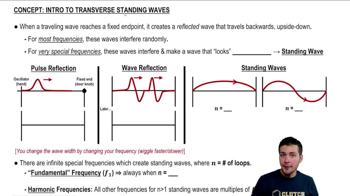
Standing waves are formed by the superposition of two traveling waves moving in opposite directions with the same frequency and amplitude. They are characterized by nodes, where the wave amplitude is always zero, and antinodes, where the amplitude is maximum. The given wave function represents a standing wave, which is a result of the interference of two identical traveling waves.
추천 영상:
가이드 코스
07:58
Intro to Transverse Standing Waves

Wave Function

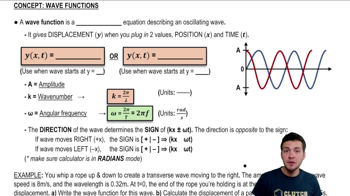
A wave function describes the displacement of a wave at any point in space and time. For a standing wave, the wave function is typically expressed as the product of two sine functions, one depending on position (x) and the other on time (t). In the given function, y(x, t) = 4.44 mm sin[(32.5 rad/m)x] sin[(754 rad/s)t], the amplitude of the standing wave is 4.44 mm.
추천 영상:
가이드 코스
08:30
Intro to Wave Functions

Amplitude of Traveling Waves

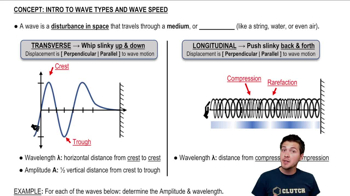
The amplitude of a traveling wave is the maximum displacement of points on the wave from their equilibrium position. For a standing wave formed by two identical traveling waves, the amplitude of each traveling wave is half the amplitude of the standing wave. Therefore, if the standing wave has an amplitude of 4.44 mm, each traveling wave has an amplitude of 2.22 mm.
추천 영상:
가이드 코스
07:19
Intro to Waves and Wave Speed
관련 실천
교과서 질문

The wave function of a standing wave is y(x,t)=4.44 mmsin[(32.5 rad/m)x]sin[(754rad/s)t]y(x,t)=4.44\(\text{ mm}\]\sin\)[(32.5\(\text{ rad/m}\))x]\(\sin\)[(754\(\text{rad/s}\))t]. For the two traveling waves that make up this standing wave, find the frequency.

1495
views

교과서 질문

A wire with mass 40.0 g is stretched so that its ends are tied down at points 80.0 cm apart. The wire vibrates in its fundamental mode with frequency 60.0 Hz and with an amplitude at the antinodes of 0.300 cm. What is the speed of propagation of transverse waves in the wire?

1726
views
교과서 질문

CALC. A thin, taut string tied at both ends and oscillating in its third harmonic has its shape described by the equation y(x,t)=(5.60 cm)sin[(0.0340 rad/cm)x]sin[(50.0 rad/s)t]y(x,t)=(5.60\(\text{ cm}\))\(\sin\)[(0.0340\(\text{ rad/cm}\))x]\(\sin\)[(50.0\(\text{ rad/s}\))t], where the origin is at the left end of the string, the xx-axis is along the string, and the yy-axis is perpendicular to the string. Draw a sketch that shows the standing-wave pattern.

1669
views
교과서 질문

The wave function of a standing wave is y(x,t)=4.44 mmsin[(32.5 rad/m)x]sin[(754rad/s)t]y(x,t)=4.44\(\text{ mm}\]\sin\)[(32.5\(\text{ rad/m}\))x]\(\sin\)[(754\(\text{rad/s}\))t]. For the two traveling waves that make up this standing wave, find the wavelength.

2060
views
교과서 질문

A piano tuner stretches a steel piano wire with a tension of 800 N. The steel wire is 0.400 m long and has a mass of 3.00 g. What is the frequency of its fundamental mode of vibration?

1898
views
교과서 질문

The wave function of a standing wave is y(x,t)=4.44 mmsin[(32.5 rad/m)x]sin[(754rad/s)t]y(x,t)=4.44\(\text{ mm}\]\sin\)[(32.5\(\text{ rad/m}\))x]\(\sin\)[(754\(\text{rad/s}\))t]. For the two traveling waves that make up this standing wave, find the wave speed.

1497
views