Ch 16: Sound & Hearing
Young & Freedman Calc - University Physics 14th Edition
Young & Freedman Calc14th EditionUniversity PhysicsISBN: 9780321973610당신이 사용하는 게 아니라요?교과서 변경
16장, 문제 25b

Standing sound waves are produced in a pipe that is 1.20 m long. For the fundamental and first two overtones, determine the locations along the pipe (measured from the left end) of the displacement nodes and the pressure nodes if the pipe is closed at the left end and open at the right end.

검증된 단계별 안내
1
Understand the concept of standing waves in a pipe closed at one end: In such a pipe, the closed end is a displacement node (where the air doesn't move) and a pressure antinode (where the pressure variation is maximum), while the open end is a displacement antinode and a pressure node.
Identify the pattern of nodes and antinodes for the fundamental frequency: For the fundamental frequency (first harmonic), the pipe length is one-quarter of the wavelength (λ/4). Therefore, the displacement node is at the closed end, and the displacement antinode is at the open end.
Calculate the wavelength for the fundamental frequency: Use the relationship between the speed of sound (v), frequency (f), and wavelength (λ): v = f * λ. For the fundamental frequency, the pipe length L = λ/4, so λ = 4L.
Determine the locations of nodes and antinodes for the first overtone: The first overtone (second harmonic) has a pattern where the pipe length is three-quarters of the wavelength (3λ/4). This means there will be one additional displacement node and antinode within the pipe.
Determine the locations of nodes and antinodes for the second overtone: The second overtone (third harmonic) has a pattern where the pipe length is five-quarters of the wavelength (5λ/4). This results in two additional displacement nodes and antinodes within the pipe.

비슷한 문제에 대한 검증된 영상 답변:

이 영상 해법은 위 문제에 도움이 된다고 튜터들이 추천한 것입니다.
영상 길이:
9m
도움이 되었나요?

주요 개념

질문에 올바르게 답하기 위해 반드시 이해해야 하는 핵심 개념들은 다음과 같습니다.

Standing Waves

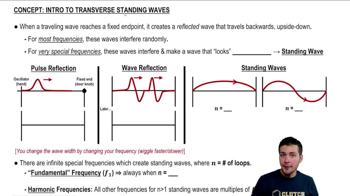
Standing waves are formed by the interference of two waves traveling in opposite directions, resulting in a wave that appears to be stationary. In a pipe, these waves create nodes (points of no displacement) and antinodes (points of maximum displacement), crucial for understanding sound wave patterns in closed and open pipes.
추천 영상:
가이드 코스
07:58
Intro to Transverse Standing Waves

Boundary Conditions in Pipes

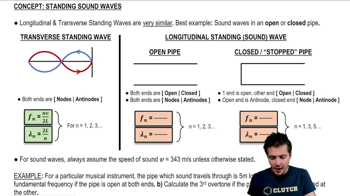
Boundary conditions refer to the constraints at the ends of a pipe that affect wave behavior. In a pipe closed at one end and open at the other, the closed end is a displacement node (pressure antinode), while the open end is a displacement antinode (pressure node). These conditions determine the wave patterns and node locations.
추천 영상:
가이드 코스
05:17
Standing Sound Waves

Harmonics and Overtones

Harmonics are integral multiples of the fundamental frequency, and overtones are the frequencies above the fundamental. In a closed-open pipe, the fundamental frequency has one-quarter wavelength, while overtones have additional quarter wavelengths. Understanding harmonics helps locate nodes and antinodes for different frequencies.
추천 영상:
가이드 코스
07:52
Simple Harmonic Motion of Pendulums