
Ch 16: Sound & Hearing
Young & Freedman Calc - University Physics 14th Edition
Young & Freedman Calc14th EditionUniversity PhysicsISBN: 9780321973610당신이 사용하는 게 아니라요?교과서 변경
16장, 문제 35a

Two loudspeakers, A and B (Fig. E16.35), are driven by the same amplifier and emit sinusoidal waves in phase. Speaker B is 2.00 m to the right of speaker A. Consider point Q along the extension of the line connecting the speakers, 1.00 m to the right of speaker B. Both speakers emit sound waves that travel directly from the speaker to point Q. What is the lowest frequency for which constructive interference occurs at point Q?
Illustration of two speakers A and B connected to an amplifier, showing distances to point Q.

검증된 단계별 안내
1
Identify the path difference between the sound waves from speakers A and B to point Q. The distance from A to Q is 3.00 m (2.00 m + 1.00 m), and the distance from B to Q is 1.00 m.
Calculate the path difference: ΔL = L_AQ - L_BQ = 3.00 m - 1.00 m = 2.00 m.
For constructive interference, the path difference must be an integer multiple of the wavelength: ΔL = mλ, where m is an integer (m = 0, 1, 2, ...).
To find the lowest frequency, use the speed of sound in air, v = 343 m/s, and the relationship between speed, frequency, and wavelength: v = fλ. Rearrange to find the wavelength: λ = v/f.
Substitute the expression for wavelength into the constructive interference condition: 2.00 m = m(343 m/s)/f. Solve for the frequency f for the smallest integer m that satisfies the equation.

비슷한 문제에 대한 검증된 영상 답변:

이 영상 해법은 위 문제에 도움이 된다고 튜터들이 추천한 것입니다.
영상 길이:
7m
도움이 되었나요?

주요 개념

질문에 올바르게 답하기 위해 반드시 이해해야 하는 핵심 개념들은 다음과 같습니다.

Constructive Interference

Constructive interference occurs when two or more waves meet in phase, resulting in a wave of greater amplitude. For sound waves, this happens when the path difference between the waves arriving at a point is an integer multiple of the wavelength. In this scenario, the condition for constructive interference at point Q must be determined based on the distances from speakers A and B.
추천 영상:
가이드 코스
03:47
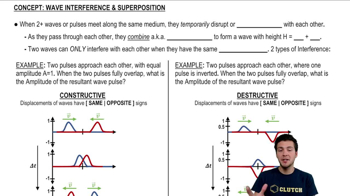
Wave Interference & Superposition

Path Difference

The path difference is the difference in distance traveled by two waves from their sources to a common point. In this case, the path difference between the sound waves from speakers A and B to point Q is crucial for determining whether constructive or destructive interference occurs. For constructive interference, this path difference must equal nλ, where n is an integer and λ is the wavelength of the sound.
추천 영상:

Frequency and Wavelength Relationship

The frequency of a wave is inversely related to its wavelength, described by the equation v = fλ, where v is the speed of sound, f is the frequency, and λ is the wavelength. To find the lowest frequency for constructive interference at point Q, one must first calculate the wavelength corresponding to the path difference that satisfies the constructive interference condition, and then use this relationship to determine the frequency.
추천 영상:
가이드 코스
05:08
Circumference, Period, and Frequency in UCM
관련 실천
교과서 질문

Small speakers A and B are driven in phase at 725 Hz by the same audio oscillator. Both speakers start out 4.50 m from the listener, but speaker A is slowly moved away (Fig. E16.34)<IMAGE>. If A is moved even farther away than in part (a), at what distance d will the speakers next produce destructive interference at the listener’s location?

253
views
교과서 질문

Small speakers A and B are driven in phase at 725 Hz by the same audio oscillator. Both speakers start out 4.50 m from the listener, but speaker A is slowly moved away (Fig. E16.34). At what distance d will the sound from the speakers first produce destructive interference at the listener's location?

<Image>

2528
views
교과서 질문

Two small stereo speakers are driven in step by the same variable-frequency oscillator. Their sound is picked up by a microphone arranged as shown in Fig. E16.39. For what frequencies does their sound at the speakers produce constructive interference?

2444
views
교과서 질문

Two guitarists attempt to play the same note of wavelength 64.8 cm at the same time, but one of the instruments is slightly out of tune and plays a note of wavelength 65.2 cm instead. What is the frequency of the beats these musicians hear when they play together?

2180
views
교과서 질문

Two loudspeakers, A and B (Fig. E16.35), are driven by the same amplifier and emit sinusoidal waves in phase. Speaker B is 2.00 m to the right of speaker A. Consider point Q along the extension of the line connecting the speakers, 1.00 m to the right of speaker B. Both speakers emit sound waves that travel directly from the speaker to point Q. What is the lowest frequency for which destructive interference occurs at point Q?

2105
views
교과서 질문

The fundamental frequency of a pipe that is open at both ends is 524 Hz. the frequency of the new fundamental.

1506
views