Ch 16: Sound & Hearing
Young & Freedman Calc - University Physics 14th Edition
Young & Freedman Calc14th EditionUniversity PhysicsISBN: 9780321973610당신이 사용하는 게 아니라요?교과서 변경
16장, 문제 12

What must be the stress (F/A) in a stretched wire of a material whose Young's modulus is Y for the speed of longitudinal waves to equal 30 times the speed of transverse waves?

검증된 단계별 안내
1
Understand the relationship between the speed of longitudinal waves (v_l) and transverse waves (v_t) in a material. The problem states that v_l = 30 * v_t.
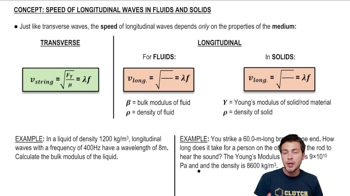
Recall the formula for the speed of longitudinal waves in a material: v_l = sqrt(Y / ρ), where Y is Young's modulus and ρ is the density of the material.
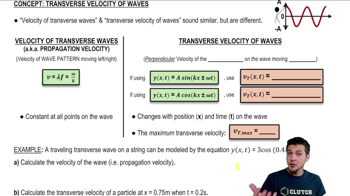
Recall the formula for the speed of transverse waves in a stretched wire: v_t = sqrt(T / μ), where T is the tension in the wire and μ is the linear mass density (mass per unit length) of the wire.
Since v_l = 30 * v_t, substitute the expressions for v_l and v_t into this equation: sqrt(Y / ρ) = 30 * sqrt(T / μ).
Square both sides of the equation to eliminate the square roots, and solve for the tension T in terms of Young's modulus Y, density ρ, and linear mass density μ. Then, use the relationship between tension and stress (T = F/A) to find the stress in the wire.

비슷한 문제에 대한 검증된 영상 답변:

이 영상 해법은 위 문제에 도움이 된다고 튜터들이 추천한 것입니다.
영상 길이:
4m
도움이 되었나요?

주요 개념

질문에 올바르게 답하기 위해 반드시 이해해야 하는 핵심 개념들은 다음과 같습니다.

Young's Modulus

Young's modulus (Y) is a measure of the stiffness of a material, defined as the ratio of stress (force per unit area) to strain (deformation per unit length). It quantifies how much a material will deform under a given load, and is crucial for understanding the relationship between stress and wave speed in a material.
추천 영상:
가이드 코스
12:00
Young's Double Slit Experiment

Longitudinal Waves

Longitudinal waves are waves in which the particle displacement is parallel to the direction of wave propagation. In solids, these waves travel through the material by compressing and expanding it, and their speed is influenced by the material's density and elastic properties, such as Young's modulus.
추천 영상:
가이드 코스
05:40
Speed of Longitudinal Waves (Fluids & Solids)

Transverse Waves

Transverse waves are waves where the particle displacement is perpendicular to the direction of wave propagation. In solids, these waves move through the material by shearing it, and their speed is determined by the material's shear modulus and density. Understanding the speed difference between longitudinal and transverse waves is key to solving the problem.
추천 영상:
가이드 코스
07:32
Transverse Velocity of Waves
관련 실천
교과서 질문

You are trying to overhear a juicy conversation, but from your distance of 15.0 m, it sounds like only an average whisper of 20.0 dB. How close should you move to the chatterboxes for the sound level to be 60.0 dB?

2215
views
1
rank

교과서 질문

Sound is detected when a sound wave causes the tympanic membrane (the eardrum) to vibrate. Typically, the diameter of this membrane is about 8.4 mm in humans. How much energy is delivered to the eardrum each second when someone whispers (20 dB) a secret in your ear?

2578
views
교과서 질문

(a) By what factor must the sound intensity be increased to raise the sound intensity level by 13.0 dB? (b) Explain why you don't need to know the original sound intensity

1996
views
교과서 질문

An oscillator vibrating at 1250 Hz produces a sound wave that travels through an ideal gas at 325 m/s when the gas temperature is 22.0°C. For a certain experiment, you need to have the same oscillator produce sound of wavelength 28.5 cm in this gas. What should the gas temperature be to achieve this wavelength?

1480
views
교과서 질문

A loud factory machine produces sound having a displacement amplitude of 1.00 mm, but the frequency of this sound can be adjusted. In order to prevent ear damage to the workers, the maximum pressure amplitude of the sound waves is limited to 10.0 Pa. Under the conditions of this factory, the bulk modulus of air is 1.42 × 10⁵ Pa. What is the highest-frequency sound to which this machine can be adjusted without exceeding the prescribed limit? Is this frequency audible to the workers?

1985
views
1
rank
교과서 질문

A metal bar with a length of 1.50 m has density 6400 kg/m3. Longitudinal sound waves take 3.90 × 10⁻⁴ s to travel from one end of the bar to the other. What is Young's modulus for this metal?

1545
views