
Ch 17: Temperature and Heat
Young & Freedman Calc - University Physics 14th Edition
Young & Freedman Calc14th EditionUniversity PhysicsISBN: 9780321973610당신이 사용하는 게 아니라요?교과서 변경
17장, 문제 36

One suggested treatment for a person who has suffered a stroke is immersion in an ice-water bath at 0°C to lower the body temperature, which prevents damage to the brain. In one set of tests, patients were cooled until their internal temperature reached 32.0°C. To treat a 70.0 kg patient, what is the minimum amount of ice (at 0°C) you need in the bath so that its temperature remains at 0°C? The specific heat of the human body is 3480 J/kg C°, and recall that normal body temperature is 37.0°C.

검증된 단계별 안내
1
Determine the amount of heat that needs to be removed from the patient's body to lower the temperature from 37.0°C to 32.0°C. Use the formula for heat transfer: \( Q = mc\Delta T \), where \( m \) is the mass of the patient, \( c \) is the specific heat capacity, and \( \Delta T \) is the change in temperature.
Calculate the change in temperature \( \Delta T \) as \( 37.0°C - 32.0°C = 5.0°C \).
Substitute the known values into the heat transfer formula: \( Q = (70.0 \text{ kg})(3480 \text{ J/kg°C})(5.0°C) \). This will give you the total heat \( Q \) that needs to be removed from the patient's body.
To find the minimum amount of ice required, use the formula for the heat absorbed by the ice: \( Q = mL_f \), where \( m \) is the mass of the ice and \( L_f \) is the latent heat of fusion for ice, which is 334,000 J/kg.
Set the heat removed from the body equal to the heat absorbed by the ice: \( (70.0 \text{ kg})(3480 \text{ J/kg°C})(5.0°C) = m(334,000 \text{ J/kg}) \). Solve for \( m \) to find the minimum mass of ice needed.

비슷한 문제에 대한 검증된 영상 답변:

이 영상 해법은 위 문제에 도움이 된다고 튜터들이 추천한 것입니다.
영상 길이:
2m
도움이 되었나요?

주요 개념

질문에 올바르게 답하기 위해 반드시 이해해야 하는 핵심 개념들은 다음과 같습니다.

Specific Heat Capacity

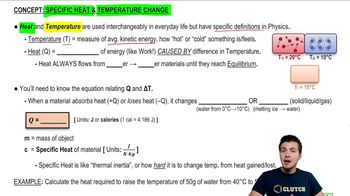
Specific heat capacity is the amount of heat required to change the temperature of a unit mass of a substance by one degree Celsius. It is crucial in this problem to calculate the heat loss needed to lower the patient's body temperature from 37.0°C to 32.0°C. The specific heat capacity of the human body is given as 3480 J/kg°C, which will be used to determine the total heat energy that must be removed.
추천 영상:
가이드 코스
06:50
Specific Heat & Temperature Changes

Heat Transfer

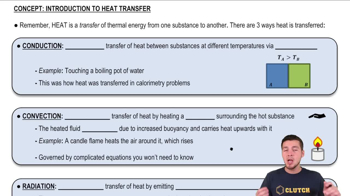
Heat transfer is the process of thermal energy moving from a hotter object to a cooler one. In this scenario, heat will transfer from the patient's body to the ice-water bath. Understanding this concept is essential to calculate how much ice is needed to absorb the heat lost by the patient, ensuring the bath remains at 0°C.
추천 영상:
가이드 코스
05:14
Overview of Heat Transfer

Latent Heat of Fusion

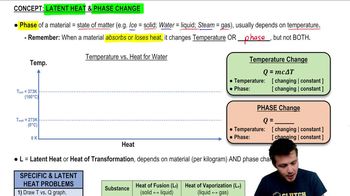
The latent heat of fusion is the amount of heat required to change a unit mass of a solid into a liquid without a temperature change. For ice, this is the energy needed to melt it at 0°C. This concept is vital to determine how much ice must melt to absorb the heat from the patient, ensuring the bath's temperature remains constant at 0°C.
추천 영상:
가이드 코스
10:40
Latent Heat & Phase Changes
관련 실천
교과서 질문

A copper calorimeter can with mass 0.100 kg contains 0.160 kg of water and 0.0180 kg of ice in thermal equilibrium at atmospheric pressure. If 0.750 kg of lead at 255°C is dropped into the calorimeter can, what is the final temperature? Assume that no heat is lost to the surroundings.

1953
views
교과서 질문

A nail driven into a board increases in temperature. If we assume that 60% of the kinetic energy delivered by a 1.80 kg hammer with a speed of 7.80 m/s is transformed into heat that flows into the nail and does not flow out, what is the temperature increase of an 8.00 g aluminum nail after it is struck ten times?

2316
views
1
comments
교과서 질문

A copper pot with a mass of 0.500 kg contains 0.170 kg of water, and both are at 20.0°C. A 0.250-kg block of iron at 85.0°C is dropped into the pot. Find the final temperature of the system, assuming no heat loss to the surroundings.

2283
views
교과서 질문

A blacksmith cools a 1.20 kg chunk of iron, initially at 650.0°C, by trickling 15.0°C water over it. All of the water boils away, and the iron ends up at 120.0°C. How much water did the blacksmith trickle over the iron?

2148
views
교과서 질문

While painting the top of an antenna 225 m in height, a worker accidentally lets a 1.00-L water bottle fall from his lunchbox. The bottle lands in some bushes at ground level and does not break. If a quantity of heat equal to the magnitude of the change in mechanical energy of the water goes into the water, what is its increase in temperature?

2092
views
교과서 질문

You have 750 g of water at 10.0°C in a large insulated beaker. How much boiling water at 100.0°C must you add to this beaker so that the final temperature of the mixture will be 75°C?

2568
views