Ch 23: Electric Potential
Young & Freedman Calc - University Physics 14th Edition
Young & Freedman Calc14th EditionUniversity PhysicsISBN: 9780321973610당신이 사용하는 게 아니라요?교과서 변경
23장, 문제 22c

At a certain distance from a point charge, the potential and electric-field magnitude due to that charge are 4.984.98 V and 16.216.2 V/m, respectively. (Take V=0V = 0 at infinity.) Is the electric field directed toward or away from the point charge?

검증된 단계별 안내
1
Understand that the electric field direction depends on the sign of the point charge. A positive charge has an electric field directed away from it, while a negative charge has an electric field directed toward it.
Recall that the electric potential (V) and the electric field (E) are related to the charge (q) and the distance (r) from the charge by the formulas: V = k * q / r and E = k * q / r^2, where k is Coulomb's constant.
Since the potential is positive (4.98 V), this suggests that the point charge is positive, as a positive charge creates a positive potential.
Given that the electric field magnitude is 16.2 V/m, and knowing the potential is positive, the electric field is directed away from the point charge.
Conclude that the electric field is directed away from the point charge, consistent with the behavior of a positive charge.

비슷한 문제에 대한 검증된 영상 답변:

이 영상 해법은 위 문제에 도움이 된다고 튜터들이 추천한 것입니다.
영상 길이:
1m
도움이 되었나요?

주요 개념

질문에 올바르게 답하기 위해 반드시 이해해야 하는 핵심 개념들은 다음과 같습니다.

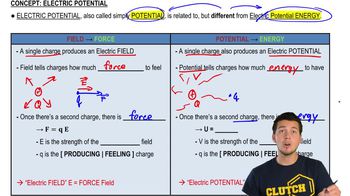
Electric Potential

Electric potential at a point in space is the work done per unit charge in bringing a positive test charge from infinity to that point. It is a scalar quantity measured in volts (V) and indicates the potential energy per unit charge at a location due to an electric field.
추천 영상:
가이드 코스
07:33
Electric Potential

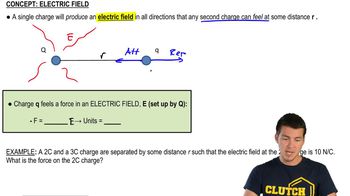
Electric Field

The electric field is a vector field around a charged object where a force would be exerted on other charges. It is measured in volts per meter (V/m) and represents the force per unit charge exerted on a positive test charge. The direction of the field is the direction of the force on a positive charge.
추천 영상:
가이드 코스
03:16
Intro to Electric Fields

Direction of Electric Field

The direction of the electric field is determined by the nature of the source charge. For a positive point charge, the electric field radiates outward, while for a negative point charge, it points inward. This concept helps determine whether the field is directed toward or away from the charge.
추천 영상:
가이드 코스
03:16
Intro to Electric Fields
관련 실천
교과서 질문

At a certain distance from a point charge, the potential and electric-field magnitude due to that charge are 4.984.98 V and 16.216.2 V/m, respectively. (Take V=0V = 0 at infinity.) What is the distance to the point charge?

3195
views

교과서 질문

An electron is to be accelerated from 3.00×1063.00\(\times\)10^6 m/s to 8.00×1068.00\(\times\)10^6 m/s. Through what potential difference must the electron pass to accomplish this?

3080
views
1
rank
교과서 질문

A thin spherical shell with radius R1=3.00R_1 = 3.00 cm is concentric with a larger thin spherical shell with radius R2=5.00R_2 = 5.00 cm. Both shells are made of insulating material. The smaller shell has charge q1=+6.00q_1 = +6.00 nC distributed uniformly over its surface, and the larger shell has charge q2=9.00q_2 = -9.00 nC distributed uniformly over its surface. Take the electric potential to be zero at an infinite distance from both shells. What is the electric potential due to the two shells at the following distance from their common center: (i) r=0 r=0; (ii) r=4.00r=4.00 cm; (iii) r=6.00r=6.00 cm?

3481
views
1
comments
교과서 질문

An infinitely long line of charge has linear charge den­sity 5.00×10125.00\(\times\)10^{-12} C/m. A proton (mass 1.67×10271.67\(\times\)10^{-27} kg, charge +1.60×10¹⁹+1.60\(\times\)10^{-19} C) is 18.018.0 cm from the line and moving directly toward the line at 3.50×1033.50\(\times\)10^3 m/s. Calculate the proton's initial kinetic energy.

3601
views
교과서 질문

At a certain distance from a point charge, the potential and electric-field magnitude due to that charge are 4.984.98 V and 16.216.2 V/m, respectively. (Take V=0V = 0 at infinity.) What is the magnitude of the charge?

2099
views
1
rank
교과서 질문

An infinitely long line of charge has linear charge den­sity 5.00×10125.00\(\times\)10^{-12} C/m. A proton (mass 1.67×10271.67\(\times\)10^{-27} kg, charge +1.60×10¹⁹+1.60\(\times\)10^{-19} C) is 18.018.0 cm from the line and moving directly toward the line at 3.50×1033.50\(\times\)10^3 m/s. How close does the proton get to the line of charge?

2597
views