Ch 23: Electric Potential
Young & Freedman Calc - University Physics 14th Edition
Young & Freedman Calc14th EditionUniversity PhysicsISBN: 9780321973610당신이 사용하는 게 아니라요?교과서 변경
23장, 문제 38

Certain sharks can detect an electric field as weak as 1.01.0 μμV/m. To grasp how weak this field is, if you wanted to produce it between two parallel metal plates by connecting an ordinary 1.51.5­V AA battery across these plates, how far apart would the plates have to be?

검증된 단계별 안내
1
Understand the relationship between electric field (E), voltage (V), and distance (d) between plates. The electric field between two parallel plates is given by the formula: E = Vd.
Identify the given values in the problem: the electric field (E) is 1.0 μV/m, which is equivalent to 1.0 x 10⁻⁶ V/m, and the voltage (V) is 1.5 V.
Rearrange the formula to solve for the distance (d) between the plates: d = VE.
Substitute the known values into the rearranged formula: d = 1.51.0 imes 10^{-6}.
Calculate the distance (d) using the substituted values to find how far apart the plates need to be to produce the electric field of 1.0 μV/m with a 1.5 V battery.

비슷한 문제에 대한 검증된 영상 답변:

이 영상 해법은 위 문제에 도움이 된다고 튜터들이 추천한 것입니다.
영상 길이:
1m
도움이 되었나요?

주요 개념

질문에 올바르게 답하기 위해 반드시 이해해야 하는 핵심 개념들은 다음과 같습니다.

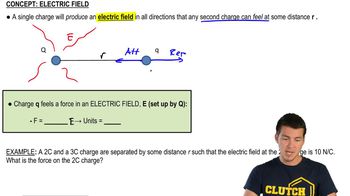
Electric Field

An electric field is a region around a charged object where other charged objects experience a force. It is represented by the symbol E and measured in volts per meter (V/m). The strength of the electric field is determined by the voltage applied and the distance between the plates, following the formula E = V/d.
추천 영상:
가이드 코스
03:16
Intro to Electric Fields

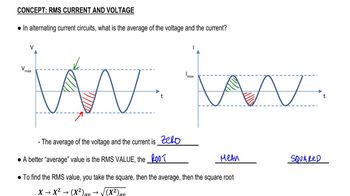
Voltage

Voltage, or electric potential difference, is the measure of the energy per unit charge available to move electrons between two points. It is measured in volts (V) and is a key factor in determining the electric field between two plates. In this scenario, a 1.5 V AA battery provides the voltage needed to create the electric field.
추천 영상:
가이드 코스
07:14
RMS Current and Voltage

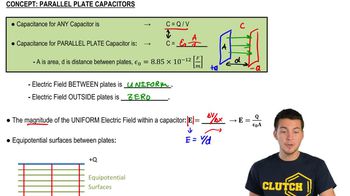
Distance Between Plates

The distance between two parallel plates affects the strength of the electric field created between them. According to the formula E = V/d, the electric field (E) is inversely proportional to the distance (d). To achieve a weak electric field of 1.0 μV/m, the plates must be placed at a specific distance calculated using the given voltage.
추천 영상:
가이드 코스
08:53
Parallel Plate Capacitors
관련 실천
교과서 질문

How much excess charge must be placed on a copper sphere 25.025.0 cm in diameter so that the potential of its center, rela­tive to infinity, is 3.753.75 kV? What is the potential of the sphere's surface relative to infinity?

2666
views

교과서 질문

A metal sphere with radius ra r_a is supported on an insulating stand at the center of a hollow, metal, spherical shell with radius rbr_b. There is charge +q+q on the inner sphere and charge q-q on the outer spherical shell. Calculate the potential V(r)V(r) for (i) r<rar < r_a; (ii) ra<r<rbr_a < r < r_b; (iii) r>rbr > r_b. (Hint: The net potential is the sum of the potentials due to the individual spheres.) Take VV to be zero when rr is infinite.

1869
views
교과서 질문

Two large, parallel conducting plates carrying op­posite charges of equal magnitude are separated by 2.202.20 cm. If the surface charge density for each plate has magnitude 47.047.0 nC/m2, what is the magnitude of EE in the region between the plates?

1931
views
1
rank
교과서 질문

A metal sphere with radius ra r_a is supported on an insulating stand at the center of a hollow, metal, spherical shell with radius rbr_b. There is charge +q+q on the inner sphere and charge q-q on the outer spherical shell. Show that the potential of the inner sphere with respect to the outer is Vab=q/(4πϵ0)(1/ra1/rb)V_ab=q/(4πϵ_0 ) (1/r_a -1/r_b).

1897
views
1
rank
교과서 질문

Two large, parallel conducting plates carrying op­posite charges of equal magnitude are separated by 2.202.20 cm. What is the potential difference between the two plates?

2111
views
교과서 질문

Two large, parallel conducting plates carrying op­posite charges of equal magnitude are separated by 2.202.20 cm. The surface charge density for each plate has magnitude 47.047.0 nC/m^2. If the separation between the plates is doubled while the surface charge density is kept constant at the given value, what happens to the magnitude of the electric field and to the po­tential difference?

2753
views