Ch 23: Electric Potential
Young & Freedman Calc - University Physics 14th Edition
Young & Freedman Calc14th EditionUniversity PhysicsISBN: 9780321973610당신이 사용하는 게 아니라요?교과서 변경
23장, 문제 18a

Two point charges of equal magnitude QQ are held a distance dd apart. Consider only points on the line passing through both charges. If the two charges have the same sign, find the location of all points (if there are any) at which (i) the potential (relative to infinity) is zero (is the electric field zero at these points?), and (ii) the electric field is zero (is the potential zero at these points?).

검증된 단계별 안내
1
Understand the concept of electric potential and electric field. The electric potential at a point due to a point charge is given by \( V = \frac{kQ}{r} \), where \( k \) is Coulomb's constant, \( Q \) is the charge, and \( r \) is the distance from the charge. The electric field due to a point charge is given by \( E = \frac{kQ}{r^2} \).
For part (a)(i), consider the potential due to two charges of the same sign. The potential at a point on the line is the algebraic sum of the potentials due to each charge. Set up the equation \( V = \frac{kQ}{r_1} + \frac{kQ}{r_2} = 0 \), where \( r_1 \) and \( r_2 \) are the distances from the point to each charge. Solve for the location where this condition is satisfied.
Determine if the electric field is zero at the points where the potential is zero. The electric field is the vector sum of the fields due to each charge. Set up the equation \( E = \frac{kQ}{r_1^2} - \frac{kQ}{r_2^2} = 0 \) (since the charges are of the same sign, the fields will oppose each other). Solve for the location where this condition is satisfied.
For part (a)(ii), find the location where the electric field is zero. Use the equation \( E = \frac{kQ}{r_1^2} - \frac{kQ}{r_2^2} = 0 \) and solve for the point where the fields cancel each other out. Check if the potential is zero at these points by substituting back into the potential equation.
Summarize the findings: Points where the potential is zero are not necessarily where the electric field is zero, and vice versa. Analyze the conditions under which these phenomena occur, considering the symmetry and properties of electric fields and potentials.

비슷한 문제에 대한 검증된 영상 답변:

이 영상 해법은 위 문제에 도움이 된다고 튜터들이 추천한 것입니다.
영상 길이:
2m
도움이 되었나요?

주요 개념

질문에 올바르게 답하기 위해 반드시 이해해야 하는 핵심 개념들은 다음과 같습니다.

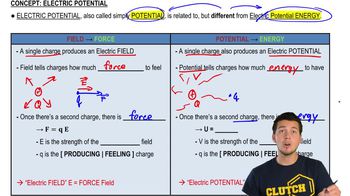
Electric Potential

Electric potential at a point is the work done per unit charge in bringing a positive test charge from infinity to that point. For two like charges, the potential at a point is the algebraic sum of potentials due to each charge. Points where the potential is zero are equidistant from both charges, but the electric field may not be zero at these points.
추천 영상:
가이드 코스
07:33
Electric Potential

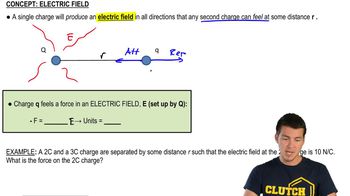
Electric Field

The electric field is a vector field representing the force experienced by a unit positive charge at a point in space. For two like charges, the field is zero at a point where the forces due to each charge cancel each other out. At these points, the potential is not necessarily zero, as potential is a scalar quantity.
추천 영상:
가이드 코스
03:16
Intro to Electric Fields

Superposition Principle

The superposition principle states that the net electric field or potential at a point is the vector or algebraic sum of fields or potentials due to individual charges. This principle is crucial for calculating the potential and field at any point on the line between two charges, allowing us to determine where these quantities are zero.
추천 영상:
가이드 코스
03:32
Superposition of Sinusoidal Wave Functions
관련 실천
교과서 질문

A particle with charge +4.20+4.20 nC is in a uniform electric field EE directed to the left. The charge is released from rest and moves to the left; after it has moved 6.006.00 cm, its kinetic energy is +2.20x10⁶+2.20x10^{-6} J. What is the work done by the electric force?

2817
views

교과서 질문

Two stationary point charges +3.00+3.00 nC and +2.00+2.00 nC are separated by a distance of 50.050.0 cm. An electron is released from rest at a point midway between the two charges and moves along the line connecting the two charges. What is the speed of the electron when it is 10.010.0 cm from the +3.00+3.00-nC charge?

5349
views
1
comments
교과서 질문

Two point charges q1=+2.40q_1 = +2.40 nC and q2=6.50q_2 = -6.50 nC are 0.1000.100 m apart. Point AA is midway between them; point BB is 0.0800.080 m from q1q_1 and 0.0600.060 m from q2q_2 (Fig. E23.1923.19). Take the electric potential to be zero at infinity. Find the potential at point BB.

2115
views
교과서 질문

An electron is to be accelerated from 3.00×1063.00\(\times\)10^6 m/s to 8.00×1068.00\(\times\)10^6 m/s. Through what potential difference must the electron pass to accomplish this?

3080
views
1
rank
교과서 질문

Two point charges q1=+2.40q_1 = +2.40 nC and q2=6.50q_2 = -6.50 nC are 0.1000.100 m apart. Point AA is midway between them; point BB is 0.0800.080 m from q1q_1 and 0.0600.060 m from q2q_2 (Fig. E23.1923.19). Take the electric potential to be zero at infinity. Find the potential at point AA.

3160
views
1
rank
교과서 질문

Point charges q1=+2.00q_1 = +2.00 μμC and q2=2.00q_2 = -2.00 μμC are placed at adjacent corners of a square for which the length of each side is 3.003.00 cm. Point aa is at the center of the square, and point bb is at the empty corner closest to q2q_2q2q_2. Take the electric potential to be zero at a distance far from both charges. (a) What is the electric potential at point a due to q1q_1 and q2q_2?

3293
views