Ch 18: Thermal Properties of Matter
Young & Freedman Calc - University Physics 14th Edition
Young & Freedman Calc14th EditionUniversity PhysicsISBN: 9780321973610당신이 사용하는 게 아니라요?교과서 변경
18장, 문제 33a

Oxygen (O2) has a molar mass of 32.0 32.0 g/mol. What is the average translational kinetic energy of an oxygen molecule at a temperature of 300300 K?

검증된 단계별 안내
1
Start by understanding the concept of translational kinetic energy for a molecule. The average translational kinetic energy of a molecule in a gas is given by the formula: 3kT2, where k is the Boltzmann constant and T is the temperature in Kelvin.
Identify the values needed for the calculation. The temperature T is given as 300 K. The Boltzmann constant k is approximately 1.38×10⁻²³J·K-1.
Substitute the values into the formula for average translational kinetic energy: 3×1.38×10-23×3002.
Perform the multiplication in the numerator: 3×1.38×10-23×300.
Divide the result from the previous step by 2 to find the average translational kinetic energy of an oxygen molecule at 300 K.

비슷한 문제에 대한 검증된 영상 답변:

이 영상 해법은 위 문제에 도움이 된다고 튜터들이 추천한 것입니다.
영상 길이:
3m
도움이 되었나요?

주요 개념

질문에 올바르게 답하기 위해 반드시 이해해야 하는 핵심 개념들은 다음과 같습니다.

Kinetic Theory of Gases

The kinetic theory of gases explains the behavior of gases in terms of the motion of their molecules. It states that the average kinetic energy of gas molecules is directly proportional to the temperature of the gas. This concept is crucial for understanding how temperature affects the energy of molecules in a gas.
추천 영상:
가이드 코스
01:50
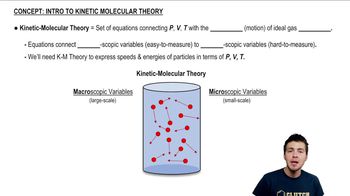
Introduction to Kinetic-Molecular Theory

Translational Kinetic Energy

Translational kinetic energy refers to the energy due to the motion of a molecule moving from one place to another. For a single molecule, it is given by the formula (3/2)kT, where k is the Boltzmann constant and T is the temperature in Kelvin. This concept helps in calculating the energy associated with the movement of molecules at a given temperature.
추천 영상:
가이드 코스
06:07
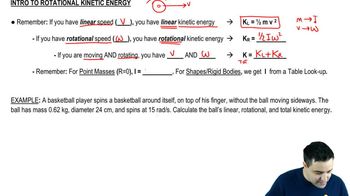
Intro to Rotational Kinetic Energy

Boltzmann Constant

The Boltzmann constant (k) is a fundamental physical constant that relates the average kinetic energy of particles in a gas with the temperature of the gas. Its value is approximately 1.38 x 10^-23 J/K. Understanding this constant is essential for calculating the average kinetic energy of molecules in a gas at a specific temperature.
추천 영상:
가이드 코스
08:59
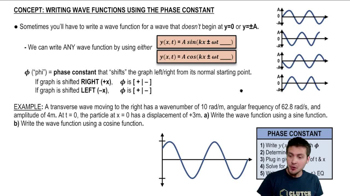
Phase Constant of a Wave Function
관련 실천
교과서 질문

A flask contains a mixture of neon (Ne), krypton (Kr), and radon (Rn) gases. Compare the root-mean-square speeds. (Hint: Appendix D shows the molar mass (in g/mol) of each element under the chemical symbol for that element.)

1759
views

교과서 질문

Oxygen (O2) has a molar mass of 32.0 32.0 g/mol. Suppose an oxygen molecule traveling at this speed bounces back and forth between opposite sides of a cubical vessel 0.100.10 m on a side. What is the average force the molecule exerts on one of the walls of the container? (Assume that the molecule's velocity is perpendicular to the two sides that it strikes.)

1904
views
교과서 질문

Oxygen (O2) has a molar mass of 32.032.0 g/mol. How many oxygen molecules traveling at this speed are necessary to produce an average pressure of 11 atm?

2794
views
교과서 질문

Oxygen (O2) has a molar mass of 32.0 32.0 g/mol. What is the momentum of an oxygen molecule traveling at this speed?

12863
views
교과서 질문

We have two equal-size boxes, A and B. Each box contains gas that behaves as an ideal gas. We insert a thermometer into each box and find that the gas in box A is at 5050°C while the gas in box B is at 1010°C. This is all we know about the gas in the boxes. Which of the following statements must be true? Which could be true? Explain your reasoning.

(a) The pressure in A is higher than in B.

(b) There are more molecules in A than in B.

(c) A and B do not contain the same type of gas.

(d) The molecules in A have more average kinetic energy per molecule than those in B.

(e) The molecules in A are moving faster than those in B.

302
views
교과서 질문

The atmosphere of Mars is mostly CO2 (molar mass 44.044.0 g/mol) under a pressure of 650650 Pa, which we shall assume remains constant. In many places the temperature varies from 0.00.0°C in summer to 100-100°C in winter. Over the course of a Martian year, what are the ranges of the rms speeds of the CO2 molecules.

2421
views
1
rank