Ch 21: Electric Charge and Electric Field
Young & Freedman Calc - University Physics 14th Edition
Young & Freedman Calc14th EditionUniversity PhysicsISBN: 9780321973610당신이 사용하는 게 아니라요?교과서 변경
21장, 문제 25b

A proton is traveling horizontally to the right at 4.50×1064.50\(\times\)10^6 m/s. How much time does it take the proton to stop after entering the field?

검증된 단계별 안내
1
Identify the initial velocity of the proton, which is given as \( v_i = 4.50 \times 10^6 \) m/s.
Recognize that the proton is entering a field that will exert a force on it, causing it to decelerate to a stop. The final velocity \( v_f \) will be 0 m/s.
Use the formula for acceleration \( a = \frac{F}{m} \), where \( F \) is the force exerted by the field and \( m \) is the mass of the proton. You will need to know the force exerted by the field to find the acceleration.
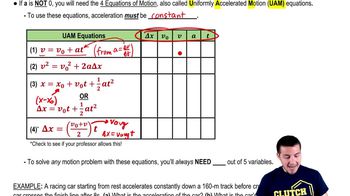
Apply the kinematic equation \( v_f = v_i + at \) to solve for the time \( t \). Rearrange the equation to \( t = \frac{v_f - v_i}{a} \).
Substitute the known values into the equation: \( v_f = 0 \) m/s, \( v_i = 4.50 \times 10^6 \) m/s, and \( a \) (calculated from the force and mass) to find the time \( t \) it takes for the proton to stop.

비슷한 문제에 대한 검증된 영상 답변:

이 영상 해법은 위 문제에 도움이 된다고 튜터들이 추천한 것입니다.
영상 길이:
4m

주요 개념

질문에 올바르게 답하기 위해 반드시 이해해야 하는 핵심 개념들은 다음과 같습니다.

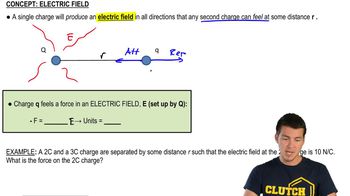
Electric Field

An electric field is a region around a charged particle where a force would be exerted on other charges. It is represented by field lines and is measured in newtons per coulomb (N/C). In this context, the electric field is responsible for exerting a force on the proton, causing it to decelerate.
추천 영상:
가이드 코스
03:16
Intro to Electric Fields

Kinematics

Kinematics is the branch of physics that deals with the motion of objects without considering the forces that cause the motion. It involves parameters such as velocity, acceleration, and time. To find the time it takes for the proton to stop, we use kinematic equations that relate these parameters.
추천 영상:
가이드 코스
08:25
Kinematics Equations

Newton's Second Law

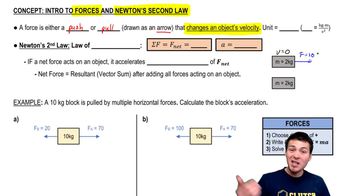
Newton's Second Law states that the force acting on an object is equal to the mass of the object multiplied by its acceleration (F = ma). This law is crucial for determining the acceleration of the proton due to the electric field, which is needed to calculate the time taken for the proton to come to a stop.
추천 영상:
가이드 코스
06:54
Intro to Forces & Newton's Second Law
관련 실천
교과서 질문

Three point charges are arranged along the xx-axis. Charge q1=+3.00q_1=+3.00 μ\(\mu\)C is at the origin, and charge q2=−5.00q_2=-5.00 μ\(\mu\)C is at x=0.200x = 0.200 m. Charge q2=−8.00q_2=-8.00 μ\(\mu\)C. Where is q3q_3 located if the net force on q1q_1 is 7.007.00 N in the −x-x-direction?

3603
views
교과서 질문

A positive charge qq is fixed at the point x=0x = 0, y=0y = 0, and a negative charge −2q-2q is fixed at the point x=ax = a, y=0 y = 0. Show the positions of the charges in a diagram.

2591
views
교과서 질문

The earth has a net electric charge that causes a field at points near its surface equal to 150150 N/CN/C and directed in toward the center of the earth. What would be the force of repulsion between two people each with the charge calculated in part (a) and separated by a distance of 100100 m? Is use of the earth's electric field a feasible means of flight? Why or why not? Note: Part (a) asked for what magnitude and sign of charge would a 6060-kg human have to acquire to overcome his or her weight by the force exerted by the earth's electric field.

1733
views
교과서 질문

A proton is traveling horizontally to the right at 4.50×1064.50\(\times\)10^6 m/s. Find the magnitude and direction of the weakest electric field that can bring the proton uniformly to rest over a distance of 3.203.20 cm.

3320
views
7
rank
교과서 질문

The earth has a net electric charge that causes a field at points near its surface equal to 150150 N/CN/C and directed in toward the center of the earth. What magnitude and sign of charge would a 6060-kg human have to acquire to overcome his or her weight by the force exerted by the earth's electric field?

2510
views
교과서 질문

A proton is traveling horizontally to the right at 4.50×1064.50\(\times\)10^6 m/s. What minimum field (magnitude and direction) would be needed to stop an electron under the conditions of part (a)? Note: Part (a) asks for how much time does it take the proton to stop after entering the field.

1721
views