
Ch 22: Gauss' Law
Young & Freedman Calc - University Physics 14th Edition
Young & Freedman Calc14th EditionUniversity PhysicsISBN: 9780321973610당신이 사용하는 게 아니라요?교과서 변경
22장, 문제 19c

A hollow, conducting sphere with an outer radius of 0.2500.250 m and an inner radius of 0.2000.200 m has a uniform surface charge density of +6.37×10⁶+6.37\(\times\)10^{-6} C/m2. A charge of 0.500−0.500 μ\(\mu\)C is now introduced at the center of the cavity inside the sphere. What is the electric flux through a spherical surface just inside the inner surface of the sphere?

검증된 단계별 안내
1
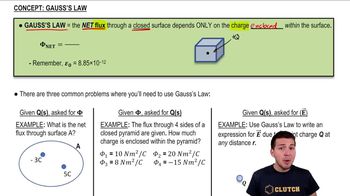
First, understand that the electric flux through a closed surface is given by Gauss's Law, which states that the electric flux Φ through a closed surface is equal to the charge enclosed Q divided by the permittivity of free space ε₀: Φ = Q/ε₀.
Identify the charge enclosed by the spherical surface just inside the inner surface of the sphere. Since the charge of -0.500 μC is introduced at the center of the cavity, this is the charge enclosed by the surface.
Convert the charge from microcoulombs to coulombs for calculation purposes. Recall that 1 μC = 1×10⁻⁶ C, so -0.500 μC = -0.500×10⁻⁶ C.
Use Gauss's Law to calculate the electric flux. Substitute the charge enclosed (-0.500×10⁻⁶ C) into the formula Φ = Q/ε₀, where ε₀ is the permittivity of free space, approximately 8.85×10⁻¹² C²/(N·m²).
Perform the division to find the electric flux Φ through the spherical surface just inside the inner surface of the sphere. Remember, the direction of the electric field lines will be inward due to the negative charge.

비슷한 문제에 대한 검증된 영상 답변:

이 영상 해법은 위 문제에 도움이 된다고 튜터들이 추천한 것입니다.
영상 길이:
2m
도움이 되었나요?

주요 개념

질문에 올바르게 답하기 위해 반드시 이해해야 하는 핵심 개념들은 다음과 같습니다.

Gauss's Law

Gauss's Law relates the electric flux through a closed surface to the charge enclosed by that surface. It states that the total electric flux is equal to the enclosed charge divided by the permittivity of free space. This principle is crucial for calculating the electric flux through surfaces surrounding charged objects, such as the spherical surface inside the conducting sphere.
추천 영상:

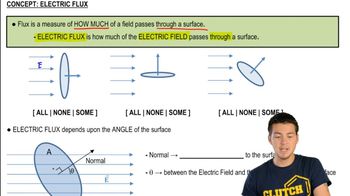
Electric Flux

Electric flux is a measure of the electric field passing through a given surface. It is calculated as the product of the electric field and the area through which the field lines pass, considering the angle between the field lines and the surface normal. Understanding electric flux is essential for determining how electric fields interact with surfaces, especially in the context of Gauss's Law.
추천 영상:

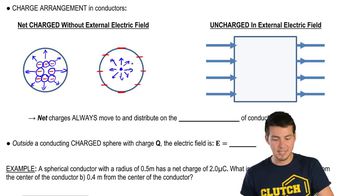
Conductors and Charge Distribution

Conductors allow charges to move freely, resulting in charge distribution on their surfaces. In electrostatic equilibrium, the electric field inside a conductor is zero, and any excess charge resides on the surface. This concept is important for understanding how the introduced charge affects the electric field and flux within the hollow sphere, as charges will redistribute to maintain equilibrium.
추천 영상:
가이드 코스
07:43
Electric Fields in Conductors
관련 실천
교과서 질문

Charge qq is distributed uniformly throughout the volume of an insulating sphere of radius R=4.00R = 4.00 cm. At a distance of r=8.00r = 8.00 cm from the center of the sphere, the electric field due to the charge distribution has magnitude E=940E = 940 N/C. What is the volume charge density for the sphere?

3864
views
1
rank
1
comments
교과서 질문

A conductor with an inner cavity, like that shown in Fig. 22.2322.23c, carries a total charge of +5.00+5.00 nC. The charge within the cavity, insulated from the conductor, is 6.00−6.00 nC. How much charge is on (a) the inner surface of the conductor and (b) the outer surface of the conductor?

3054
views
교과서 질문

A hollow, conducting sphere with an outer radius of 0.2500.250 m and an inner radius of 0.2000.200 m has a uniform surface charge density of +6.37×10⁶+6.37\(\times\)10^{-6} C/m2. A charge of 0.500−0.500 μ\(\mu\)C is now introduced at the center of the cavity inside the sphere. What is the new charge density on the outside of the sphere?

1998
views
교과서 질문

Charge qq is distributed uniformly throughout the volume of an insulating sphere of radius R=4.00R = 4.00 cm. At a distance of r=8.00r = 8.00 cm from the center of the sphere, the electric field due to the charge distribution has magnitude E=940E = 940 N/C. What is the electric field at a distance of 2.002.00 cm from the sphere's center?

2034
views
교과서 질문

A very long uniform line of charge has charge per unit length 4.804.80 μ\(\mu\)C/m and lies along the xx-axis. A second long uniform line of charge has charge per unit length 2.40-2.40 μ\(\mu\)C/m and is parallel to the xx-axis at y=0.400y = 0.400 m. What is the net electric field (magnitude and direction) at the following points on the yy-axis: (a) y=0.200y = 0.200 m and (b) y=0.600 y = 0.600 m?

340
views
교과서 질문

A hollow, conducting sphere with an outer radius of 0.2500.250 m and an inner radius of 0.2000.200 m has a uniform surface charge density of +6.37×10⁶+6.37\(\times\)10^{-6} C/m2. A charge of 0.500−0.500 μ\(\mu\)C is now introduced at the center of the cavity inside the sphere. Calculate the strength of the electric field just outside the sphere?

3585
views