
Ch 24: Capacitance and Dielectrics
Young & Freedman Calc - University Physics 14th Edition
Young & Freedman Calc14th EditionUniversity PhysicsISBN: 9780321973610당신이 사용하는 게 아니라요?교과서 변경
24장, 문제 6

A 5.005.00-μ\(\mu\)F parallel-plate capacitor is connected to a 12.012.0 V battery. After the capacitor is fully charged, the battery is disconnected without loss of any of the charge on the plates.
(a) A voltmeter is connected across the two plates without discharging them. What does it read?
(b) What would the voltmeter read if (i) the plate separation were doubled; (ii) the radius of each plate were doubled but their separation was unchanged?

검증된 단계별 안내
1
Step 1: Understand the initial setup. A parallel-plate capacitor with capacitance \( C = 5.00 \, \mu\text{F} \) is connected to a battery with voltage \( V = 12.0 \, \text{V} \). When fully charged, the charge \( Q \) on the capacitor is given by \( Q = C \times V \).
Step 2: For part (a), after disconnecting the battery, the charge \( Q \) remains constant on the plates. The voltmeter reads the voltage across the plates, which is still \( V = 12.0 \, \text{V} \) because the charge has not changed.
Step 3: For part (b)(i), if the plate separation is doubled, the capacitance \( C \) changes. The capacitance of a parallel-plate capacitor is given by \( C = \frac{\varepsilon_0 A}{d} \), where \( \varepsilon_0 \) is the permittivity of free space, \( A \) is the area of the plates, and \( d \) is the separation between the plates. Doubling \( d \) halves the capacitance, \( C' = \frac{C}{2} \). Since \( Q \) remains constant, the new voltage \( V' \) is \( V' = \frac{Q}{C'} = 2V \).
Step 4: For part (b)(ii), if the radius of each plate is doubled, the area \( A \) of the plates increases by a factor of four (since \( A = \pi r^2 \)). The capacitance \( C'' \) becomes \( C'' = 4C \). With the charge \( Q \) constant, the new voltage \( V'' \) is \( V'' = \frac{Q}{C''} = \frac{V}{4} \).
Step 5: Summarize the results: (a) The voltmeter reads \( 12.0 \, \text{V} \). (b)(i) If the plate separation is doubled, the voltmeter reads \( 24.0 \, \text{V} \). (b)(ii) If the radius of each plate is doubled, the voltmeter reads \( 3.0 \, \text{V} \).

비슷한 문제에 대한 검증된 영상 답변:

이 영상 해법은 위 문제에 도움이 된다고 튜터들이 추천한 것입니다.
영상 길이:
7m
도움이 되었나요?

주요 개념

질문에 올바르게 답하기 위해 반드시 이해해야 하는 핵심 개념들은 다음과 같습니다.

Capacitance and Charge Relationship

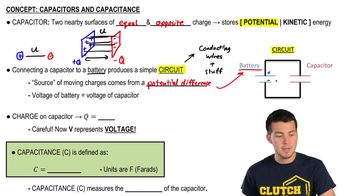
Capacitance (C) is the ability of a capacitor to store charge (Q) per unit voltage (V), expressed as C = Q/V. For a parallel-plate capacitor, the charge remains constant when disconnected from the battery, meaning the voltage across the plates is determined by the stored charge and the capacitance.
추천 영상:
가이드 코스
08:02
Capacitors & Capacitance (Intro)

Effect of Plate Separation on Capacitance

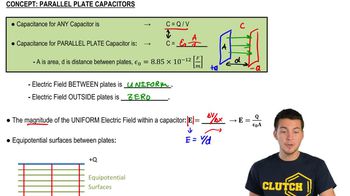
The capacitance of a parallel-plate capacitor is inversely proportional to the distance between the plates, given by C = ε₀A/d, where ε₀ is the permittivity of free space, A is the plate area, and d is the separation. Doubling the separation reduces the capacitance, increasing the voltage across the plates if the charge remains constant.
추천 영상:
가이드 코스
08:53
Parallel Plate Capacitors

Effect of Plate Area on Capacitance

Capacitance is directly proportional to the plate area, as seen in the formula C = ε₀A/d. Doubling the radius of the plates increases the area, thus increasing the capacitance. If the separation remains unchanged, the increased capacitance results in a decreased voltage across the plates for the same charge.
추천 영상:
가이드 코스
08:53
Parallel Plate Capacitors
관련 실천
교과서 질문

A parallel-plate air capacitor is to store charge of magnitude 240.0240.0 pC on each plate when the potential difference between the plates is 42.042.0 V.

(a) If the area of each plate is 6.806.80 cm2, what is the separation between the plates?

(b) If the separation between the two plates is double the value calculated in part (a), what potential difference is required for the capacitor to store charge of magnitude 240.0240.0 pC on each plate?

2539
views
교과서 질문

The plates of a parallel-plate capacitor are 2.502.50 mm apart, and each carries a charge of magnitude 80.080.0 nC. The plates are in vacuum. The electric field between the plates has a magnitude of 4.00×1064.00\(\times\)10^6 V/m. What is (a) the potential difference between the plates; (b) the area of each plate; (c) the capacitance?

1767
views
교과서 질문

A capacitor is made from two hollow, coaxial, iron cylinders, one inside the other. The inner cylinder is negatively charged and the outer is positively charged; the magnitude of the charge on each is 10.010.0 pC. The inner cylinder has radius 0.500.50 mm, the outer one has radius 5.005.00 mm, and the length of each cylinder is 18.018.0 cm.

(a) What is the capacitance?

(b) What applied potential difference is necessary to produce these charges on the cylinders?

1975
views
교과서 질문

A parallel-plate air capacitor of capacitance 245245 pF has a charge of magnitude 0.148 0.148 μ\(\mu\)C on each plate. The plates are 0.3280.328 mm apart.

(a) What is the potential difference between the plates?

(b) What is the area of each plate?

(c) What is the electric field magnitude between the plates?

(d) What is the surface charge density on each plate?

1666
views
교과서 질문

A spherical capacitor contains a charge of 3.303.30 nC when connected to a potential difference of 220220 V. If its plates are separated by vacuum and the inner radius of the outer shell is 4.004.00 cm, calculate: (a) the capacitance; (b) the radius of the inner sphere; (c) the electric field just outside the surface of the inner sphere.

2452
views