Ch 24: Capacitance and Dielectrics
Young & Freedman Calc - University Physics 14th Edition
Young & Freedman Calc14th EditionUniversity PhysicsISBN: 9780321973610당신이 사용하는 게 아니라요?교과서 변경
24장, 문제 24.24

A parallel-plate air capacitor has a capacitance of 920 pF. The charge on each plate is 3.90 uC. (a) What is the potential difference between the plates? (b) If the charge is kept constant, what will be the potential difference if the plate separation is doubled? (c) How much work is required to double the separation?

검증된 단계별 안내
1
To find the potential difference between the plates, use the formula for capacitance: \( C = \frac{Q}{V} \), where \( C \) is the capacitance, \( Q \) is the charge, and \( V \) is the potential difference. Rearrange the formula to solve for \( V \): \( V = \frac{Q}{C} \). Substitute \( Q = 3.90 \mu C \) and \( C = 920 \text{ pF} \) into the equation.
For part (b), if the plate separation is doubled, the capacitance will change. The capacitance of a parallel-plate capacitor is given by \( C = \frac{\varepsilon_0 A}{d} \), where \( \varepsilon_0 \) is the permittivity of free space, \( A \) is the area of the plates, and \( d \) is the separation between the plates. Doubling \( d \) will halve the capacitance, so the new capacitance \( C' = \frac{C}{2} \). Use the formula \( V' = \frac{Q}{C'} \) to find the new potential difference.
For part (c), calculate the work required to double the separation. The work done on a capacitor is given by \( W = \frac{1}{2} Q (V' - V) \), where \( V' \) is the new potential difference and \( V \) is the initial potential difference. Substitute the values of \( Q \), \( V \), and \( V' \) from the previous steps into this formula to find the work done.
Ensure that all units are consistent when performing calculations. Convert microcoulombs to coulombs and picofarads to farads as necessary. Remember that \( 1 \mu C = 1 \times 10^{-6} \text{ C} \) and \( 1 \text{ pF} = 1 \times 10^{-12} \text{ F} \).
Review the concepts of capacitance and potential difference in a parallel-plate capacitor. Understand how changes in physical parameters like plate separation affect the electrical properties of the capacitor, and how energy is involved in these changes.

비슷한 문제에 대한 검증된 영상 답변:

이 영상 해법은 위 문제에 도움이 된다고 튜터들이 추천한 것입니다.
영상 길이:
5m
도움이 되었나요?

주요 개념

질문에 올바르게 답하기 위해 반드시 이해해야 하는 핵심 개념들은 다음과 같습니다.

Capacitance

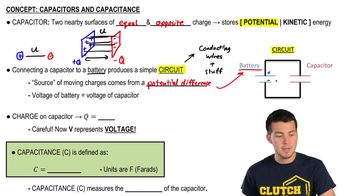
Capacitance is the ability of a system to store charge per unit voltage, measured in farads (F). For a parallel-plate capacitor, capacitance is determined by the area of the plates, the distance between them, and the permittivity of the material between the plates. It is given by the formula C = Q/V, where C is capacitance, Q is charge, and V is voltage.
추천 영상:
가이드 코스
08:02
Capacitors & Capacitance (Intro)

Potential Difference

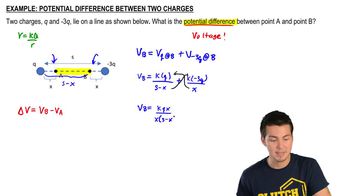
Potential difference, or voltage, is the work done per unit charge to move a charge between two points in an electric field. For capacitors, it is calculated using the formula V = Q/C, where V is the potential difference, Q is the charge, and C is the capacitance. It represents the energy required to move charges between the plates.
추천 영상:
가이드 코스
07:04
Potential Difference Between Two Charges

Work Done in Electric Fields

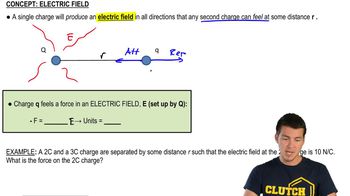
Work done in electric fields refers to the energy required to move charges within the field. For capacitors, changing the separation between plates affects the electric field and potential energy. The work done to change the separation is calculated using W = 0.5 * Q * ΔV, where W is work, Q is charge, and ΔV is the change in potential difference.
추천 영상:
가이드 코스
03:16
Intro to Electric Fields
관련 실천
교과서 질문

For the system of capacitors shown in Fig. E24.1624.16, find the equivalent capacitance between bb and cc.

2719
views
1
rank
교과서 질문

A parallel-plate capacitor has capacitance C0=8.00C_0=8.00 pF when there is air between the plates. The separation between the plates is 1.501.50 mm.

(a) What is the maximum magnitude of charge QQ that can be placed on each plate if the electric field in the region between the plates is not to exceed 3.00×1043.00\(\times\)10^4 V/m?

(b) A dielectric with K=2.70K = 2.70 is inserted between the plates of the capacitor, completely filling the volume between the plates. Now what is the maximum magnitude of charge on each plate if the electric field between the plates is not to exceed 3.00×1043.00\(\times\)10^4 V/m?

1939
views
1
rank
교과서 질문

In Fig. E24.2024.20, C1=6.00C_1=6.00 μ\(\mu\)F, C2=3.00C_2 = 3.00 μ\(\mu\)F, and C3=5.00C_3 = 5.00 μ\(\mu\)F. The capacitor network is connected to an applied potential VabV_{ab}.

(a) After the charges on the capacitors have reached their final values, the charge on C2C_2 is 30.030.0 mC. What are the charges on capacitors C1C_1 and C3C_3?

(b) What is the applied voltage VabV_{ab}?

4327
views
교과서 질문

A 5.805.80-μ\(\mu\)F, parallel-plate, air capacitor has a plate separation of 5.005.00 mm and is charged to a potential difference of 400400 V. Calculate the energy density in the region between the plates, in units of J/m3.

2037
views
교과서 질문

You have two identical capacitors and an external potential source.

(a) Compare the total energy stored in the capacitors when they are connected to the applied potential in series and in parallel.

(b) Compare the maximum amount of charge stored in each case.

(c) Energy storage in a capacitor can be limited by the maximum electric field between the plates. What is the ratio of the electric field for the series and parallel combinations?

2159
views
교과서 질문

An air capacitor is made from two flat parallel plates 1.501.50 mm apart. The magnitude of charge on each plate is 0.01800.0180 μ\(\mu\)C when the potential difference is 200200 V.

(a) What is the capacitance?

(b) What is the area of each plate?

(c) What maximum voltage can be applied without dielectric breakdown? (Dielectric breakdown for air occurs at an electric-field strength of 3.0×1063.0\(\times\)10^6 V/m.)

(d) When the charge is 0.01800.0180 μ\(\mu\)C, what total energy is stored?

1447
views