
Ch 24: Capacitance and Dielectrics
Young & Freedman Calc - University Physics 14th Edition
Young & Freedman Calc14th EditionUniversity PhysicsISBN: 9780321973610당신이 사용하는 게 아니라요?교과서 변경
24장, 문제 40

Polystyrene has dielectric constant 2.62.6 and dielectric strength 2.0×1072.0\(\times\)10^7 V/m. A piece of polystyrene is used as a dielectric in a parallel-plate capacitor, filling the volume between the plates.
(a) When the electric field between the plates is 8080%% of the dielectric strength, what is the energy density of the stored?
(b) When the capacitor is connected to a battery with voltage 500.0500.0 V, the electric field between the plates is 80%80\% of the dielectric strength. What is the area of each plate if the capacitor stores 0.2000.200 mJ of energy under these conditions?

검증된 단계별 안내
1
Step 1: Understand the problem by identifying the given values: dielectric constant (κ) = 2.6, dielectric strength = 2.0 × 10^7 V/m, electric field (E) = 80% of dielectric strength, battery voltage (V) = 500.0 V, and stored energy (U) = 0.200 mJ.
Step 2: For part (a), calculate the electric field (E) when it is 80% of the dielectric strength. Use the formula E = 0.8 × dielectric strength. Then, use the formula for energy density (u) in a dielectric: u = 0.5 × κ × ε₀ × E², where ε₀ is the permittivity of free space (8.85 × 10^-12 C²/N·m²).
Step 3: For part (b), calculate the electric field (E) again using E = 0.8 × dielectric strength. Then, use the formula for the energy stored in a capacitor: U = 0.5 × C × V², where C is the capacitance. Rearrange this formula to solve for C: C = 2U / V².
Step 4: Use the relationship between capacitance, dielectric constant, area of the plates (A), and separation distance (d): C = κ × ε₀ × A / d. Since the electric field E = V/d, rearrange to find d = V/E. Substitute d into the capacitance formula to solve for A: A = C × d / (κ × ε₀).
Step 5: Substitute the values for C, d, κ, and ε₀ into the formula for A to find the area of each plate. Ensure all units are consistent when performing calculations.

비슷한 문제에 대한 검증된 영상 답변:

이 영상 해법은 위 문제에 도움이 된다고 튜터들이 추천한 것입니다.
영상 길이:
10m
도움이 되었나요?

주요 개념

질문에 올바르게 답하기 위해 반드시 이해해야 하는 핵심 개념들은 다음과 같습니다.

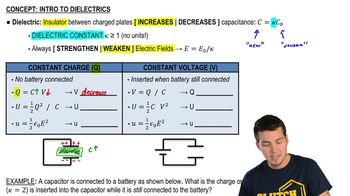
Dielectric Constant

The dielectric constant, also known as relative permittivity, is a measure of a material's ability to store electrical energy in an electric field. It is the ratio of the permittivity of the dielectric material to the permittivity of free space. A higher dielectric constant indicates better insulating properties, allowing the capacitor to store more energy.
추천 영상:
가이드 코스
06:25
Intro To Dielectrics

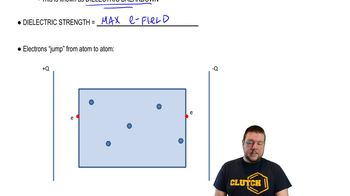
Dielectric Strength

Dielectric strength is the maximum electric field a material can withstand without breaking down or losing its insulating properties. It is expressed in volts per meter (V/m). In the context of capacitors, it determines the maximum voltage that can be applied across the dielectric without causing electrical breakdown, which is crucial for safe operation.
추천 영상:
가이드 코스
04:32
Dielectric Breakdown

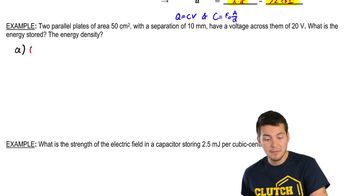
Energy Density in Capacitors

Energy density refers to the amount of energy stored in a capacitor per unit volume. It is calculated using the formula: energy density = 0.5 * ε * E^2, where ε is the permittivity of the dielectric material and E is the electric field strength. Understanding energy density helps in determining how much energy a capacitor can store under specific conditions.
추천 영상:
가이드 코스
09:26
Energy Stored by Capacitor
관련 실천
교과서 질문

A parallel-plate capacitor has capacitance C0=8.00C_0=8.00 pF when there is air between the plates. The separation between the plates is 1.501.50 mm.

(a) What is the maximum magnitude of charge QQ that can be placed on each plate if the electric field in the region between the plates is not to exceed 3.00×1043.00\(\times\)10^4 V/m?

(b) A dielectric with K=2.70K = 2.70 is inserted between the plates of the capacitor, completely filling the volume between the plates. Now what is the maximum magnitude of charge on each plate if the electric field between the plates is not to exceed 3.00×1043.00\(\times\)10^4 V/m?

1939
views
1
rank
교과서 질문

A constant potential difference of 1212 V is maintained between the terminals of a 0.250.25-μ\(\mu\)F, parallel-plate, air capacitor.

(a) A sheet of Mylar is inserted between the plates of the capacitor, completely filling the space between the plates. When this is done, how much additional charge flows onto the positive plate of the capacitor (see Table 24.124.1)?

(b) What is the total induced charge on either face of the Mylar sheet?

(c) What effect does the Mylar sheet have on the electric field between the plates? Explain how you can reconcile this with the increase in charge on the plates, which acts to increase the electric field.

2119
views
교과서 질문

You have two identical capacitors and an external potential source.

(a) Compare the total energy stored in the capacitors when they are connected to the applied potential in series and in parallel.

(b) Compare the maximum amount of charge stored in each case.

(c) Energy storage in a capacitor can be limited by the maximum electric field between the plates. What is the ratio of the electric field for the series and parallel combinations?

2159
views
교과서 질문

When a 360360-nF air capacitor (11 nF = 10910^{-9} F) is connected to a power supply, the energy stored in the capacitor is 1.85x1051.85x10^{-5} J. While the capacitor is kept connected to the power supply, a slab of dielectric is inserted that completely fills the space between the plates. This increases the stored energy by 2.32×1052.32\(\times\)10^{-5} J.

(a) What is the potential difference between the capacitor plates?

(b) What is the dielectric constant of the slab?

2047
views
1
rank