
Ch 27: Magnetic Field and Magnetic Forces
Young & Freedman Calc - University Physics 14th Edition
Young & Freedman Calc14th EditionUniversity PhysicsISBN: 9780321973610당신이 사용하는 게 아니라요?교과서 변경
27장, 문제 31

Singly ionized (one electron removed) atoms are accelerated and then passed through a velocity selector consisting of perpendicular electric and magnetic fields. The electric field is 155 V/m and the magnetic field is 0.0315 T. The ions next enter a uniform magnetic field of magnitude 0.0175 T that is oriented perpendicular to their velocity. (a) How fast are the ions moving when they emerge from the velocity selector? (b) If the radius of the path of the ions in the second magnetic field is 17.5 cm, what is their mass?

검증된 단계별 안내
1
To find the speed of the ions as they emerge from the velocity selector, use the condition for the velocity selector where the electric force equals the magnetic force: \( qE = qvB \). Here, \( E \) is the electric field, \( B \) is the magnetic field, and \( v \) is the velocity. Solve for \( v \) using the equation \( v = \frac{E}{B} \).
Substitute the given values for the electric field \( E = 155 \text{ V/m} \) and the magnetic field \( B = 0.0315 \text{ T} \) into the equation \( v = \frac{E}{B} \) to find the velocity of the ions.
For part (b), use the formula for the radius of the circular path in a magnetic field: \( r = \frac{mv}{qB} \), where \( r \) is the radius, \( m \) is the mass of the ion, \( v \) is the velocity found in part (a), \( q \) is the charge of the ion, and \( B \) is the magnetic field in the second region.
Rearrange the formula to solve for the mass \( m \): \( m = \frac{rqB}{v} \).
Substitute the known values: \( r = 0.175 \text{ m} \), \( B = 0.0175 \text{ T} \), and the velocity \( v \) from part (a) into the equation \( m = \frac{rqB}{v} \) to find the mass of the ions.

비슷한 문제에 대한 검증된 영상 답변:

이 영상 해법은 위 문제에 도움이 된다고 튜터들이 추천한 것입니다.
영상 길이:
6m
도움이 되었나요?

주요 개념

질문에 올바르게 답하기 위해 반드시 이해해야 하는 핵심 개념들은 다음과 같습니다.

Velocity Selector

A velocity selector uses perpendicular electric and magnetic fields to filter particles based on their velocity. The electric field exerts a force on charged particles, while the magnetic field applies a perpendicular force. Only particles with a specific velocity, where the electric and magnetic forces balance each other, pass through without deflection. This velocity is given by v = E/B, where E is the electric field strength and B is the magnetic field strength.
추천 영상:
가이드 코스
7:27
Escape Velocity

Lorentz Force

The Lorentz force is the force experienced by a charged particle moving through electric and magnetic fields. It is the sum of the electric force (qE) and the magnetic force (qvB), where q is the charge, v is the velocity, E is the electric field, and B is the magnetic field. In a velocity selector, the Lorentz force is used to determine the velocity of particles that pass through without deflection.
추천 영상:
가이드 코스
13:39
Lorentz Transformations of Velocity

Circular Motion in Magnetic Fields

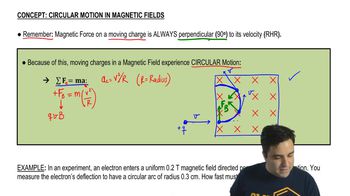
When charged particles enter a magnetic field perpendicular to their velocity, they experience a centripetal force that causes them to move in a circular path. The radius of this path is determined by the balance between the magnetic force and the centripetal force, given by r = mv/qB, where m is the mass, v is the velocity, q is the charge, and B is the magnetic field strength. This relationship allows for the determination of particle mass when other variables are known.
추천 영상:
가이드 코스
11:33
Circular Motion of Charges in Magnetic Fields
관련 실천
교과서 질문

A straight, 2.5 m wire carries a typical household current of 1.5 A (in one direction) at a location where the earth's magnetic field is 0.55 gauss from south to north. Find the magnitude and direction of the force that our planet's magnetic field exerts on this wire if it is oriented so that the current in it is running (a) from west to east, (b) vertically upward, (c) from north to south. (d) Is the magnetic force ever large enough to cause significant effects under normal household conditions?

2863
views
교과서 질문

In a cyclotron, the orbital radius of protons with energy 300 keV is 16.0 cm. You are redesigning the cyclotron to be used instead for alpha particles with energy 300 keV. An alpha particle has charge q = +2e and mass m = 6.64 x 10⁻²⁷ kg. If the magnetic field isn't changed, what will be the orbital radius of the alpha particles?

1671
views
교과서 질문

A 150 V battery is connected across two parallel metal plates of area 28.5 cm2 and separation 8.20 mm. A beam of alpha particles (charge +2e, mass 6.64 x 10⁻²⁷ kg) is accelerated from rest through a potential difference of 1.75 kV and enters the region between the plates perpendicular to the electric field, as shown in Fig. E27.29. What magnitude and direction of magnetic field are needed so that the alpha particles emerge undeflected from between the plates?

1684
views
교과서 질문

A beam of protons traveling at 1.20 km/s enters a uniform magnetic field, traveling perpendicular to the field. The beam exits the magnetic field, leaving the field in a direction perpendicular to its original direction (Fig. E27.24) . The beam travels a distance of 1.18 cm while in the field. What is the magnitude of the magnetic field?

2111
views
1
rank
교과서 질문

A long wire carrying 4.50 A of current makes two 90° bends, as shown in Fig. E27.35. The bent part of the wire passes through a uniform 0.240 T magnetic field directed as shown in the figure and confined to a limited region of space. Find the magnitude and direction of the force that the magnetic field exerts on the wire.

5198
views
교과서 질문

A thin, 50.0 cm long metal bar with mass 750 g rests on, but is not attached to, two metallic supports in a uniform 0.450 T magnetic field, as shown in Fig. E27.37. A battery and a 25.0 Ω resistor in series are connected to the supports. (a) What is the highest voltage the battery can have without breaking the circuit at the supports? (b) The battery voltage has the maximum value calculated in part (a). If the resistor suddenly gets partially short-circuited, decreasing its resistance to 2.00 Ω, find the initial acceleration of the bar.

2826
views
2
rank