Ch 28: Sources of Magnetic Field
Young & Freedman Calc - University Physics 14th Edition
Young & Freedman Calc14th EditionUniversity PhysicsISBN: 9780321973610당신이 사용하는 게 아니라요?교과서 변경
28장, 문제 42

As a new electrical technician, you are designing a large solenoid to produce a uniform 0.150 T magnetic field near the center of the solenoid. You have enough wire for 4000 circular turns. This solenoid must be 55.0 cm long and 2.80 cm in diameter. What current will you need to produce the necessary field?

검증된 단계별 안내
1
Start by understanding the formula for the magnetic field inside a solenoid: B=μnI, where B is the magnetic field, μ is the permeability of free space (μ=4π×107Tm/A), n is the number of turns per unit length, and I is the current.
Calculate the number of turns per unit length, n, using the formula n=40000.55, where 4000 is the total number of turns and 0.55 m is the length of the solenoid.
Rearrange the formula to solve for the current I: I=B/μn. Substitute the values for B (0.150 T), μ (permeability of free space), and n (calculated in the previous step).
Ensure that all units are consistent, particularly converting the length of the solenoid from centimeters to meters, as the permeability constant is in meters.
After substituting the values into the rearranged formula, calculate the current I needed to produce the desired magnetic field.

비슷한 문제에 대한 검증된 영상 답변:

이 영상 해법은 위 문제에 도움이 된다고 튜터들이 추천한 것입니다.
영상 길이:
2m
도움이 되었나요?

주요 개념

질문에 올바르게 답하기 위해 반드시 이해해야 하는 핵심 개념들은 다음과 같습니다.

Magnetic Field of a Solenoid

The magnetic field inside a solenoid is uniform and parallel to the axis of the solenoid. It is given by the formula B = μ₀ * n * I, where B is the magnetic field, μ₀ is the permeability of free space, n is the number of turns per unit length, and I is the current. This formula is crucial for calculating the current needed to achieve a specific magnetic field strength.
추천 영상:
가이드 코스
13:54
Magnetic Field Produced by Loops and Solenoids

Permeability of Free Space

Permeability of free space, denoted as μ₀, is a fundamental physical constant that describes the ability of a vacuum to support a magnetic field. Its value is approximately 4π x 10⁻⁷ T·m/A. Understanding μ₀ is essential for calculating the magnetic field in a solenoid, as it directly influences the relationship between current and magnetic field strength.
추천 영상:
가이드 코스
5:05
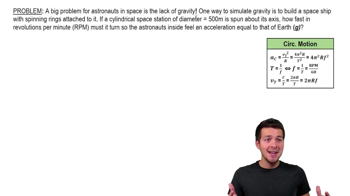
Spinning Space Station

Number of Turns per Unit Length

The number of turns per unit length, n, is calculated by dividing the total number of turns by the length of the solenoid. It is a critical factor in determining the magnetic field inside the solenoid, as it directly affects the field's strength according to the formula B = μ₀ * n * I. For this problem, n = 4000 turns / 0.55 m.
추천 영상:
가이드 코스
10:54
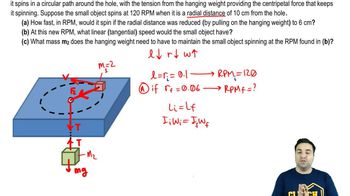
Spinning on a string of variable length
관련 실천
교과서 질문

A closed curve encircles several conductors. The line integral Bdl\(\oint\) B\(\cdot\) dl around this curve is 3.83×10⁴ T m3.83\(\times\)10^{-4}\(\text{ T m}\). If you were to integrate around the curve in the opposite direction, what would be the value of the line integral? Explain.

1292
views

교과서 질문

A solid conductor with radius a is supported by insulating disks on the axis of a conducting tube with inner radius b and outer radius c (Fig. E28.43). The central conductor and tube carry equal currents I in opposite directions. The currents are distributed uniformly over the cross sections of each conductor. Derive an expression for the magnitude of the magnetic field at points outside the tube (r > c).

1958
views
1
rank
교과서 질문

A solenoid is designed to produce a magnetic field of 0.0270 T at its center. It has radius 1.40 cm and length 40.0 cm, and the wire can carry a maximum current of 12.0 A. What minimum number of turns per unit length must the solenoid have?

1511
views
교과서 질문

A 15.0 cm long solenoid with radius 0.750 cm is closely wound with 600 turns of wire. The current in the windings is 8.00 A. Compute the magnetic field at a point near the center of the solenoid.

1844
views
교과서 질문

Two long, parallel wires are separated by a distance of 0.400 m (Fig. E28.29). The currents I1 and I2 have the directions shown. Each current is doubled, so that I1 becomes 10.0 A and I2 becomes 4.00 A. Now what is the magnitude of the force that each wire exerts on a 1.20 m length of the other?

1449
views
교과서 질문

Two long, parallel wires are separated by a distance of 0.400 m (Fig. E28.29). The currents I1 and I2 have the directions shown. Calculate the magnitude of the force exerted by each wire on a 1.20-m length of the other. Is the force attractive or repulsive?

1775
views