
Ch 26: Direct-Current Circuits
Young & Freedman Calc - University Physics 14th Edition
Young & Freedman Calc14th EditionUniversity PhysicsISBN: 9780321973610당신이 사용하는 게 아니라요?교과서 변경
26장, 문제 10b

Power Rating of a Resistor. The power rating of a resistor is the maximum power the resistor can safely dissipate without too great a rise in temperature and hence damage to the resistor. A 9.0 kΩ resistor is to be connected across a 120 V potential difference. What power rating is required?

검증된 단계별 안내
1
First, understand the relationship between power, voltage, and resistance. The power dissipated by a resistor can be calculated using the formula: P=V2R, where P is the power, V is the voltage, and R is the resistance.
Identify the given values in the problem: the resistance R is 9.0 kΩ (or 9000 Ω) and the voltage V is 120 V.
Substitute the given values into the power formula: P=12029000.
Calculate the square of the voltage: 1202.
Divide the result from the previous step by the resistance value to find the power rating required for the resistor.

비슷한 문제에 대한 검증된 영상 답변:

이 영상 해법은 위 문제에 도움이 된다고 튜터들이 추천한 것입니다.
영상 길이:
2m
도움이 되었나요?

주요 개념

질문에 올바르게 답하기 위해 반드시 이해해야 하는 핵심 개념들은 다음과 같습니다.

Ohm's Law

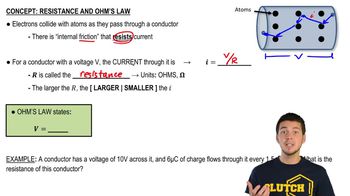
Ohm's Law states that the current through a conductor between two points is directly proportional to the voltage across the two points, given by the formula V = IR, where V is voltage, I is current, and R is resistance. This principle helps determine the current flowing through the resistor when connected to a voltage source.
추천 영상:
가이드 코스
03:07
Resistance and Ohm's Law

Power Dissipation in Resistors

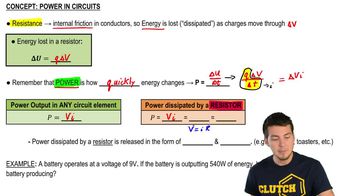
Power dissipation in resistors is calculated using the formula P = IV, where P is power, I is current, and V is voltage. Alternatively, it can be expressed as P = V^2/R or P = I^2R, depending on known values. This concept is crucial for determining the power rating needed to ensure the resistor operates safely without overheating.
추천 영상:
가이드 코스
06:18
Power in Circuits

Resistor Power Rating

The power rating of a resistor is the maximum power it can handle without damage. It is essential to select a resistor with a power rating higher than the calculated power dissipation to prevent excessive heat buildup, which can lead to failure or damage. This ensures the resistor operates within safe limits under specified conditions.
추천 영상:
관련 실천
교과서 질문

Power Rating of a Resistor. The power rating of a resistor is the maximum power the resistor can safely dissipate without too great a rise in temperature and hence damage to the resistor. A 100.0 Ω and a 150.0 Ω resistor, both rated at 2.00 W, are connected in series across a variable potential difference. What is the greatest this potential difference can be without overheating either resistor, and what is the rate of heat generated in each resistor under these conditions?

3130
views
교과서 질문

A triangular array of resistors is shown in Fig. E26.5. What current will this array draw from a 35.0 V battery having negligible internal resistance if we connect it across ac?

1468
views
교과서 질문

Light Bulbs in Series and in Parallel. Two light bulbs have constant resistances of 400Ω and 800Ω. If the two light bulbs are connected in series across a 120 V line, find the power dissipated in each bulb.

1413
views
1
rank
교과서 질문

A triangular array of resistors is shown in Fig. E26.5. If the battery has an internal resistance of 3.00Ω, what current will the array draw if the battery is connected across bc?

1865
views
교과서 질문

Power Rating of a Resistor. The power rating of a resistor is the maximum power the resistor can safely dissipate without too great a rise in temperature and hence damage to the resistor. If the power rating of a 15 kΩ resistor is 5.0 W, what is the maximum allowable potential difference across the terminals of the resistor?

1703
views
교과서 질문

Light Bulbs in Series and in Parallel. Two light bulbs have constant resistances of 400Ω and 800Ω. If the two light bulbs are connected in series across a 120-V line, find the current through each bulb.

1936
views
1
rank