
Ch 26: Direct-Current Circuits
Young & Freedman Calc - University Physics 14th Edition
Young & Freedman Calc14th EditionUniversity PhysicsISBN: 9780321973610당신이 사용하는 게 아니라요?교과서 변경
26장, 문제 30a

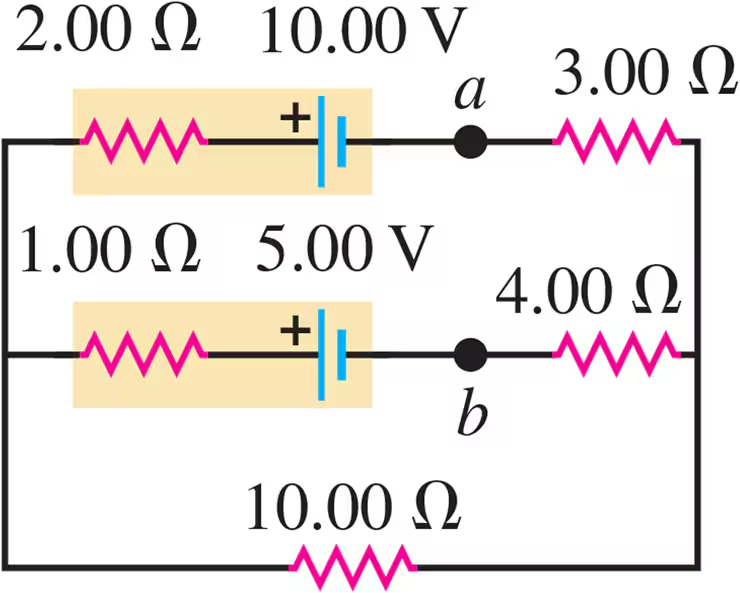
The 5.00 V battery in Fig. E26.28 is removed from the circuit and replaced by a 15.00 V battery, with its negative terminal next to point b. The rest of the circuit is as shown in the figure. Find the current in each branch.

검증된 단계별 안내
1
Step 1: Identify the components in the circuit and their arrangement. The circuit consists of resistors and a battery. The battery has been replaced with a 15.00-V battery, and its negative terminal is connected to point b.
Step 2: Apply Kirchhoff's loop rule to the circuit. This rule states that the sum of the potential differences (voltage) around any closed loop in a circuit must equal zero. Write equations for each loop in the circuit using this rule.
Step 3: Apply Kirchhoff's junction rule at any junction in the circuit. This rule states that the sum of currents entering a junction must equal the sum of currents leaving the junction. Write equations for the junctions using this rule.
Step 4: Solve the system of equations obtained from the loop and junction rules. Use algebraic methods to find the current in each branch of the circuit. You may need to use substitution or matrix methods to solve the equations.
Step 5: Verify the solution by checking that the calculated currents satisfy both the loop and junction rules. Ensure that the sum of the potential differences in each loop is zero and that the sum of currents at each junction is balanced.

비슷한 문제에 대한 검증된 영상 답변:

이 영상 해법은 위 문제에 도움이 된다고 튜터들이 추천한 것입니다.
도움이 되었나요?

주요 개념

질문에 올바르게 답하기 위해 반드시 이해해야 하는 핵심 개념들은 다음과 같습니다.

Ohm's Law

Ohm's Law is fundamental for analyzing electrical circuits, stating that the current (I) through a conductor between two points is directly proportional to the voltage (V) across the two points and inversely proportional to the resistance (R) of the conductor. It is expressed as I = V/R, and is essential for calculating the current in each branch of the circuit.
추천 영상:
가이드 코스
03:07
Resistance and Ohm's Law

Kirchhoff's Circuit Laws

Kirchhoff's Circuit Laws consist of two rules: the Junction Rule and the Loop Rule. The Junction Rule states that the total current entering a junction equals the total current leaving, while the Loop Rule states that the sum of the voltage sources in a closed loop equals the sum of voltage drops. These laws are crucial for analyzing complex circuits and determining current distribution.
추천 영상:
가이드 코스
04:08
Kirchhoff's Junction Rule

Series and Parallel Circuits

Understanding series and parallel circuits is vital for analyzing how components are connected and how they affect the overall circuit behavior. In series circuits, components share the same current, while in parallel circuits, they share the same voltage. This knowledge helps in determining how the replacement of the battery affects the current in each branch.
추천 영상:
가이드 코스
09:51
Combining Capacitors in Series & Parallel