Ch 29: Electromagnetic Induction
Young & Freedman Calc - University Physics 14th Edition
Young & Freedman Calc14th EditionUniversity PhysicsISBN: 9780321973610당신이 사용하는 게 아니라요?교과서 변경
29장, 문제 29b

The conducting rod ab shown in Fig. E29.29 makes contact with metal rails ca and db. The apparatus is in a uniform magnetic field of 0.800 T, perpendicular to the plane of the figure. In what direction does the current flow in the rod?

검증된 단계별 안내
1
Identify the direction of the magnetic field (B), which is perpendicular to the plane of the figure and directed into the page, as indicated by the 'X' symbols.
Determine the direction of the velocity (v) of the rod, which is moving to the right as shown by the arrow in the figure.
Apply the right-hand rule to find the direction of the induced current. Point your thumb in the direction of the rod's velocity (to the right), and your fingers in the direction of the magnetic field (into the page).
The palm of your hand will face the direction of the force on positive charges, which is upwards in the rod. This indicates the direction of the induced current.
Conclude that the current flows from point q to point p in the rod, as the force on positive charges is upwards, causing the current to flow in that direction.

비슷한 문제에 대한 검증된 영상 답변:

이 영상 해법은 위 문제에 도움이 된다고 튜터들이 추천한 것입니다.
영상 길이:
4m
도움이 되었나요?

주요 개념

질문에 올바르게 답하기 위해 반드시 이해해야 하는 핵심 개념들은 다음과 같습니다.

Faraday's Law of Electromagnetic Induction

Faraday's Law states that a change in magnetic flux through a circuit induces an electromotive force (EMF) in the circuit. In this scenario, as the conducting rod moves through the magnetic field, it cuts across magnetic field lines, changing the magnetic flux and inducing an EMF, which drives a current through the circuit.
추천 영상:

Lorentz Force

The Lorentz force is the force experienced by a charged particle moving through a magnetic field. It is given by the equation F = q(v × B), where q is the charge, v is the velocity, and B is the magnetic field. In this context, the direction of the force on the charges in the rod determines the direction of the induced current.
추천 영상:
가이드 코스
13:39
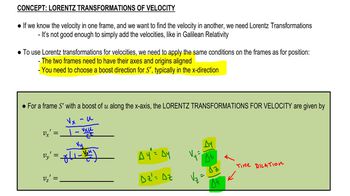
Lorentz Transformations of Velocity

Right-Hand Rule

The right-hand rule is a mnemonic for determining the direction of the magnetic force on a positive charge moving in a magnetic field. Point your thumb in the direction of the velocity (v) of the rod, your fingers in the direction of the magnetic field (B), and your palm will face the direction of the force on positive charges, indicating the current's direction.
추천 영상:
가이드 코스
19:11
Force on Moving Charges & Right Hand Rule
관련 실천
교과서 질문

The magnetic field within a long, straight solenoid with a circular cross section and radius R is increasing at a rate of dB/dt. What is the magnitude of the induced emf if the radius in part (d) is 2R?

2041
views

교과서 질문

A metal ring 4.50 cm in diameter is placed between the north and south poles of large magnets with the plane of its area perpendicular to the magnetic field. These magnets produce an initial uniform field of 1.12 T between them but are gradually pulled apart, causing this field to remain uniform but decrease steadily at 0.250 T/s. What is the magnitude of the electric field induced in the ring?

2190
views
1
rank
교과서 질문

A circular loop of wire with radius r = 0.0480 m and resistance R = 0.160 Ω is in a region of spatially uniform magnetic field, as shown in Fig. E29.22. The magnetic field is directed out of the plane of the figure. The magnetic field has an initial value of 8.00 T and is decreasing at a rate of dB/dt = -0.680 T/s. Is the induced current in the loop clockwise or counterclockwise?

2362
views
교과서 질문

Using Lenz's law, determine the direction of the current in resistor ab of Fig. E29.19 when (a) switch S is opened after having been closed for several minutes; (b) coil B is brought closer to coil A with the switch closed; (c) the resistance of R is decreased while the switch remains closed.

1701
views
교과서 질문

The magnetic field within a long, straight solenoid with a circular cross section and radius R is increasing at a rate of dB/dt. What is the magnitude of the induced emf in a circular turn of radius R/2 that has its center on the solenoid axis?

1873
views
교과서 질문

A cardboard tube is wrapped with two windings of insulated wire wound in opposite directions, as shown in Fig. E29.20. Terminals a and b of winding A may be connected to a battery through a reversing switch. State whether the induced current in the resistor R is from left to right or from right to left in the following circumstances: (a) the current in winding Ais from a to b and is increasing; (b) the current in winding A is from b to a and is decreasing; (c) the current in winding A is from b to a and is increasing.

1549
views