
Ch 33: The Nature and Propagation of Light
Young & Freedman Calc - University Physics 14th Edition
Young & Freedman Calc14th EditionUniversity PhysicsISBN: 9780321973610당신이 사용하는 게 아니라요?교과서 변경
33장, 문제 28a

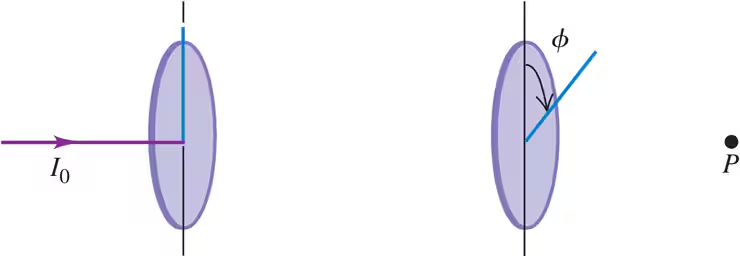
Light of original intensity I0 passes through two ideal polarizing filters having their polarizing axes oriented as shown in Fig. E33.28. You want to adjust the angle f so that the intensity at point P is equal to I0/10. If the original light is unpolarized, what should Φ be?

검증된 단계별 안내
1
Understand that when unpolarized light passes through a polarizer, its intensity is reduced by half. Therefore, after the first polarizer, the intensity becomes I0/2.
Recall Malus's Law, which states that the intensity of polarized light after passing through a second polarizer is given by: I=I0/2cos2φ, where φ is the angle between the polarizing axes of the two polarizers.
Set up the equation using Malus's Law to find the angle φ such that the intensity at point P is I0/10: I=I0/10. Substitute the intensity after the first polarizer: I0/2cos2φ=I0/10.
Solve the equation for φ: cos2φ=1/5. This requires taking the square root and then the inverse cosine.
Calculate the angle φ using the inverse cosine function: φ=cos-1(1/sqrt(5)). This will give you the angle needed to achieve the desired intensity at point P.

비슷한 문제에 대한 검증된 영상 답변:

이 영상 해법은 위 문제에 도움이 된다고 튜터들이 추천한 것입니다.
영상 길이:
3m
도움이 되었나요?

주요 개념

질문에 올바르게 답하기 위해 반드시 이해해야 하는 핵심 개념들은 다음과 같습니다.

Polarization of Light

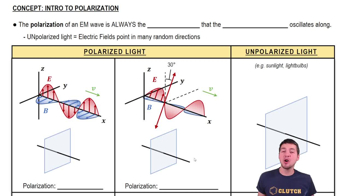
Polarization refers to the orientation of oscillations in light waves. Unpolarized light has oscillations in multiple directions, while polarized light oscillates in a single plane. Polarizing filters can selectively block certain orientations, allowing only light polarized along their axis to pass through.
추천 영상:
가이드 코스
05:32
Introduction to Polarization

Malus's Law

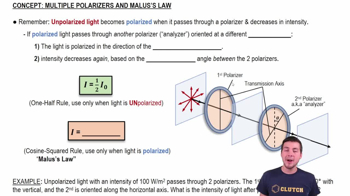
Malus's Law describes how the intensity of polarized light changes as it passes through a polarizing filter. It states that the intensity I of light after passing through a filter is given by I = I0 * cos²(Φ), where I0 is the initial intensity and Φ is the angle between the light's polarization direction and the filter's axis.
추천 영상:
가이드 코스
09:47
Multiple Polarizers & Malus's Law

Intensity Reduction through Filters

When unpolarized light passes through a polarizing filter, its intensity is reduced by half. Subsequent filters further reduce intensity based on Malus's Law. To achieve a specific intensity at point P, the angle Φ must be adjusted to ensure the desired fraction of the original intensity is transmitted.
추천 영상:
관련 실천
교과서 질문

Unpolarized light with intensity I0 is incident on two polarizing filters. The axis of the first filter makes an angle of 60.0° with the vertical, and the axis of the second filter is horizontal. What is the intensity of the light after it has passed through the second filter?

1555
views
교과서 질문

A beam of light strikes a sheet of glass at an angle of 57.0° with the normal in air. You observe that red light makes an angle of 38.1° with the normal in the glass, while violet light makes a 36.7° angle. What are the speeds of red and violet light in the glass?

389
views
교과서 질문

A beam of unpolarized light of intensity I0 passes through a series of ideal polarizing filters with their polarizing axes turned to various angles as shown in Fig. E33.27. If we remove the middle filter, what will be the light intensity at point C?

1707
views
교과서 질문

Light of original intensity I0 passes through two ideal polarizing filters having their polarizing axes oriented as shown in Fig. E33.28. You want to adjust the angle f so that the intensity at point P is equal to I0/10. If the original light is linearly polarized in the same direction as the polarizing axis of the first polarizer the light reaches, what should Φ be?

1411
views
교과서 질문

A beam of white light passes through a uniform thickness of air. If the intensity of the scattered light in the middle of the green part of the visible spectrum is I, find the intensity (in terms of I) of scattered light in the middle of the red part of the spectrum.

1749
views