


Ch 34: Geometric Optics
Young & Freedman Calc - University Physics 14th Edition
Young & Freedman Calc14th EditionUniversity PhysicsISBN: 9780321973610당신이 사용하는 게 아니라요?교과서 변경
34장, 문제 21a

A Spherical Fish Bowl. A small tropical fish is at the center of a water-filled, spherical fish bowl 28.0 cm in diameter. Find the apparent position and magnification of the fish to an observer outside the bowl. The effect of the thin walls of the bowl may be ignored.

검증된 단계별 안내
1
Determine the relevant parameters for the problem: The diameter of the spherical fish bowl is 28.0 cm, so the radius (R) is half of that, R = 14.0 cm. The refractive index of water (n₁) is approximately 1.33, and the refractive index of air (n₂) is approximately 1.00. The fish is located at the center of the sphere, so the object distance (s) is equal to the radius, s = 14.0 cm.
Use the formula for refraction at a spherical surface: \( \frac{n_2}{s'} - \frac{n_1}{s} = \frac{n_2 - n_1}{R} \), where \( s' \) is the image distance (apparent position of the fish). Substitute the known values: \( n_1 = 1.33 \), \( n_2 = 1.00 \), \( s = 14.0 \ \text{cm} \), and \( R = 14.0 \ \text{cm} \).
Rearrange the formula to solve for \( s' \) (the image distance): \( s' = \frac{n_2 s R}{n_1 R - (n_1 - n_2)s} \). Substitute the values into this equation to calculate \( s' \).
To find the magnification (M), use the magnification formula for refraction at a spherical surface: \( M = \frac{s'}{s} \). Substitute the value of \( s' \) obtained in the previous step and the given \( s = 14.0 \ \text{cm} \) to calculate the magnification.
Interpret the results: The value of \( s' \) will indicate the apparent position of the fish relative to the surface of the sphere, and the magnification \( M \) will indicate how much larger or smaller the fish appears to the observer outside the bowl.

비슷한 문제에 대한 검증된 영상 답변:

이 영상 해법은 위 문제에 도움이 된다고 튜터들이 추천한 것입니다.
영상 길이:
4m
도움이 되었나요?

주요 개념

질문에 올바르게 답하기 위해 반드시 이해해야 하는 핵심 개념들은 다음과 같습니다.

Refraction of Light

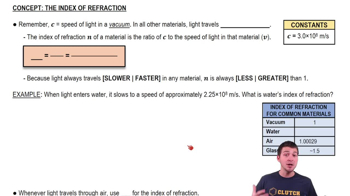
Refraction is the bending of light as it passes from one medium to another, caused by a change in its speed. In the context of the fish bowl, light travels from water (denser medium) to air (less dense medium), resulting in the apparent displacement of the fish's position. This phenomenon is governed by Snell's Law, which relates the angles of incidence and refraction to the indices of refraction of the two media.
추천 영상:
가이드 코스
03:46
Index of Refraction

Lens Maker's Equation

The Lens Maker's Equation describes the relationship between the focal length of a lens and the radii of curvature of its surfaces, as well as the refractive indices of the lens material and surrounding medium. For a spherical fish bowl, it can be used to determine how the curvature of the bowl affects the focal point and the magnification of the image seen by an observer outside the bowl.
추천 영상:
가이드 코스
05:38
Lens Maker Equation

Magnification

Magnification is the ratio of the height of the image to the height of the object, indicating how much larger or smaller the image appears compared to the actual object. In this scenario, the magnification can be calculated using the distances involved in the refraction process, allowing the observer to understand how the fish appears through the curved surface of the bowl.
추천 영상:
가이드 코스
09:03
Mirror Equation
관련 실천
교과서 질문

Dental Mirror. A dentist uses a curved mirror to view teeth on the upper side of the mouth. Suppose she wants an erect with a magnification of 2.00 when the mirror is 1.25 cm from a tooth. (Treat this problem as though the object and lie along a straight line.) What must be the focal length and radius of curvature of this mirror?

2158
views
교과서 질문

A person is lying on a diving board 3.00 m above the surface of the water in a swimming pool. She looks at a penny that is on the bottom of the pool directly below her. To her, the penny appears to be a distance of 7.00 m from her. What is the depth of the water at this point?

1613
views
교과서 질문

The glass rod of Exercise 34.22 is immersed in oil (n = 1.45). An object placed to the left of the rod on the rod's axis is to be d 1.20 m inside the rod. How far from the left end of the rod must the object be located to form the image?

1611
views
교과서 질문

The left end of a long glass rod 8.00 cm in diameter, with an index of refraction of 1.60, is ground and polished to a convex hemispherical surface with a radius of 4.00 cm. An object in the form of an arrow 1.50 mm tall, at right angles to the axis of the rod, is located on the axis 24.0 cm to the left of the vertex of the convex surface. Find the position and height of the of the arrow formed by paraxial rays incident on the convex surface. Is the erect or inverted?

2238
views
교과서 질문

The thin glass shell shown in Fig. E34.15 has a spherical shape with a radius of curvature of 12.0 cm, and both of its surfaces can act as mirrors. A seed 3.30 mm high is placed 15.0 cm from the center of the mirror along the optic axis, as shown in the figure. Calculate the location and height of the of this seed.

2418
views
교과서 질문

A lens forms an of an object. The object is 16.0 cm from the lens. The is 12.0 cm from the lens on the same side as the object. What is the focal length of the lens? Is the lens converging or diverging?

2007
views